• Our hope-filled future is bound up in sharing the story of Jesus, in discipling others, in bringing those disciples together into communities of believers, and in developing and releasing those believers to create other communities... till Jesus the King comes again!

God’s Friday

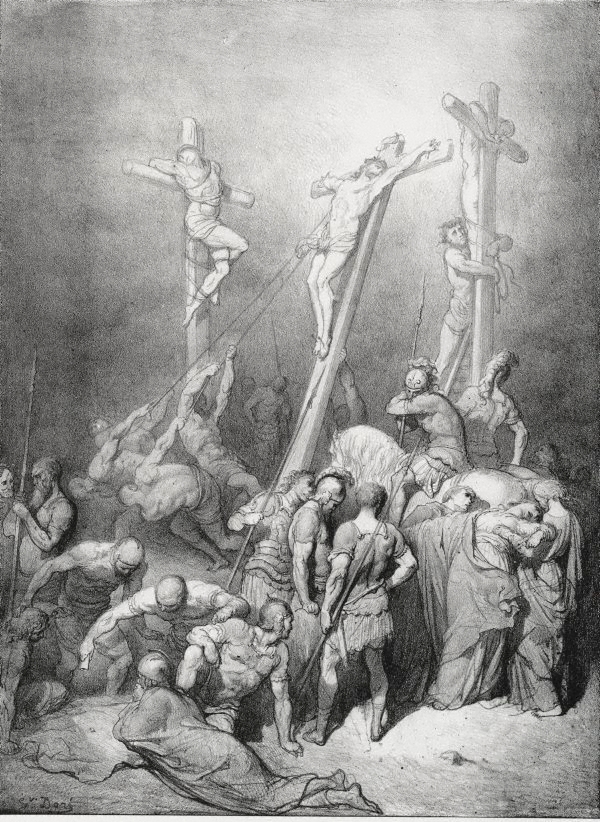
I’ve often wondered why, in the liturgical calendar of the church, we call this day, “Good Friday”.  Surf the net and you’ll fall on a host of responses.  Certainly, we know from Scriptures that it is at time to remember Christ’s betrayal and crucifixion (Mark 14:32-15:41).  But why call it “good”?

Some say that the term is derived from an older meaning of the word ‘good’ which meant ‘holy or set apart.’  With that in mind, the day was one that stood out from others and which called for us to stop and consider the deeper implications of the events of that day. “I have been crucified with Christ; and it is not longer I who live, but Christ lives in me; and the life which I now live in the flesh, I live by faith in the Son of God, who loved me and delivered Himself up for me.” (Galatians 2:20)

Others say that the term, ‘Good Friday’, may be derived from ‘God’s Friday’ in the same way that good-bye is derived from ‘God be with you’.  Whether this is etymologically true or not, I found this thought added a new dimension to my reflection on this day. As I wrote yesterday, all the effort expended for our salvation then comes from God. This is His day. This is His work. This is His act of love and justice to bring us back into relationship with Him.

Oh yes, this day is ‘good’ because on this day, God the Son offered Himself for us as a holy and acceptable sacrifice.  However, this day is, in every way, God’s day. In our helpless state, and at the right time, God the Son “died for the ungodly” (Romans 5:6)

Since it is His day, may I offer a ‘sacrifice of praise’ today that is worthy of Him.

Substitutionary Sacrifice

Charles Spurgeon once preached: “If ever there should come a wretched day when all our pulpits shall be full of modern thought, and the old doctrine of substitutionary sacrifice shall be exploded, then will there remain no word of comfort for the guilty or hope for the despairing.  Hushed will be for
ever those silver notes which now console the living, and cheer the dying; a dumb spirit will possess this sullen world, and no voice of joy will break the
blank silence of people
.”

I like that phrase, ‘substitutionary sacrifice.’  In many ways, it attacks my pride which would want to say that I have something to bring to God, something to offer in exchange for my wrongdoings. I ultimately have nothing to offer, nothing but my heart cry for His mercy and grace.  I need a substitute.  I need someone to stand in my place.  I need Jesus.

But he, having offered one sacrifice for sins for all time, sat down at the right hand of God.”  (Hebrews 10:12)

I have wondered, though lately if that is the message I am ultimately sharing with others.  Or am I offering them another ‘substitute’ such as program, a study guide, a structure for their life, or even me as a friend and spiritual mentor?  I should be pointing people back to Jesus, back to the cross as the only substitute that they need, as their only source of comfort and hope.

Jesus went alone to the cross … for me.  I need to figure out how to share that in new ways with those around me.

Setting the Scene

May this thought help us “set the scene” in our hearts and minds for this week as we remember the death of our Lord and celebrate His resurrection:

This understanding of the cross of Christ stands at the very heart of the gospel.  There is a captivating beauty in the sacrificial love of a God who gave himself for his people.  It is this that first draws many believers to the Lord Jesus Christ, and this that will draw us to him when he returns on the last day to vindicate his name and welcome his people into his eternal kingdom.  That the Lord Jesus Christ died for us – a shameful death, bearing our curse, enduring our pain, suffering the wrath of his own Father in our place – has been the wellspring of the hope of countless Christians throughout the ages.”

Prayer Journaling

When life makes sense, it becomes a journey, a spiritual adventure.  Writing down the adventure as it happens gives us a feel for our place in the story God is weaving in our lives.  Journaling helps us to become aware of the journey.”  Journaling is not one of my strengths or common practices, but I recognize the benefit of processing life from time to time through journaling as Paul Miller describes in the quote above.

What was new to me in this chapter, though, was Paul Miller’s insight that prayer journaling provides a means to ‘become aware of self on the journey.’  It is an avenue to self-awareness. 

Here’s how he puts it: “The modern quest for self-fulfillment is a secularized version of Christianity’s discovery of the self.  Without the Shepherd guiding us to see our true selves in relationship to him, we can lose our way and become obsessed with self. Instead of seeing our bent toward evil, we can become increasingly touchy, supersensitive to self but insensitive to others.  We no longer see ourselves clearly.  The spiritual pilgrimage is the opposite.  The discovery of self in relationship to God leads to a lifestyle of repentance.”  So, a prayer journal could serve as an opportunity not just to process life, but to become more aware of how I am interacting with and ‘being received’ by others.

Two questions can guide this process:

  • “How am I doing?  What is coming at me?  Am I happy, sad, thankful, discouraged, angry, frustrated?”
  • “What is God saying to me?  What does the Word say to me?”

 Writing down our reflections to these questions can help better discern what God is teaching us. 

What’s been your experience with ‘prayer journaling’?

Much Joy

Indeed, since much joy is the true fruit of the gospel of Christ, the angel calls this gospel “good tidings of great joy, that shall be to all people.””

Joy is that elusive quality of the Christian journey.  We can find ourselves often tied to an emotion-al roller coaster due to the circumstances in life and ministry.  Something in this comment though, from Jonathan Edwards, points to a deeper, a more settled response of our heart.

I know (we know) that joy is the fruit produced by the work on the Spirit in our lives: “The fruit of the Spirit is love, joy, peace …” I know (we know) that joy flows out of our experience with the Lord: “The joy of the Lord is my strength.”  Remember singing that little chorus: “I’ve got the joy, joy, joy, joy way down in the depths of my heart”?

So, I can talk about ‘joy’, but what I’m having trouble grabbing a hold of is this notion of ‘much joy’.  Somehow this takes the discussion to a whole new level.  Something needs to go deeper.  It is probably the Gospel in its fullness.  My heart needs to ‘feel’, to experience God’s work on my behalf.  I need to bask anew in the ‘great’ sacrifice, the ‘deep’ love of God the Son.  Centering my heart on that good news, on the Lamb of God will cause a fruit of ‘much joy’ to overflow in my heart and life.

Listening to God

As I re-read Paul Miller’s chapter on, “Listening to God”, I was struck by the common themes that I had also heard during the Central Asia & CH Area Conference on prayer and discernment.  I won’t try to summarize three packed days of reflecting on this topic, but I wanted to come back to one element that stood out both in the book and the conference, and that is the need to cultivate a listening heart.  Let me quote from A Praying Life:


Listening is just one of the things that happens in the course of my soul connecting with God.  You can’t listen to God if you are isolated from a life of surrender that draws you into his story for your life.  And it must be a gospel story. By that I mean your dying, your weakness is what you bring to the table.  God brings to the table his grace, his resurrection … When referring to communication with God, Scriptures assumes that I know what God is saying.  The problem isn’t the activity of listening, but my listening heart.  Am I attentive to God? Is my heart soft and teachable? Am I remembering his ways, his commands?  Psalm 25:15 says, “My eyes are ever toward the Lord.”  The means of communication is secondary to a surrendered heart.  Our responsibility is to cultivate a listening heart in the midst of the noise from our own hearts and from the world, not to mention the Devil.”  (247)


It’s not just ‘listening’ that is fundamental, but cultivating a heart that is tender towards the Spirit’s voice.  Miller says that keeping the Word and the Spirit active together in my life happens as I “saturate my life with the Word, so as to give the Spirit a vocabulary to personalize the Word to me.”


Cultivating such a listening heart is the journey that we are on.


[For more input on this topic, you might want to read, The Voice of Jesus, by Gordon Smith, IVP Press.  Gordon spoke at the recent Central Asia & CH conference)