• Our hope-filled future is bound up in sharing the story of Jesus, in discipling others, in bringing those disciples together into communities of believers, and in developing and releasing those believers to create other communities... till Jesus the King comes again!

Mushroom Eaters

We long to be more intentional this year in our outreach, our discipleship, our mentoring and our own personal growth and development.  Should we not also long to be more intentional in our innovation?

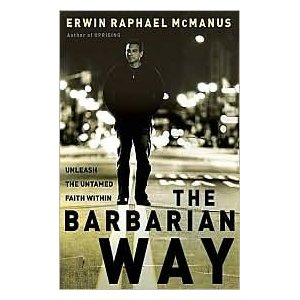
Jay recently shared this quote from Erwin McManus which speaks to this desire:

The Church Communication Network sent me an invitation to do a session on leadership in one of their national conferences… I would follow one of the most credible experts on church leadership… I was honored… Somewhere in his lecture he started to say something that totally threw me. Point-blank he instructed, “Don’t be an innovator; be an early adaptor… the innovator is the guy who eats the poisonous mushroom and dies. The early adaptor is the guy right next to him, who doesn’t have to eat it…” After thanking him for his amazing contribution to the body of Christ and for mentoring me through his books and ministry I went on to thank him for a new metaphor for my life. I am a mushroom eater… Any day now might be my last supper. But without risking the poisonous mushrooms, we never would have discovered the joys of portabellas. The barbarian call is just this simple; we are called to be mushroom eaters. A world without God cannot wait for us to choose the safe path. If we wait for someone else to take the risk, we risk that no one will ever act and that nothing will ever be accomplished. John the Baptist was a mushroom eater, and it cost him his life…”  [From: Erwin Raphael McManus, The Barbarian Way: Unleash The Tamed Faith Within, Thomas Nelson, Nashville: TN, 2005]


Maybe we should start praying to be “mushroom eaters”; choosing to take the risk and not be satisfied with the safe path.

Intentionality

Intentionality, by its root, is linked to being intentional.  If we scan the dictionary, we discover that “intentional” is when something is “done deliberately or on purpose.”  It is the act of consciously, deliberately, knowingly and purposively working towards carrying out an intended goal or objective.  Therefore, to be intentional about something is to exhibit intentionality

Our hearts and minds have been focused over the past few weeks on the birth of the One who came and ‘tabernacled’ among us; the One who entered our world in order to save His people from their sins.  From the very start, there was intentionality in all God the Father, God the Son, and God the Holy Spirit undertook on our behalf.  The Creator God was intentional in seeking to re-establish relationship between Himself and His creation.  That intentionality led to the pouring out of His life for others.

Missional living, though, is a constant struggle of intentionality.  Our lives and ministries continually call for deliberate and purposeful action.  We do not wait for people to move towards us, rather we must move towards them in an intentional way, just as God did and does for us.  Our own personal growth and development does not happen by osmosis, rather we must consciously build more and more upon the faith foundation that has been laid by His Spirit in our hearts.

As this New Year begins, we would do well to consider our ‘intentionality quotient’, that is, how quick are we to be intentional in our life, development and ministry?   Or are we more accidental in our approach?

Try prayerfully thinking through this question:  what is the greatest hindrance that would keep me from being more intentional this year in my outreach, my discipleship, my mentoring or my own personal growth and development?

In the midst of change

Over the past year, we have been dialoguing together on the impact of global currents on the outworking of World Team’s global vision.  Many of you have either been involved in working groups discussing this topic or have freely shared your thoughts and ideas with me.

Earlier in the year, I made available the Global QuickVIEW document on this blog.  Now I would like to make available two documents that were given to all our leaders: “Leading Well in the Midst of Change” and “Resources Supplement”.  Simply right click on the link below to save these documents for yourself.

Leading Well in the Midst of Change

Resources Supplement

Working through all the input that was given by workers in the WT community, a series of ‘guiding principles’ were drawn up to direct our next planning process.  The “Leading Well in the Midst of Change” document is an attempt to provide a framework for the development of ministry plans over the coming months, knowing that change will be needed for the new contexts that we find.  The “Resources Supplement” summarizes all the input given as to possible broad-based solutions to our global vision in light of global currents.

As you read these documents, I encourage you to ask yourself and your team these questions:

  • What concepts, ideas, or insights do I resonate with as I read through these documents?
  • What trend(s) is most at work in my area of ministry?
  • What changes will I (we) need to make in order to carry out more fruitfully our vision of innovative teams multiplying disciples and communities of believers bringing the Gospel within reach of lost people everywhere we go?

We are global

Traveling around to our various regions, I regularly hear comments like the following: “We need to make sure the home office is aware of this information,” or “who is the person in the home office that I need to talk to about this issue?”  I will inevitably respond by asking: Which home office do you mean?  Now I know what office the person is referring to.  He/she is talking about the US Ministry Support Center, or to put it more simply, the US office.   However, World Team has ‘home offices’ in Australia, Canada and the US.

We are global.

I realize that we could chalk this up to a simple oversight on our part, given that a large portion of our workers come from the United States.  However, the reality is that we are now mobilizing workers from a variety of different locations.  Should other Sending Countries be established, which is a live option in the coming year, the pool from which workers could be mobilized would further increase.

We are global.

Several of our Team Leaders, Field Leaders and Area Staff are non North American.

We are global.

The World Team International board is discussing a proposal to create a global alliance where selected members of each Sending Country would participate together in the oversight of global ministries.  In this scenario, a global alliance would be made up of an equal number of Australian, Canadian and US representatives plus a number of other international representatives.

We are global.

It’s a small change, but it would signal a step forward towards becoming more international, towards becoming WT Global.  Instead of saying ‘home office’ with the understanding that ‘home office’ equals ‘US office’, let’s specify which office we are referring to: the Australian office, the Canadian office or the US office.  Try it out!  Encourage others in this ‘name change.’

We are global.

Trends Update

Ed, one of our most experienced and insightful workers, writes:

According to James Glassman, a senior economist with JPMorgan Chase in the October 31 –November 6, 2011, issue of the Bloomberg/Businessweek we are globally in the middle of a dramatic change.  We have never witnessed structural employment like what we have now.  Industry has always preferred to hire people that have the ability needed to pull their weight on the job from day one, but we have never seen this amplified as it is today.  Businesses are benefiting from extensive new markets opening globally; yet, fewer young people are getting jobs since businesses are putting and emphasis to a degree never seen before on experience, education and skills.  Globally young people without these qualities can not find jobs.  This phenomenon is not due only to the recession but also due to the forces of globalization and the global shifts in economic power.  This is one of the majors causes of youth discontent, unrest, and even riots from Greece to the Occupy Wall Street movements, which will likely continue long-term since a major contributing cause is globalization.”

What does this trend mean to WT with it God-given mandate?

How will this trend impact us in areas such as –mobilization, criteria for acceptance as a cross cultural worker, and ministry?

What biblical truth will seem relevant to these disillusioned young people?

How will the churches planted be perceived by these unemployed and unemployable youth as having any answers to their top felt needs?

What decisions should WT make now in the light of this trend?

Also what strategic actions should WT implement viewing this trend short-term and long-term?

The Gospel Pattern

Every time I get together with Steve, I feel pushed and challenged in my thinking.  Steve is a practitioner in the world of church multiplication movements. I would encourage you to surf his blog: http://www.movements.net/blog, to get a feel for some of the issues we need to be thinking about.

In recent days, Steve has been focusing on the biblical pattern of church multiplication movements as seen in the Gospels and the book of Acts.  “Many writers try to drive a wedge between the Gospels and Acts (or between the ministry of Jesus as described in the Gospels and the ministry of Paul as described in Acts).  But Luke sees them as one continuous whole story.”  It is the story of the dynamic Word of God spreading and growing.

Sounds like straightforward stuff, but then Steve’s words struck deep.  He said, “We must be careful that the model we pursue is not focused on ourselves because in reality we are too caught up with ourselves.”  Quoting Neil Cole, he went further, saying, “How you disciple your next believer will determine whether there will be a movement or not.” 

What I took from those words is that:

  • The Gospel must be transforming my heart to enable me to be more and more other centered.
  • Othercenteredness should move me to be quicker to encourage others in ministry and to turn ministry over more quickly to others.
  • “What Jesus did”, what the apostles did, was to invest in others, and then move on; their time frame for moving on to other harvests was faster than our current practice.

Growth, multiplication, and movement begin from the very moment we engage others; from the very first steps in discipleship.