• Our hope-filled future is bound up in sharing the story of Jesus, in discipling others, in bringing those disciples together into communities of believers, and in developing and releasing those believers to create other communities... till Jesus the King comes again!

Techie Prayer

In a post last month (24.01.2012), I asked the question as to whether you were “gathering for prayer.”  That post was meant to be an encouragement about trying creative or original approaches to “gather in prayer” for one another.

Well, yesterday I saw an example of such an innovative approach.  As the team here in France gathered for their annual retreat, they began their time in prayer and worship.  The facilitators of this part of the retreat said that we would be praying for each one of our ministries in Europe.  Using their computer screen and an external speaker, they ‘skype-ed’ in each one of the leaders of our European teams.  Each person was given a few minutes to share key prayer items.  One of the facilitators translated each request into French.  When each leader was finished sharing, we prayed together with that leader, and then moved to the next leader.

I don’t know how those other leaders felt, but I can tell you that the time spent together not only enlarged the vision of our Franceteam members, but also unified their hearts in ministry with colleagues in other places in Europe who are experiencing many of the same joys and frustrations.

Neither the distance nor the language posed a problem for the Franceteam.  All I can say is “bravo” to those facilitators for coming up with such an idea, and “thanks” to God for allowing us to share with one another in this important way!


Are We Fluid Enough?

Many of you were praying for us as global leaders as we met two weeks ago.  The main theme of our time together was to review and evaluate our Area project plans for the coming years.  Through small group interaction, we asked the hard questions of each plan as to how it aligned with the larger WT global vision and how it interacted with the guiding principles we drew from the studies on global trends.  Each leader gave critical recommendations to other leaders as to how to improve their plan.  Outside evaluators (from outside of WT) were also given opportunity to give input and recommendations for changes and improvement.

All this was good and your prayers were greatly appreciated.  However, the speed of change in our world is making each of us realize that we as an agency need to be more and more “fluid” in our planning, quicker to respond to new ministry opportunities that present themselves.  One contributor put it this way:

“In a rapid-response world you cannot make a strategic decision and expect it to meet WT’s needs for years (sometimes even for months). Today you need faster – indeed continuous – processes for being proactively responsive in your strategic decision-making in the constantly changing contexts.  That is the flaw in the current state of the art: traditional strategic plans, once complete, are not fluid and organic but static –and they quickly grow stale.  I believe that we need a new paradigm of strategy formation.  The rapid response world in which we live requires organizations like WT to identify, understand, and act upon new information and dynamically changing situations in real time, which means now, not five or six months from now.  Making this shift in thinking will not be easy; it is not easy to break out of the three years planning cycle pattern.   Long-term plans often get in the way of being truly strategic in real time.”

The reason this quote stood out for me was because it was written by a member of our WT community, and one of the senior members of our WT community.  This writer puts it so well in calling us to a more “fluid” approach to planning, while at the same time reminding us that our fluidity needs to result in concrete, specific steps that move us to a proactive response to ministry opportunity.

Much fruit has been borne through the work and ministry of the World Team community over the years, but if we want to remain ‘strategic’ in the future, we are going to need a lot of grace and a willingness to act now.

One Response to The King and the Cross

It’s always an encouragement when people engage right away with an idea that has been launched. 

One World Team member wrote this after receiving the invitation to read King’s Cross: “I want to personally thank you for recommending Keller’s book to the World Team family. I just downloaded it into my Kindle and look forward to digging into it and the discussion.  I have been using Keller’s materials with our Skype guys in our Area for several years – A rich feast for all of us and now this.”

I’ve heard from several others that they have already downloaded the book to their Kindle!

Look forward to having you join us as a World Team community in reading this year, King’s Cross, by Dr. Timothy Keller [http://www.amazon.co.uk/Kings-Cross-Story-World-Jesus/dp/1444702130/ref=sr_1_1?s=books&ie=UTF8&qid=1329136272&sr=1-1]

The King and the Cross

When we talk about the ‘ethos’ of World Team, we mean the environment or framework in which we carry out our work and ministry.  At the very least, this environment is structured by our global purpose, vision and values.  We currently affirm four core values: the Gospel, prayer and worship, interdependence, and developing and releasing leaders.

It is hard to talk about the Gospel as one of our values because it is the overarching, driving force behind all we do.  We do well to frequently remember and go over in our hearts what the Gospel means and what it brings to us.

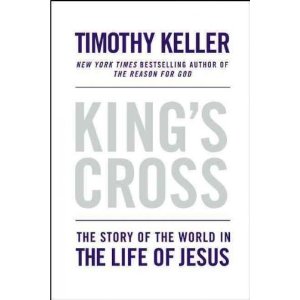
To that end, I am inviting you as a World Team community to join me in reading this year, King’s Cross, by Dr. Timothy Keller [http://www.amazon.co.uk/Kings-Cross-Story-World-Jesus/dp/1444702130/ref=sr_1_1?s=books&ie=UTF8&qid=1329136272&sr=1-1]

We will begin an interactive discussion on the book in the next one to two months so as to give time for each of us to purchase or download this book.  I am willing to send PDF files of the opening chapters if you are in a place where getting a copy of the book will take some time.

Tim Keller makes this comment in the introduction to his work: “[This volume] is an extended meditation on the historical Christian premise that Jesus’ life, death, and resurrection form the central event of cosmic and human history as well as the central organizing principle of our own lives.  Said another way, the whole story of the world – and of how we fit into it – is most clearly understood through a careful, direct look at the story of Jesus.

May that serve as our expectation in reading this book together: that Jesus will become, more and more, the central organizing principle [Person] of our lives.

Are you gathering for prayer?

Tomorrow marks the start of some important meetings. From Wednesday through Friday of this week, members of the global structure task force are meeting here at our house to finalize a proposal for creating a global network or alliance to better support and resource our World Team ministries. 

Right after that (starting Saturday), our leadership team of Area Directors and Sending Country arrives for a weeklong conference where we will share draft project plans for the coming years that seek to further our global vision in light of global trends.  There will be much discussion and feedback intended to refine and improve these project plans.

We have asked for prayer for both of these meetings for the past number of weeks.  I am asking again for your prayers during these days.  Would you gather for prayer with others and pray for these discussions that God would give wisdom and insight?

It is not an easy task to gather for pray.  We often find ourselves coming up with numerous reasons why we should put it off times of prayer until another more “convenient” time.   On February 2nd or 3rd, World Team is setting aside a Day of Prayer.  This is an opportunity for us to celebrate what God is doing and to pray for current needs.  This is an opportunity for us to be innovative in our approach to prayer together.

  • Perhaps gathering might mean inviting a group of workers by Skype conference to pray together online for half an hour.
  • Perhaps gathering might mean opening your home or apartment in the morning for an open time of prayer.  People could come whenever they wanted, and stay to pray as long as they could.
  • Perhaps gathering might mean meeting for a meal, praying before the meal, during the meal and after the meal for World Team ministries.

Maybe you have other ideas about how to gather for prayer.


Reflecting on “the list”

The question is a difficult one to answer, and one that we as a community have pondered over for some time: “What is church?”  Or to put it another way, “What do we mean by church?”

If you go to a theological handbook, you would probably come across a definition such as the following: “The church is the community of all true believers for all time.”  This definition, though, refers primarily to the universal or global church.  What about the local church that we long to see established where we live and serve?  What are the elements that make up a local church or community?

I remember one of my profs in school walking us through an exercise where we had to write down all the elements that we believed were essential to the local church.  Once our individual lists were established, we then discussed them with fellow students, trying to agree on what were the irreducible elements.  Needless to say, that exercise was not completed in ten minutes.

My friend Steve wrote a blog post a number of months ago which reminded me of that very exercise.  I quote it in its entirety because I think it is relevant to our situation and discussion:

Let’s drop in to the home of Cornelius (Acts 10). Cornelius and his extended family and friends have just come to know Christ through Peter, the reluctant missionary.

It’s late at night and the next morning Peter and his companions are leaving. Peter hopes to return in the next few months, but there is no guarantee.

Time is running out and Peter needs to explain to Cornelius what it means to be the people of God.

What do they need to form communities of disciples? To leave anything out that is essential will corrupt what this group becomes and what it reproduces. To add anything that is not essential will reduce its ability to function and spread unhindered.

Put yourself in Peter’s place. List every possible element that you could include in helping Cornelius understand what it means be God’s people. Now remove every item you can until what you have left is the irreducible minimum of a church.

Until you can answer that question, you will not see a church planting movement. You may see some churches planted, but not a movement.

Movements know what the essentials of church are, and that’s what they produce and reproduce. Nothing more, and nothing less. Other things may be desirable, but not essential. They slow a movement down. Some elements are so essential, that if they are removed what is left is no longer a church.

What goes down on the list? What gets crossed off?

Luke has his list, the bare bones of what a church is (Acts 2:42-47). Nothing added that would slow down the spread of a movement. Nothing neglected that was essential.

The more you add to that list, the harder it becomes for new believers to form churches in their world. If new believers are not forming churches, you’ll never see a church planting movement. You may plant churches, but they won’t multiply.”