• Our hope-filled future is bound up in sharing the story of Jesus, in discipling others, in bringing those disciples together into communities of believers, and in developing and releasing those believers to create other communities... till Jesus the King comes again!

“Independent Subcontractors”

So have we really drifted into becoming more like “independent contractors” than a “bonded fellowship”?   Why would this be case?  How did this come about?

One reason would be that certain concerns take precedence over others.  For the most part, those concerns are right in front of us: just to live and to work.  Those concerns, though certainly legitimate, can push us away from others who are not right here with us.  A common definition of an independent subcontractor is “a person or business which has a contract to provide some portion of the work or services on a project agreed to by a contractor.”  A subcontractor sets his/her own hours and work schedule.  A subcontractor has his/her own small team and doesn’t necessarily work in tandem with other workers outside of his/her local context.  Their chief concern is to make sure they get paid for the work they do.

Another reason would be that we only apply the value at a local level.  WT has a strong aspirational value for community, though its application can be limited.  We have done a good job building local communities, but struggle to have any sense of connection to the larger WT community

A final reason would be the lack of trust that quickly sets in between people.  I have heard one writer say that it takes ten positive comments to offset one critical one.  Could it be that we too quickly find ourselves thinking less of a member within the WT community because of one misplaced comment?  The longer that comment is not dealt with, the harder it is to maintain a bonded fellowship.

The WT community is a unique group of cross cultural workers, passionate about one thing: the multiplication of disciples and communities of believers around the globe.  Many communities of workers work towards this end.  Maybe I’m not seeing things correctly, but it seems like we act more like a group of “independent subcontractors” sometimes than a community pulling together with and for one another.


the Feast

Today’s post comes from Jan in France about chapter 14: The Feast

Have you ever had a defining meal? This is one that commemorated or celebrated a defining moment in your life or that of someone special to you.  What comes to mind?  Most likely the reason, the person or people commemorated, the venue, the food.  You might even remember what you wore.  And sometimes it will be a quirky thing that occurred which will stand out, because it was so unlikely.  We could probably all share some great stories… ʽand then the Prime Minister turned up’… ʽand then the waiter gobbled the after dinner mints’ (both true).

Defining meals often have special food and drink.  The central feature of the original Passover meal for the Israelites was a whole unblemished male lamb which was to be eaten in haste.  By killing a lamb and using its blood to mark the doors as a sign of their faith and then taking the lamb into themselves during the meal, the plague of death passed over them.  Keller says that in every home that night there was either a dead child or a dead lamb, and the Israelites needed to accept the shelter of the substitute – this blood of the lamb.  Therefore, no mention was made of wine.

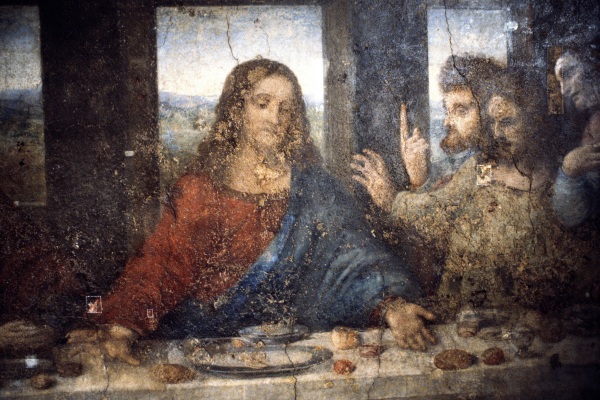
Coming forward to the time of Jesus, the final meal our Lord ate before he died was the Passover meal.  The Passover took a distinct form and included four cups of wine representing the four promises made by God in Exodus 6:6-7: rescue, freedom from slavery, redemption and a renewed relationship with God.  Jesus departed from the usual script, telling his disciples that the bread was His body.  “Take it,” He said, because it needed to be received actively and incorporated into themselves.  He planned to rescue them from the way of the world, free them from slavery to sin, redeem them fully, thus paving the way for a renewed relationship with God.

The cup of wine, from which they all drank, was the Lamb’s blood of the covenant – a new covenant of Jesus’ unconditional commitment to us, pointing us to the kingdom of God.  Keller says Jesus often compared God’s kingdom to sitting at a big feast and that this Passover meal makes the ultimate feast possible.

Isaiah 25:6 describes an endtime feast being prepared by the Lord of hosts:  a lavish banquet with refined aged wine and choice pieces with marrow.  This is when He swallows up death for all time (v.8).

However, in the gospel accounts of the Last Supper, there is no mention of eating meat.  Instead, the Lamb of God was at the table, and Keller says Jesus was the main course.

My question is:  What does “Jesus, the main course” mean for you?


Next installment of the King’s Cross blog post will be September 17th, looking at Ch 15 “the Cup”


One little phrase

Sometimes when you’re reading an article, one little phrase seems to jump off the page at you. Such was the case when I read this little phrase recently in the International Bulletin of Missionary Research (Vol. 28, No. 3):  “I realized how few “traditional missionaries” are sent there by mission “agencies” (a horrible word, representing the disastrous shift from a closely bonded fellowship of fund-sharing teams to groups of independently-funded individuals for whom “agencies” are merely temporary flags of convenience.””  I felt the ‘sting’ of that comment and that criticism.

However, every criticism has elements of truth in it; otherwise it wouldn’t hurt so much.  That’s when I began to wonder how we as workers may have drifted from that ‘closely bonded fellowship’ to ‘independent subcontractors’, if you will.  In other words, have we become less of a ‘network of like-minded individuals’ and more of ‘convenient groups’ of workers who enjoy being with each other from time to time?

Kind of sobering to think that we may drifted more than we realize.  Let’s talk more in the coming days about why this might be the case, how it may have come about, and what we might do to restore an attitude of ‘bonded fellowship’.


the Temple

Today’s post comes from Amy in the Philippines about chapter 13: The Temple

Jesus, King of Kings, enters Jerusalem on a non-consequential donkey.  He is the Lion of Judah and the lamb on the throne.  He enters the courts of the Temple for the Jewish holiday of Passover and his concern is for the nations.  The curtain is torn, and the Temple takes a new role in the lives of God’s people.

Keller tells us that Jesus’ personality, that which is full of “perfect justice yet boundless grace, absolute sovereignty yet utter submission,” is a “complete and beautiful whole.”  And the wholeness of our God’s beautiful personality is passionately concerned for the holiness of his people, including the Gentile nations.

I love that Keller draws our attention to what Jesus is doing.  Honestly, I never noticed the part where Jesus says, “Is it not written: ‘My house will be called a house of prayer for all nations’?”  But Keller draws us to this point because, he says, Jesus is not only overturning tables of money-changers, but overturning the sacrificial system itself.  He’s standing up for those (the nations) who still don’t know that God is fighting for them.

He’s preparing them, and us, for the cross by challenging the system of sacrifice enacted by God.  Keller tells us of the sword that blocked the way for Adam and Eve to re-enter Eden.  And the “sword” that exacts the death sacrifice of animals to atone for sins.  And the sword that Jesus must face to take the penalty for us and bring us into the holy place.  Jesus’ pre-Passover time in the Temple wasn’t filled with traditional worship, but was a last declaration that the Temple the people knew would never suffice again.  There was a new Temple now, known in the Body of Christ, and it was for all people.

But the most challenging part of this chapter for me is the parable of the fig.  Finally I know now, thanks to Keller, that Jesus’ curse on the fig tree was not unjust, but because the tree was meant to be fruitful even when not bearing figs; it was essentially not doing its job.  And neither was the sacrificial system of Israel.  And Keller asks us readers, “…is it clear to the people who know you best that your character is undergoing radical regeneration?”  In other words, are you a fruitless fig?

And that, Keller tells us, is Jesus’ challenge to us all: “Jesus, who unites such apparent extremes of character into such an integrated and balanced whole, demands an extreme response from every one of us…This man who throws open the gates of his kingdom to everyone, then warns the most devout insiders that their standing in the kingdom is in jeopardy without fruitfulness.”

Does your life and ministry show that Jesus is the one who opens the Kingdom? 

Or are you filling the courts of your work with activities or goals or objectives that get in the way of His purpose (i.e. creating a sacrificial system of your own)?

Are you fruitful where it counts? 

And I couldn’t ask it better than Keller: “Is it clear to the people who know you best that your character is undergoing radical regeneration?”


Next installment of the King’s Cross blog post will be September 10th, looking at Ch 14 “the Feast”

Ever learning more

The “rentrée” is just about upon us.  The “rentrée” is the French equivalent of the start up of the new academic or business year.  I realize that this is a predominantly northern hemisphere phenomenon, but bear with me as there are principles all of us can take away.  The “rentrée” is that time when everyone looks back on the past few months and then begins to anticipate what is ahead.

In most people’s minds, they savor all that they were able to do, but look forward (both excitedly and nervously) to all there is still to learn and experience.

We as workers need to step back and once again prepare our “rentrée”, whether that occurs for you in September or in February.  Sometimes we get so stuck in always looking back, living on what we have learned and experienced already, that we never take the time to assess and anticipate what we ought to learn in the days, weeks and months ahead.

My challenge to each of us is this:

  • Choose one growth area, one area for improvement in your personal, family, spiritual or ministry life;
  • Write a description of the end result you will strive towards and specific activities that will move you towards that end result;
  • Ask someone to be a growth coach or partner with you, praying and encouraging you in this growth area.

The reason we should still learn more is so that “whether we eat or drink or whatever we do, we do all to the glory of God.”  (1 Corinthians 10:31)


Learning from the ‘old’ guys

J.I. Packer, in his book, A Quest for Godliness, quotes a well known Puritan writer (17th century): “And he that doth not feed on and thrive in the digestion of the food which he  provides for others will scarce make it savoury unto them; yea, he know not but that the food he hath provided may be poison, unless he have really tasted of it himself. If the word do not dwell with power in us, it will not pass with power from us.”  A fitting word for us today.

The hardest part of any day is setting aside time to dig into the Word of God for ourselves, to mine its truths and to dialogue with God about what we are learning and how it all applies to us.  The excuses are multiple: I just don’t have time; or doesn’t Bible study preparation count; or there’s no ‘system’ that seems to work for me.

Two small steps might be a beginning towards getting us back into ‘savouring’ the truths of the Word. First, ask someone to pray over the coming week(s) for you to have a desire to be with the Father.  Second, start sharing what you are learning with others, not in a teaching sense, but just sharing how something from the Bible is impacting you and how you desire to work it into your heart.  It sounds so straightforward, but the act of sharing or giving to others in this way creates a thirst for more, more time in His Word.

This is exactly what we want to see in our disciples as well, isn’t it?  To have a thirst and hunger for God’s Word and share it with others?