• Our hope-filled future is bound up in sharing the story of Jesus, in discipling others, in bringing those disciples together into communities of believers, and in developing and releasing those believers to create other communities... till Jesus the King comes again!

This is who we are

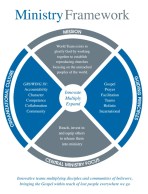
wt-ministry-framework-jan-2016A couple of months ago, we ‘launched’ the World Team Ministry Framework.  It’s our best attempt as a global community to describe ‘who we are’ and ‘what we do’.  You hopefully have seen this graphic or other slightly different ‘versions’ of it around World Team.  We’re trying to ‘contextualize’ this graphic to our various contexts.  However, the point is not having a ‘nice’ graphic that you and I like; the real point is calling each other to live and work in line with what we have decided best describes who God has called us to be.

We are at times better ‘word-smithers’ and discussion activists than implementers.  However, the world around us watches to see if all our ‘words’ will actually cause transformation and change in the way we work with one another, in the way we treat one another, in the way we freely forgive one another.

What should get us out of bed everyone is the call to “reach, invest in, and equip others to release them into ministry.”  Obviously, this focus centers on our primary stakeholders who are the lost (see Matthew 28:16-20).  However, this same focus should drive the way we support one another build up another, and forgive one another, so as “to release one another into ministry”.

I pray that our Ministry Framework will ‘frame’ the way I build into other’s lives and the way I reach out to those who do not yet know Jesus.

Did you say ‘passion’?

In a recent post, I asked the question as to where had our passion gone.  I started out with an example of my waning passion for training runs.

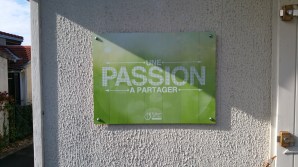
Well, the other day, while getting myself back out on a run, I jogged through a neighboring town, only to see the following sign on the front wall of an evangelical church pastored by a friend.

20160821_095113Loosely translated, it says: “A passion to share”.

Did your say ‘passion’?

There it was again, that notion of a passionate message to share that comes out of a heart that is more and more deeply rooted in our passion for Christ and His passion and love for us.

Then I came across this YouTube video by a Christian young peoples’ musical group in our area.  That was sort of the proverbial ‘icing on the cake’.  You may not understand all the words, but one of the lines in the song talks about ‘voices overflowing with passion’; a passion that flows from who He is and what He has done for us.

Passion is not something I work up.  It grows, it deepens, it bubbles up from a heart that chooses to focus its interest, affections and time on Him.

I don’t trust the plan

I have been reading the book, Nothing is Impossible: Reflections on Weakness, Faith, and Power, by Rose Marie Miller, with several colleagues.  It is the story of Rose Marie’s lifelong journey to see the Gospel worked out in very tangible ways in her everyday life and character.  Her honesty is disarming, but also strikes to the core of what plagues us the most: self.

At one point, she makes this short but telling statement: “She needs faith that God has a good, the plansovereign, wise plan for her son and the rest of the family.  Our basic problem is this: We don’t trust the plan.  We are taught by our flesh, by Satan, by our culture, even by other Christians, that we must do everything we can to avoid suffering.”

We delight in ‘being the masters of our fate’ and grate when the Lord uses situations to remind us us of how much we trust in the flesh.  We don’t like it when God uses others to re-align our plans with His.  We struggle to follow a decision our team has made or to respond graciously to a request from leadership for needed information or statistics.

Now I’m not denying the fact that some of the life situations we face, or the decisions and requests made might be worth challenging.  However, our normal reaction to these events is to question the heart intent of those involved in causing those events or making those decisions.  We reason that we would have made a better (read: ‘much wiser and smarter’) choice.

Many of us can probably remember a time when a leadership team or colleagues made a decision that we needed to get additional experience and training before moving into a new job or ministry that had been proposed to us.  We probably chafed at the ‘lack of understanding’ of these people.  However, if we look back now on that life event, we realize we struggled to ‘trust the plan’. In the long run, I’m sure that decision actually had nothing but major beneficial impact on our life and future.

In ourselves, we don’t know what is always best. However, God has given us His Spirit and He has placed you and I in a community where we can learn to discover His will for each moment and boldly walk in it.

What happened to our passion?

I do my best to run three times a week.  It is part of my effort to be a good steward of my health in order to better minister to others and to ‘run the [ministry] race’ well.  When I head out early in the morning for a run, it’s a time I can also set aside to pray for others and our ministries around the world.  Unhindered by phone calls or emails, I can spend the time to pray.

However, in recent weeks I have noticed a slippage creeping in.  Rather than three times a week, it’s been more like two or just one time a week.  The night before one of my runs, I was trying to ‘work up’ the desire when I realized that the problem was just that: my 155600-159730desire or passion was waning and none of my great efforts were helping to make that desire come back.
Ministry or missionary passion can go through the same life cycle.  There are times when the motivation and passion are seemingly there.  There are other times when the question keeps ringing in one’s head: what happened to my passion?

Like slippage occurring with my running, the answer is not found in ‘working up’ that passion again.  Rather, the remedy is found by turning away from self-fascination to consideration of the God who is our Father and who called us into this work.  “You have multiplied, O Lord my God, your wondrous deeds and your thoughts toward us; none can compare with you!  I will proclaim and tell of them, yet they are more than can be told.” (Psalm 40:5)

Our loss of passion for ministry can often be an indicator that something else has taken the place of Jesus and holds our charm.

May we be passionate about God so that we might be passionate then about the ministry!

Take your time

Last week, I shared a diagram about the different processes that team members might use to work through a decision (see the post: “Dig deeper”).  A question came to mind later: is it more biblical to take your time in making a decision?  In other words, are ‘quick’ decisions lesstake-the-time-fi well thought through or sustained by less prayer?

The answer is not a simple yes or no.  It is much more nuanced and shaped by the following elements:

Time

In any decision, we need to begin by asking the question as to how much time is needed to make the decision.  Deciding what restaurant to go to as a team for a team outing should not take a week of discussion.  However, deciding to change the strategy and direction of the ministry cannot be determined by an hour long discussion.  Establishing the time boundaries of any decision helps focus our energies towards making the right decision in the right time frame.

Opportunity

A decision may be motivated by a unique opportunity that presents itself to us.  This opportunity is time bound in some ways.  If we take an inordinate amount of time to process, it could mean that we would miss this divine opportunity.  However, an opportunity allows us to ask the question as to whether we should or should not respond to that opportunity.  The refugee crisis in Europe would be an example of such a divine opportunity that presented itself to many workers and teams in Europe.  Some of us ‘missed’ the opportunity, while others chose not to respond to the opportunity because it wasn’t where the Lord was leading them to invest their resources.

Heart Conviction

A decision, in our context, is always processed with prayer.  Prayer is a vital part of any decision making process.  However, when have we prayed enough to be able to move forward or make a decision?  Once again, this is not an easy question to answer. However, the question can call us back to our need to ‘go on’ in prayer for God’s wisdom and leading, if the heart conviction is not there. On the other hand, the question can also ferret out a spiritualized attempt to stall a discussion or decision.  This is where decision making can get ‘tricky’ as we need to listen well to others and seek to discern our heart convictions.

Decisions (made slowly or quickly) are an opportunity for God to work on our hearts and change us as we seek to ‘change the world’ around us.

Trust in the Lord with all your heart, and do not lean on your own understanding.  In all your ways acknowledge him, and he will make straight your paths.”  (Proverbs 3:5-6)

Collaboration?

Collaboration is often a ‘buzz word’ in mission and nonprofit circles. It is another term to describe working together or joining forces to see a project launched and accomplished.  However, we can certainly talk a lot about collaboration without any real collaboration occurring. meusyou

In their insightful article, “What Leadership Shadow Do You Cast?” Larry Senn and Jim Hart describe how many agencies long to live by their guiding principles and ministry framework, and yet consciously give a counter message. They sum up their findings by saying: “The central finding is that, over time, organizations tend to take on the characteristics of their leaders.”

To put it another way, there needs to be a close alignment between what we say we value and what we actually do; how we work and minister. The World Team Ministry Framework has a great graphic attached to it for explanation. However, if the Framework simply stays as a graphic and doesn’t cause some ‘realignment’ in the way we currently work together, then the ‘shadow’ we are casting is one that communicates: “Do as we say, not as we do.”

Working together, joining forces together begins by reaching out to other team members in other parts of the agency to ask for their help and input. We have several good examples of this kind of collaboration recently.  Let’s work towards a whole lot more examples.