
• Our hope-filled future is bound up in sharing the story of Jesus, in discipling others, in bringing those disciples together into communities of believers, and in developing and releasing those believers to create other communities... till Jesus the King comes again!

What are our distinctives?

I am often asked: What are the distinctives of World Team?  There are two ways that I try to answer this question.what-makes-us-different

First, World Team’s distinctives flow out of our mission and vision of multiplying disciples and communities of believers.

  • World Team focuses on establishing communities of believers that will reproduce themselves in creating other communities of believers. We want to bring living examples of God’s church within reach of people who do not have a personal relationship with God.
  • World Team works in teams. We work in teams because we believe teams are a tangible expression of our need for all members of the body of Christ in order to carry out the mission mandate that He has given to us.
  • World Team members regularly ‘speak the Gospel’ to one another. It is the ‘air we breathe’ because if the Gospel is not good news for us, how can we expect it to be good news for others.
  • World Team’s size allows us to be more flexible in our approach, more innovative in our activities.

Obviously, others in the World Team community might put these distinctives differently or might add one or two others.  The point is that World Team has markers as to who we are and what we do.

A second way to answer the question is by asking a question.  Why are distinctives so important?  By taking a ‘marketplace’ approach to missions, we try to find our market niche and offer our product to those most likely to join us.  Now there is nothing wrong with trying to communicate well in this way.  However, the context of missions has changed in significant ways.  Many of us, as agencies, are quite similar in our distinctives.  In fact, several are considering inter-agency partnerships where people are recruited to ‘multi-agency’ teams. The focus is less on the agency and its distinctives, and more on shared distinctives and a longer term objective: multiplying disciples and communities of believers.

World Team has distinctives that make us different from others.  However, the World Team Global community is open to work with many other agencies and national movements because we all share similar distinctives and the same long term goal of bringing the Gospel within reach of lost people everywhere we go.

How will you respond?

vote-electionToday, people in one area of the world will be voting to elect the next leader of their country.  For the past number of weeks, the news here where I live has focused on this upcoming election.  Conversations at church, in the neighborhood, or over coffee have centred on the question: “So, who do you think is going to win the election?”

It’s not my purpose to discuss the candidates themselves nor the content of the political debates surrounding this election.  And this is only one of a number of elections that have occurred or will occur this year.  My purpose is to talk about our response or our reaction to what happens; to what will be the outcome of this election.

In 1 Timothy 2, we read: “First of all, then, I urge that supplications, prayers, intercessions, and thanksgiving be made for all people, for kings and all who are in high positions, that we may lead a peaceful and quiet life, godly and dignified in every way.  This is good, and it is pleasing in the sight of God our Savior.”

My first reaction, and perhaps yours as well, over the past few weeks has been to speak up and say what I think about the candidates and the issues in this election.  Paul exhorts us to first take our words to God and change them into prayers for the very leaders engaged in this electoral process.  However, Paul goes even further to challenge us to pray for these leaders so that they will allow a continued openness, in that culture and society, to living out one’s faith and sharing one’s faith with others.

I almost hesitated to write that last paragraph because it seemed so obvious.  However, it is very much ‘counter cultural’ for all of us to think first of prayer because passions can ‘fly’ in political discussions.  Without realizing it, our passion may demonstrate that we really believe it is the winner of an election who determines the future.

It is our God who is sovereign, and so our hearts and prayers need to turn to Him first in response.

“Our God is in the heavens; he does all that he pleases.”  (Psalm 115:3)

Have you heard about monoculturals?

To be ‘monocultural’ is the idea of looking at another culture only from the perspective of our culture of origin.  However, have you ever heard of ‘monoculturals’?monoculturals

Monoculturals is a term that refers to people who see themselves as being connected globally to people from all different walks of life.  It’s the feeling that there is one ‘culture’ to which everyone has access and in which you engage others.   Facebook, Twitter, and the global music culture create the opportunity for people to relate to others from Cambodia, Paraguay and Denmark.  We have the possibility of ‘reaching out and touching others’ from a host of different places.

There is a caveat.  The caveat is that we can begin to ignore the specific underlying cultural assumptions and views of one another because of the ‘monoculture’ in which we believe we are all living.  The veneer of being ‘united’ can cloud the reality that there is more to each person than just a specific post or song lyrics.

If we apply this to our larger agency, we know that we are ‘united’ by a common culture, a ‘monoculture’ if you will of an unwavering commitment to multiplying disciples and communities of believers among the lost.  However, we can easily lose sight of the ‘cultural’ differences that mark each one of us and create unnecessary tensions in our relationships with one another.

Just as we did when we first started to learn a new language and culture, we should give ourselves more to listening well to others, and particularly to asking probing questions that will help us better understand what is ‘underneath’ each one of us in terms of our personal cultural values and assumptions.

Are you monocultural?

By our job description, we are ‘cross cultural workers’.  In other words, we have moved from living in one culture to adapting to life in another.  Our perspective has certainly changed.  Or our perspective should have changed.  I am sometimes surprised by how easily I can move back and forth between working as a cross cultural person and acting like a monocultural worker.

monoculturalNow when I say, ‘monocultural’, I’m thinking of the idea where we look at another culture only from the perspective of our culture of origin.
The way that this often works out is by those small criticisms (seemingly justified) of the current culture in which we live.  It happens in the smallest of situations. The ‘little man’ on the pedestrian crossing signal turns from green to red, and that local pedestrian steps right into the crosswalk without even a moment of hesitation.  In my mind, I feel like shouting out: “Did you see that the little man change from green to red?  It means stop and wait to cross!”

What I am doing is monoculturally criticizing the behavior of others.  I’m not trying to assess why this happens or what element of another’s worldview moves them to act in this way, I’m just reacting from my cultural norms; cultural norms which I believe are right.

Without daily nurturing a ‘multicultural’ perspective, I will have trouble applying the Gospel appropriately and accurately to my life as well as to the lives of others.  I will end up ‘speaking’ a lot more than ‘listening’.   I will end up nitpicking rather than grappling with cultural issues that might become avenues for communicating the message of Jesus Christ to my heart and to the hearts of others.


Happy Reformation Day!

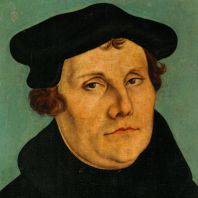
For some in our world, today, October 31st, will be a day for collecting candy from friends and neighbors.  For others, it will be a day of preparation for All Saints Day (Nov 1st) where families will spend time visiting the grave sites of family members.  martin-lutherHowever, many others will celebrate today the 500th anniversary of the Protestant Reformation, launched by Martin Luther nailing his 95 theses to the door of the Wittenberg church in Germany.
We are the ‘offspring’ of Luther’s call to return to the Living Word as our only source of forgiveness, justification and freedom.

The first of the 95 theses reads this way: “When our Lord and Master Jesus Christ said, “Repent” (Mt 4:17), he willed the entire life of believers to be one of repentance.”   Repentance is the turning away from our sin and turning back to God to receive His forgiveness and grace.  Our ‘entire life’ is to be characterized by this constant act of repentance and faith, repentance and faith, repentance and faith.

It’s easy for us to tell others of their need for repentance.  It is much harder to accept our need for daily repentance.  However, if the Gospel is not ‘good news’ for us, how can it be ‘good news’ for others?

“See what kind of love the Father has given to us, that we should be called children of God; and so we are.”  (1 John 3:1)

Happy Reformation Day!

What actually happened?

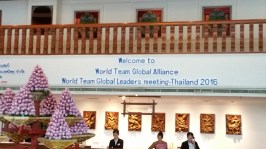
Most people within the WT Global community probably have a foggy notion as to what is the role and function of the World Team Global Alliance (WTGA).  The WTGA provides20161004_105645 oversight and accountability for the global ministries of World Team.  What that means is that they ask the hard questions about the progress of our work (to multiply disciples and communities of believers) and the outcomes of the priorities set by the International Director.  This year, during our meetings in Thailand, our discussions centred around four main topics.

First, the relationships between the WTGA, the various Ministry Support Centre boards, and our ministry teams in the different Areas where we serve. What we do not want is to add additional layers of structure to our mission that impedes the growth and development of our current ministries.  The WTGA heard from Mike R (WT Asia) about the potential expansion of the International Service Corps beyond the Philippines which provided a tangible example for the WTGA to assess in this regard.  A working group was created to seek input from the WT Global community and present proposals back to the WTGA on the relationships between the WTGA, the various Ministry Support Centres, and our ministry teams.

Second, the assessment of the progress of our global ministries.  The WTGA approved a “Vital Signs & Gauges” assessment process and tool.  More about this in a future blog post summarizing the recent global leaders meetings.

Third, the purpose or objectives of our various global partnerships.  Currently, we have three that we are working: PWTC (Philippines WT Ministry Support Centre); IMM from CH; and Latin American Initiative. The WTGA, during this time, heard from the leader of the IMM from CH.  Each one of these partnerships calls for allocated resources.  Discussion focused on our ‘bandwidth’ capability to serve these partnerships and the desired outcomes that each partner has for these partnerships.  The WTGA tasked the International Director to respond to these two questions by meeting with leaders from each partnering body.

Finally, global priorities for 2017.  The WTGA approved in principles the priorities presented by the International Director for 2017:

  • Assess our WT global ministries to better resource our teams and projects
  • Grow WT Global to 500 members in the next five years
  • Initiate leader development at all levels

Your prayers and the input received from many prior to these meetings was greatly appreciated!