• Our hope-filled future is bound up in sharing the story of Jesus, in discipling others, in bringing those disciples together into communities of believers, and in developing and releasing those believers to create other communities... till Jesus the King comes again!

Poly what?

I’m sure if you are like me, when you heard the expression: “polycentric mission”, you said to yourself: “poly what?”  I mean, what idea or thought is this expression meant to convey?

Polycentric simply means, “having more than one centre”. In other words, in our global missions context there are now many poles or centres from which mission is being launched. In the 20th century, mission was primarily from the Western world. However, in the 21st century, mission is being launched from Ethiopia Chile, Brazil and Indonesia. This is what is called the Global South.

There are several practical implications or effects from this shift. In this blog post, let’s focus on just two of the many implications. 

For one, responsibility for the task of global missions is now a shared work.  This is always easy to say, but difficult to practice.  For many of us, we are used to directing, leading, or running global mission outreach from our perspective, our centre of gravity.  This shift causes us to recognize the importance of active listening to others, as well as gospel humility, by which we will understand more and more our need for others more than their need us perhaps. This shared work of global missions may take more “time” and “energy” than in the past. However, joining hands in this shared task is a tangible mark of God’s universal church.

Another practical effect or outcome is seeing the need of cross-cultural intelligence.  It will be difficult to effectively work with others from the Global South if we from the West do not seek to understand the cultural background, cues and dynamics at play with those who share the global missions task with us. For cultures that thrive in getting things done fast, there will be the need for patience and a willingness to “slow down a bit” in the process. For those cultures where time and planning are not priorities, there will need to be more “fluid organisation” allowing all partners to know their part in the task. And the only way all this will happen will be through His grace, through a deepening understanding of the Gospel, and by adding new cross-cultural skills to our toolbox.

Poly-centric, in other words, means learning to play as a team with a whole new group of players who may be different from one another.

What are our distinctives?

I am often asked: What are the distinctives of World Team?  There are two ways that I try to answer this question.what-makes-us-different

First, World Team’s distinctives flow out of our mission and vision of multiplying disciples and communities of believers.

  • World Team focuses on establishing communities of believers that will reproduce themselves in creating other communities of believers. We want to bring living examples of God’s church within reach of people who do not have a personal relationship with God.
  • World Team works in teams. We work in teams because we believe teams are a tangible expression of our need for all members of the body of Christ in order to carry out the mission mandate that He has given to us.
  • World Team members regularly ‘speak the Gospel’ to one another. It is the ‘air we breathe’ because if the Gospel is not good news for us, how can we expect it to be good news for others.
  • World Team’s size allows us to be more flexible in our approach, more innovative in our activities.

Obviously, others in the World Team community might put these distinctives differently or might add one or two others.  The point is that World Team has markers as to who we are and what we do.

A second way to answer the question is by asking a question.  Why are distinctives so important?  By taking a ‘marketplace’ approach to missions, we try to find our market niche and offer our product to those most likely to join us.  Now there is nothing wrong with trying to communicate well in this way.  However, the context of missions has changed in significant ways.  Many of us, as agencies, are quite similar in our distinctives.  In fact, several are considering inter-agency partnerships where people are recruited to ‘multi-agency’ teams. The focus is less on the agency and its distinctives, and more on shared distinctives and a longer term objective: multiplying disciples and communities of believers.

World Team has distinctives that make us different from others.  However, the World Team Global community is open to work with many other agencies and national movements because we all share similar distinctives and the same long term goal of bringing the Gospel within reach of lost people everywhere we go.

What’s most important?

Last week I was in Asia to meet with leaders of a house church network who are sending workers to one of our ministries.  As part of the preparation, I had asked a brother in Christ for some insights as to how to approach discussions with these leaders. This brother is from that part of Asia and is a member of the local French church where we worship.

This brother gave me crucial insights into how to address issues where our expectations and values might be different.  However, the main piece of advice that he gave me was about how to create a context where these leaders would feel safe and heard.  There were cultural insights in play, no question about it.  Creating a strong relational safety net was also in play.  In fact, that ‘safety net’ would greatly influence the outcomes we were hoping to achieve through these talks.safety net

A few lessons I picked up in this process:

  • It is extremely helpful to ask for help from others, and particularly from those of the culture in which you find yourself.
  • In such discussions, intentionally seek to create a strong relational ‘safety net’ that gives freedom to all to share honestly and openly in robust dialogue.
  • Don’t avoid addressing the tough issues, but do it in a context where people feel safe and heard

The day after our meetings ended, I sent a note to the brother in Christ in France.  His response was telling: “I’m so happy to hear this good news.  May God be glorified and may we give Him glory with all our heart.  His steadfast love endures forever!”  It’s exciting to be a part of the universal Body of Christ!


The art of sacrifice in a region (Africa)

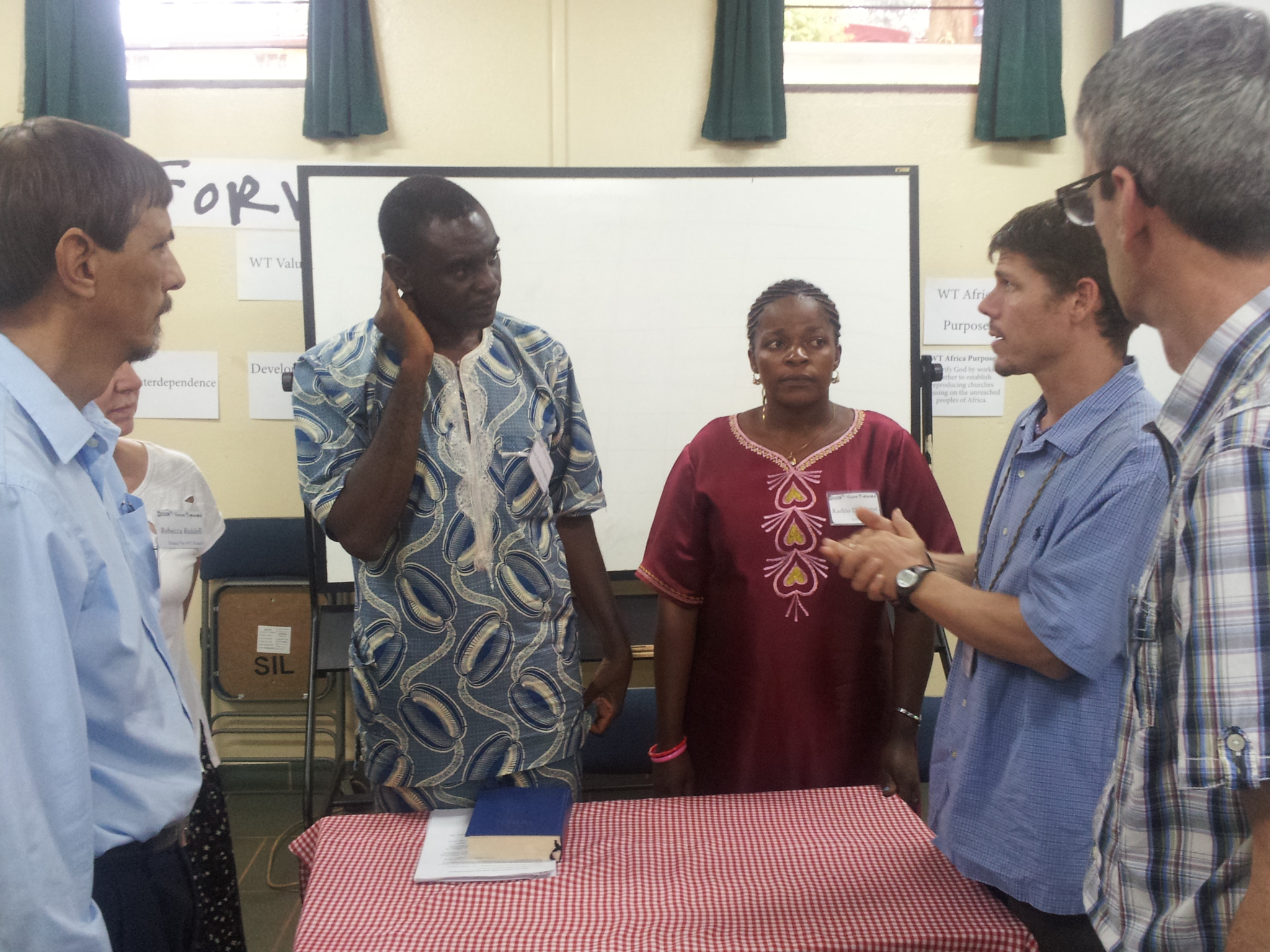
The Mission¹⁴: Vision Forward Africa conference was the second of Area conferences in 2014.  The conference focused on our WT Ethos (purpose, vision, values and ‘culture’) as well as getting input from national leaders about partnering to reach the unreached.  The large group and small group interaction times were fruitful, with many opportunities to talk further about the issues being raised.20140524_123751

As I wrote in the previous post, “I shared a number of challenges with each region or Area.  The purpose was to affirm and celebrate what God has done through us over the past few years as well as to challenge Area members to “excel still more” in their work and ministry for Jesus.”

During the WT Africa conference, I shared the following challenges.

First challenge: learn to say ‘no’. Learn to say ‘no’ to one thing in order to build a heart for a new team.  World Team Africa has historically focused its work(s) in one specific region.  The outgrowths of these efforts have been progress in translation projects, multiplying small groups and leader development.  That good work now needs to be turned towards other projects in other locations and countries. In order to do that, it will mean that workers will need to say ‘no’ to one thing to have the time to give towards researching and building new teams to reach new unreached people groups.

Second challenge: ask the hard question. “When is the time to move on?”  This hard question is not restricted just to WT Africa workers. It is the question that we all need to ask ourselves at certain times.  “When is the time to move on?”  In other words, at what point do we need to transition to a new work and project?  How might our ongoing presence be inhibiting others (national believers) to take leadership of the work?  This is neither an easy question nor an easy discussion.  However, we must help one another to regularly think through this question.

Third challenge: offer and accept outside-in input.  Each of us has experience and wisdom gained from our unique journey with Jesus.  However, we are each easily blinded to our faults and shortcomings.  Offering and accepting outside-in input is a way for each of us to come alongside other workers by investing in their lives.  However, we must be equally willing to accept the same input from those outside our contexts.  I often hear workers, in response to the offer of outside input, say that ‘those people would not understand our context.’ Granted there is an element of truth in that statement, but people from the outside are also able to see things to which we can easily be blinded.

I share these challenges to the WT AFrica workers with all of us both as a reminder of the challenges given, but also as a motivation to pray for one another as we seek to learn the further change and growth to which God is calling us.


Innovative teams mean ‘we’ work together

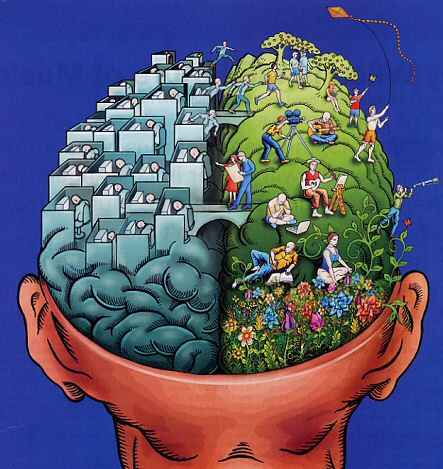
Innovative, creative types are usually right brain people.  At least that is what we have been telling each other for years.  The thinking is that if we are to get innovative, entrepreneurial approaches going in our agency, we need to bring in more right brain people, more “creative” types.left-brain-right-brain

In a recent scientific article, “The Real Neuroscience of Creativity,” this long held idea is challenged.

Scott Kaufman states: “The latest findings from the real neuroscience of creativity suggest that right brain/left brain distinction is not the right one when it comes to understanding how creativity is implemented in the brain … the entire creative process – from the initial burst of inspiration to the final polished product – consists of many interacting cognitive processes and emotions.”  This all sounds pretty dry up to this point.

However, Kaufman goes on to say: “Importantly, many of these brain regions work as a team to get the job done, and many recruit structures from both the left and right side of the brain.”  It was at this point that I made the jump to us as an agency.  Basically, Kaufman is stating one of our values, but in scientific language.  We need one another.  Creativity and innovation happen because all different kinds of people get involved in the process.  It is not the domain of one kind of person or personality type. Innovation happens best in community.

Working on innovation through community is where things can get messy. Others may put ideas on the table that you or I consider outlandish.  Others may challenge our ‘creative and innovative’ ideas, forcing us to re-think their realistic application.  Yet, as I appreciate each person in the process, I gain a different perspective and participate in the creation of truly creative and innovative ideas.

“Independent Subcontractors”

So have we really drifted into becoming more like “independent contractors” than a “bonded fellowship”?   Why would this be case?  How did this come about?

One reason would be that certain concerns take precedence over others.  For the most part, those concerns are right in front of us: just to live and to work.  Those concerns, though certainly legitimate, can push us away from others who are not right here with us.  A common definition of an independent subcontractor is “a person or business which has a contract to provide some portion of the work or services on a project agreed to by a contractor.”  A subcontractor sets his/her own hours and work schedule.  A subcontractor has his/her own small team and doesn’t necessarily work in tandem with other workers outside of his/her local context.  Their chief concern is to make sure they get paid for the work they do.

Another reason would be that we only apply the value at a local level.  WT has a strong aspirational value for community, though its application can be limited.  We have done a good job building local communities, but struggle to have any sense of connection to the larger WT community

A final reason would be the lack of trust that quickly sets in between people.  I have heard one writer say that it takes ten positive comments to offset one critical one.  Could it be that we too quickly find ourselves thinking less of a member within the WT community because of one misplaced comment?  The longer that comment is not dealt with, the harder it is to maintain a bonded fellowship.

The WT community is a unique group of cross cultural workers, passionate about one thing: the multiplication of disciples and communities of believers around the globe.  Many communities of workers work towards this end.  Maybe I’m not seeing things correctly, but it seems like we act more like a group of “independent subcontractors” sometimes than a community pulling together with and for one another.