• Our hope-filled future is bound up in sharing the story of Jesus, in discipling others, in bringing those disciples together into communities of believers, and in developing and releasing those believers to create other communities... till Jesus the King comes again!

Dependent

“You know you’ve become the missionary you were meant to be the day you become dependent on the people you were sent to serve.”

I had to read that statement twice before I began to seize its full significance.  Why?  Because my natural tendency, as well as yours I would imagine, is to believe ministry is more about others becoming dependent on me as ‘full-time worker’ than on me becoming dependent on them.

In the book, The Ideal Team Player, Patrick Lencioni argues that there are three core qualities to an ideal team player. They are hungry, they are smart, and they are humble.  The hardest to measure and assess, he said, is humility. 

Pride is probably our default mode in most ministry efforts.  We want to do the job well, and we enjoy when others notice the good job that we are doing.  Appearing dependent on others makes us look weak, less capable than we thought, lacking the necessary skills to do the job, or not “leading” as we should.  Pride is one of those root sins that keeps us from admitting (or asking for) our need for others help and for God’s help.

So, maybe one indicator of a heart that is learning humility is to assess its ‘dependence factor’; that is, how much does that person demonstrate real need of others, real need of God in the culture in which they find themselves? 

“You know you’ve become the missionary you were meant to be the day you become dependent on the people you were sent to serve.”

By the way, I pulled the quote at the beginning of this blog from another blog by Jonathan (http://leadbysoul.com/leadership/the-quiet-leader/). The quote is from a documentary interview of his father, John W (WT Papua alum).

Going ‘national’

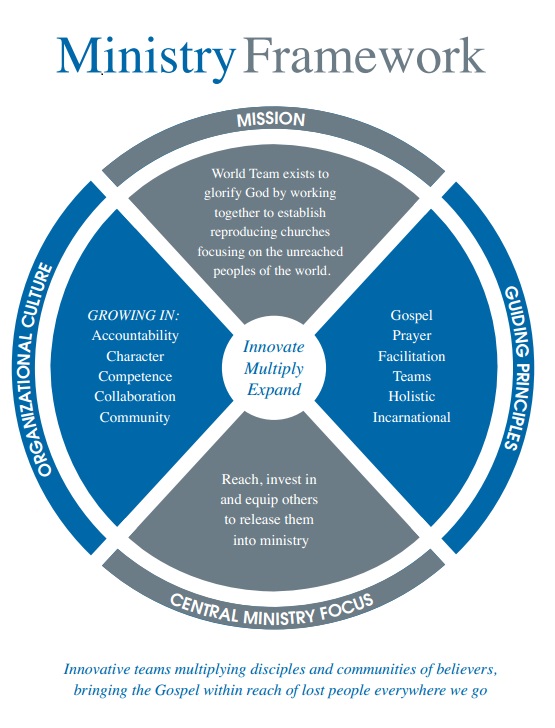
Our World Team Ministry Framework highlights the ‘guiding principles’ by which we WT Ministry Framework Jan 2016live and minister as a global community.  One of the ‘guiding principles’ that is a new addition from our previous list of ‘values’ is: incarnational.


The descriptor for this guiding principle is as follows: “As cross-cultural workers, we intentionally surrender our rights to our home culture, language, and ways and embrace those of the host culture. By this, we seek to model Christ, who emptied Himself of the privileges and powers of divinity, taking on human form, in order to carry out His mission.”

Many voices were raised in favor of adding this guiding principle to our list.  The more I have mulled over it, the more I have come to understand why Ray and others kept putting it in front of us as so important.

Living incarnationally pushes us back to the example of Christ (Philippians 2).  Jesus Christ, the eternal Son of God, chose to take on cultural forms, language and habits.  He expressed himself with words that others could understand, in cultural forms that made sense to the people he was addressing.  He made the effort to ‘be like us’ and to accept this world as his ‘home’.  Yes, his ultimate ‘home’ was not here. Yet, he did not make others around him feel that he was keeping himself a stranger to the world in which he found himself.

The word that I find the hardest in this descriptor is: surrender. Not many of us like the sound of that word because it strikes at our feeling of entitlement.  We have seemingly ‘sacrificed’ a lot to go cross culturally, and believe there should be some small return as a result.  However, God asks us to lay it all down.  In the process of that surrender, we will experience blessings and benedictions we would not have shared otherwise.

One blessing that surely stands out is the experience of deep friendship in Christ across cultural boundaries; discovering that God has truly broken down the barriers that separate us from one another.

Multicultural teams don’t work

Now that I’ve got your attention, neither multicultural nor monocultural teams work in the long run if team members don’t work hard to understand the ‘world’ of each member.

Teams do not work because team members do not take the time to understand another’s ‘culture’ or way of working.  I can be from the same culture as other team members, but if I am a ‘thinker’ and another is a ‘feeler’, I could be frustrated by his/her lack of being able to ‘make a decision’. It may feel like he/she is always stalling our team and never wanting to come to closure.  However, that is not how this person is ‘thinking’ or processing. Failing to understand another’s way of thinking will cause dissonance and conflict in a team.multicultural conflict

Teams fail, not because of the cultural make-up of the group, but because we believe our way of seeing and dealing with reality (for example, how to do ‘team life and ministry’) is the best or ‘biblical’ way.  Our own culture can create a sense of right-ness in our hearts, and keep us from humbly learning from others on our team.  We can miss the opportunity to experience team in a deeper way.

It is true that when you add the ‘multicultural’ card into a team, it adds another dimension that the team must address.  However, the ‘multicultural’ card will also add a dimension to any team that enhances its cross-cultural ministry capacity.

When two or more cultures come together to work on a church planting team, they must learn how to ‘bridge’ between the cultures represented on that team.  They learn not only how to ‘divest themselves’ (Philippians 2), but how to ‘translate and contextualize’ what another is saying.  This allows them, as a team, to be even better prepared to contextualize the message into the cultural context of the people group to whom they have been called.  In other words, they gain valuable experience for their ministry from learning to work together and minister to one another as a team.

So, whether your team is monocultural or multicultural, each of us needs to start by asking at least two questions so that our team can be built on grace and honesty:

  • What do I need to ask another to better understand how they think and process?
  • What heart barrier (cultural, emotional or spiritual) keeps me from hearing and learning from another who seems very different from me?

Gotta go all the way

go all the wayOkay, I know that’s not proper English (neither British nor American).  However, my point is simply that learning to talk with others in a language that is not our heart language is a work of perseverance in order to get to the objective of sharing our faith with others in a cross cultural context.

Perseverance calls for several actions or heart attitudes that are not natural to our hearts.

For one, the work of perseverance pushes you to always keep the endpoint in mind.  We should not be satisfied with ‘almost there’.  90% is still 10% short, we could say.  The problem here is that we are good at talking ourselves into accepting ‘half-way’ work.   Other concerns begin to weigh in on us. The main concern in cross cultural life, we believe, is to ‘get out into ministry’.

For another, the work of perseverance presses on the humility quotient.  Coming from ministry experience in our own cultural context, we can feel ‘child-like’ in cross cultural life and ministry when we recognize that it takes a whole lot longer to talk, to get a sentence out then it does in our own culture and language.  Perseverance drives us see our need for grace even in language learning and cultural acquisition.

Finally, the work of perseverance can highlight (regularly) our weaknesses. The problem for me (and most of us) is that I don’t always see the benefits of this ‘highlighting’.  However, the psalmist saw this benefit (Psalm 139:23-24) and maybe his prayer should become our prayer.

It is true that at the 30 kilometer mark in a marathon, one ‘hits the wall’.  The temptation to quit is so strong when one ‘hits that wall’ that it’s hard to resist.  When I ran the Paris marathon, one of my teammates here in France stepped on the course at the 30 kilometer mark and ran with me for two kilometers.  The words of encouragement that teammate shared were just what I needed to ‘go all the way’ to the end of the marathon at 42 kilometers.

Perseverance is hard work, but it is a community work.  Struggling in language and culture?  Tempted to ‘call it quits’ before the language acquisition finish line?  Feeling discouraged at not being able to express yourself like you would want?  Call on a friend. Call on a group of friends.  Call on the community to help because we ‘gotta go all the way’ to learning the language and culture of those God has called us to serve.

Ask who? (again)

Ad made a comment on my blog post yesterday.  Here’s what he wrote: “”Go directly to the people you have the hardest time with. Ask them what you’re doing that’s exacerbating the situation. They will surely tell you.”  Mmmh, what about if the people are from a culture with indirect communication?  Would not a mediator be better to ask that question?”

Ad hit the proverbial ‘nail on the head’.  It’s why listening is so important, and why it is a skill that most of us need to be working on continually.  Not only will listening well help us benefit from the feedback we receive, it will teach us to look for the best context in which to ask and receive that feedback.

I think that is why the writers of Thanks for the Feedback: The Science and Art of Receiving Feedback Well, stated earlier in yesterday’s quote: “… then there’s something going on that you’re not “getting,” and without her help, you’re not going to get it.  It may be a cultural difference that you need to understand if you’re going to be effective in her market.”

Not only do we need to be aware of cultural cues that we may be missing in our conversations, but we also need to understand how to ask for feedback in a culturally appropriate way.  If you are from an indirect culture, asking for feedback or receiving feedback will look quite different from those who are from direct cultures.

However, what remains constant is how we will choose to respond to that feethanksForFeedbackdback. 

It’s funny.  I can read the title of this book in two ways.  I could read it, “thanks for the feedback” and in my mind say it with a very begrudging tone.  Or, I could read it, “thanks for the feedback” and in my mind say it with an honest and grateful tone; thinking what I will “mine” from this feedback that will help me grow.

When you hear feedback, with what tone are you most often saying in your mind: “Thanks for the feedback”?

You skaking?

Just reading the news, as we know, can get one discouraged.  Here in Europe, the talk is of the exponential rise in migration, Brexit, and the internal strife in numerous countries.  There is a ‘shaking’ going on, and it can cause us to ‘shake’; to wonder what is really going on.

The daily grind of our lives as cross cultural workers can also cause us to despair, to ‘shake’, wondering what all this disruption has to do with life and ministry.

unshakeableI read this statement today which put order back into my heart and thinking: “This is why it is important to believe with an unshakeable trust that we have a kingdom that cannot be shaken.”

God builds the house (Psalm 127). God is building His Church (Matthew 16:18).  One day, God will right everything in this world (Revelation 21:4).  His kingdom is unshakeable (Hebrews 12:28).

At the end of another week, you may feel disrupted.  You may be ‘shaking in your boots’ because language learning is going badly or the person you’ve been spending time with in spiritual conversation dropped off the radar screen or family issues are causing sleep to be disturbed.

Then reach out in faith and repentance and grab hold of His hand.  Let Him overwhelm your ‘shaking’ heart with His assurance, with His ‘unshakableness’.

Not feeling like you can do that?  Then tell another, you’re having trouble even reaching out your hand.  Let them take your hand into His.