• Our hope-filled future is bound up in sharing the story of Jesus, in discipling others, in bringing those disciples together into communities of believers, and in developing and releasing those believers to create other communities... till Jesus the King comes again!

Innovative teams mean ‘we’ work together

Innovative, creative types are usually right brain people.  At least that is what we have been telling each other for years.  The thinking is that if we are to get innovative, entrepreneurial approaches going in our agency, we need to bring in more right brain people, more “creative” types.left-brain-right-brain
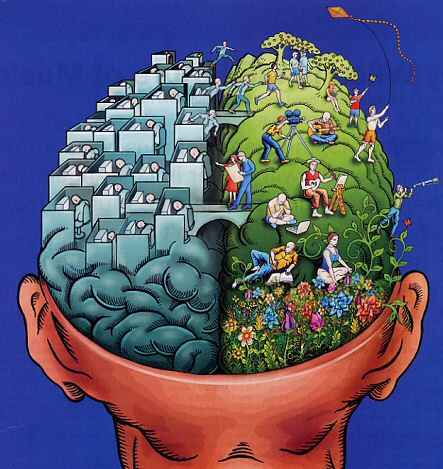
In a recent scientific article, “The Real Neuroscience of Creativity,” this long held idea is challenged.

Scott Kaufman states: “The latest findings from the real neuroscience of creativity suggest that right brain/left brain distinction is not the right one when it comes to understanding how creativity is implemented in the brain … the entire creative process – from the initial burst of inspiration to the final polished product – consists of many interacting cognitive processes and emotions.”  This all sounds pretty dry up to this point.

However, Kaufman goes on to say: “Importantly, many of these brain regions work as a team to get the job done, and many recruit structures from both the left and right side of the brain.”  It was at this point that I made the jump to us as an agency.  Basically, Kaufman is stating one of our values, but in scientific language.  We need one another.  Creativity and innovation happen because all different kinds of people get involved in the process.  It is not the domain of one kind of person or personality type. Innovation happens best in community.

Working on innovation through community is where things can get messy. Others may put ideas on the table that you or I consider outlandish.  Others may challenge our ‘creative and innovative’ ideas, forcing us to re-think their realistic application.  Yet, as I appreciate each person in the process, I gain a different perspective and participate in the creation of truly creative and innovative ideas.

Ten reasons why World Team will change

top-ten-reasons-marriedReason number 1: As the Gospel becomes more and more central to all our affections, it will work itself out in fresh ways in our ministries.

Reason number 2: Workers are rediscovering ‘the rush’ of walking with Jesus.

Reason number 3: Experienced workers are realizing that we are moving from being doers of the ministry to equippers for the ministry.

Reason number 4: New workers are arriving in greater numbers

Reason number 5: We are convinced that community is far better than independence


Community offers so much more than independent living.

Community provides a secure base where joys, disappointments and simple frustrations can be shared and carried together.  Many of us know the blessing of a timely word shared by a co-worker during a community gathering; a word that refreshed and strengthened our soul.  Community also provides a platform for fruitful ministry.  We recognize that individually we do not have all the spiritual gifts. When we see a community at work where people are using their gifts for the benefit of that community, it models the very community that exists between the members of the Trinity.  Community provides a powerful witness to the world around as to what the Gospel can do to bring diverse peoples together for His kingdom purposes.

Yet we can easily settle for an independent lifestyle because community calls for so much more engagement on our part with others.  Many in the WT community, though, are discovering that it is worth the cost.

World Team will change because we are convinced that community is far better than independence.  As we move towards one another more and more, we will call one another back to the Gospel more and more, and the outworking will be a greater passion to see those without Christ come to know Him.

I hope you are starting to “hear” what I am hearing from the WT community.  We’ll talk more these first five reasons and others in the coming weeks.

One of those days

I’m sure you have had a day like the one I’ve had today. one_of_those_days-8089

You don’t feel any strength or desire to engage in ministry.  You feel weak rather than strong, and you struggle to pick up the Word or call out to God.  All the effort (we might say, the self effort) up to this point has worn you out.

Something is missing. That something, we know, is the Gospel.  Yet, how do I, how do we get our hands and heads again around Jesus’ message of total forgiveness and righteousness?  J. D. Greear, in his book: Gospel: Recovering the Power that Made Christianity Revolutionary, writes:

The gospel is not just the ABCs of Christianity, it is the A-Z; it is not the first step in a stairway of truths it is more like the hub of God’s wheel of truth.  All other Christian virtues flow out of it.  That’s why growth in Christ is never going beyond the gospel, but going deeper into the gospel.  The purest waters from the spring of life are found by digging deeper, not wider, into the gospel well.”

Going deeper is not something that we can teach one another.  It is something we can pray for one another in community.

Let’s go deeper!

A Different Stance

Real trust is not something that we quickly give to another.  Trust needs to be built.  It takes time and experience for me to observe that you are worthy of my trust.  Yet, one small misstep and trust can be broken; all that has been built can dissipate in the space of a couple of minutes or seconds.DifferentApproachToSuccess

At that moment, we enter into “mistrust”; a holding back of our hearts from others because we are just not sure that they will come through for us. Our natural stance towards others is often one of mistrust because we have been let down so many times.  We now insist that others prove their trust before we will extend our trust to them.

Our relationships as workers are meant to be living demonstrations of God’s awesome Gospel power at work in us.  I’m not calling for a naïve trust in everyone, but I am pleading for a different stance, a different approach towards trust.

  • What if we changed our stance to one of trust, that is, of trusting the best of another and believing they have our best interest in mind until the contrary is proven or demonstrated?
  • What if we extended forgiveness to those who have broken our trust?  What if we chose not to bring that experience of mistrust up again as a means of accusation?
  • What if we measured others’ broken trust in light of the many times we have failed to trust our heavenly Father?  What if we allowed that thought to drive our hearts to repentance and faith?
  • What if we decided to write out what real trust looks like in practice and then shared that with another for their help and insights.

It’s easy to say we trust someone.  It’s another thing to actually live from a different stance, one of real trust.


Why change is hard for us

change standChange is difficult for most of us.  To move from one place to another, one culture to another means we will walk through an adaptation process that is unfamiliar to us.  We will walk through “territory” that is unknown and must explore for the first time.

Most people say they don’t like change.  However, it’s not the ‘change event’ that is troublesome, it’s the transition process.  It’s the thought of learning new habits, building new friends, and establishing a life in a new location or a new ministry that is unfamiliar to you.  Change is hard because of the emotions surrounding that journey of transition.

Living as “immigrants” (1 Peter 2:11-12) in this world is part of our calling.  It means that our immigrant lifestyle, both as individuals and as a community, will entail change.  It means that we will need to “build a transition raft” that will help navigate the changes that will be part and parcel of this calling.

One critical element of change transition is a strong and vital community.  When changes arise, a community will provide us with the stability needed to walk through the unknown.  A community will drive us back to our power base, Jesus Christ, reminding us of His sovereign care and presence in all things.  A community does not keep us from change.  It resources us by helping us see God in the change and builds anew a prayerful and dependent spirit.

World Team is changing, and will change even more as we move into the future.  For that very reason, we need to be in community and grow in community so togetherwe can navigate well those changes .

Based on trust

trustNowhere in the Bible do we find an exhortation to: “trust one another”.  We are told to “encourage one another (1 Thessalonians 5:11), “exhort one another” (Hebrews 3:13) and “love one another” (1 John 4:7).  We are told to put our trust in God (Proverbs 3:5-6).  However, “trust one another” does not make the list of ‘one another’ commands.

Why?

This is the question I asked myself.

Trust is placing confidence in another. It is giving another an open door into my life without having to order what that engagement should look like.  It is not an action like encouragement.  I encourage another when I tell them they did an excellent job in facilitating a gathering of the community, for example.  That’s a tangible outworking of that one another command; a very specific step that was taken.

Trusting another is difficult to describe in tangible steps because it requires relinquishing control, believing the other is “for me”. Trusting another is also a two-way street in that it moves us to desire to see another excel.

Now that’s the ideal, but it’s the ideal that we should be striving towards by the grace of God.  Sometimes, we determine our engagement with one another by a series of guidelines or by a “process”.  Though these are helpful at times, they may cause us to skirt around the issue of trust, and not push us to consider the level of trust that exists between us.

Trust is built over time, but trust is also granted.  Rather than always waiting to see if another merits our trust, maybe we should consider first what keeps us from trusting others.