• Our hope-filled future is bound up in sharing the story of Jesus, in discipling others, in bringing those disciples together into communities of believers, and in developing and releasing those believers to create other communities... till Jesus the King comes again!

Where do we go from here?

Just one more thought before I take a break from writing for two weeks: if we are agreed that the term ‘church planting’ needs to be expanded and restated, what do we do now?  Where do we go from here to communicate well the passion of investing our lives in such an adventure? where do we go from here

Here are a few ideas to mull over:

First, soak ourselves in the Scriptures, and particularly in the history of the expansion of the Church.  As I have been reading the book of Acts in recent days, I’m constantly amazed at the multifaceted outworking of discipling and bringing others into community.  It feels like discipleship and community are always in flux; shifting and adapting to new contexts (see Acts 11).  All the while, holding to the one firm objective of seeing everyone grow up together in Christ.

Second, listen to practitioners.  Oftentimes, in just listening to those engaged in ‘church planting’ on a day to day basis, we discover new ways of describing or painting the work.  Taking the time to just hear one another out might actually produce a host of new expressions as to a fuller picture of ‘church planting’

Finally, try out several new terms, concepts and images on one another.  The way that new expressions make it into our language and vocabulary is because people start using a term and it suddenly takes root in the mindset and heart of others.  We would benefit from trying out new ideas in community with one another; being willing to accept honest feedback and drop terms or images that don’t do justice to the passionate journey we are on.  However, some images or concepts might take hold and open up new ways to talk about our passion.

Whether you’re out in the garden, walking the streets of Hong Kong or sitting at the beach, why not give some time to ruminating on these ideas and see what God brings to your heart and mind.


I never said it would be easy

never easyIn response to my last post, many responded about the difficulty of actually choosing to focus on one or two core priorities.  I never said it would be easy.  The tyranny of the urgent is one of the main obstacles we face.  Such pressure can rob us from giving ourselves to what ought to be prioritized most.

Jesus called His disciples to an unwavering attention on what is most important: “But seek first [or ‘continually seek’] His kingdom and His righteousness; and all these things shall be added unto you.” To have such a focus requires a courage that we do not have within ourselves. We need to look outside of ourselves for help in this journey. I never said it would be easy.

Even the task of setting priorities is another step in the journey from independence to dependence.  What does ‘seeking His kingdom and righteousness’ look like today in my life?  In what tasks, what actions does God want me to engage?  Where does He want me to say ‘no’ in order to say ‘yes’ to His will, His priorities for my life this week?

Listening to God forms a major part of the answer to that question.  However, we are ‘trained’ to more quickly listen to our own wisdom than to be silent before Him in order to know the wisdom that comes down from above.

Community, fellow co-laborers are also a part of the answer to that question.  We can easily be blinded by our own reasoning and need others to bring godly perspective; to help us see more clearly where the focus of our energies should go.

I never said it would be easy.  However, focusing on one or two core priorities is a work worthy of our efforts.


community: part 3 of 3

Community_titleBill (WT Canada) has been writing some exceptionally good stuff on community and I couldn’t resist sharing his final installment:

“I want to end this three part series by talking about fruit. I like fruit; apples, oranges, grapes, I like them all. Fruit is the result of a larger process. Planting, cultivating, pruning, pollination, flowering and finally the fruit, the enjoyment, the end result. But fruit is not a guarantee. Some trees look good, look healthy, but they fail to produce.

Our Christian community should be that of fruit producing. The sweetness of the fruit, the way the vine and the branches are interconnected and together produce the fruit. Jesus himself says in John 15:4-5; “Abide in me, and I in you. As the branch cannot bear fruit by itself, unless it abides in the vine, neither can you unless you abide in me. I am the vine, you are the branches”.  There is an interconnectedness of the vine (Jesus), the branches (you and I) and the fruit that results from this relationship.

However, the real secret of the fruit are the seeds. The ability to reproduce “in like kind” and thus continue to bear fruit each season is something that we also need to have within our Christian community. We must become reproducers of good fruit. We must allow, even look for at times, the necessary pruning in our lives that make “abundant fruit” possible.

It’s easy to just look good, to have the appearance of community, maybe even some perception of fruit. But the real test is in the seeds, the ability to reproduce. Our Christian community needs to be multiplicative by nature, inviting, discipling, training, nurturing and sending out that the seeds of our community self-propagate, grow and produce new fruit wherever they fall.

Are we willing to allow ourselves to be pruned by the master vine-dresser so that our fruit extends beyond our community and reproduces itself in other areas?”

Bill’s last question is a challenge for each of us to consider. Join us as well on ‘the Hub’ at the Global Conversation Café for an ongoing discussion of community.

community: part 2 of 3

In an earlier post, Bill (WT Canada) had written about his trip to Cameroon and sharing on the theme of community.  In this post, he challenges our thinking further on this issue of community:

“Matthew 4:16-17 says; “the people living in darkness have seen a great light; on those living in the land of the shadow of death a light has dawned. From that time on Jesus began to preach, “Repent, for the kingdom of heaven has come near.” The truth is we were all living in darkness without the Gospel.

The thing about the Gospel and community is that we are invited into something larger than ourselves, something that includes other people, different than us. Light does not dissolve what is in the darkness, it exposes it, it highlights it, it reveals what is there. We once lived our lives in the darkness without Jesus, in black and white, failing to see clearly we fumbled around bumping into things and others in conflict. The Gospel gives light and reveals others to us. The community to which we are called includes others, different than ourselves that compliment, challenge and encourage us. We have moved from darkness, black and white to living colour – diversity, difference, acceptance – all through the cross.community three people

It is through the cross that we are called into this new community of light and living colour. The world is full of hurting and lost people fumbling around in the dark. The invitation is to come to the cross, to be revealed, to be healed, forgiven and accepted into this new community of living colour where we see clearly. When we repent of ourselves and our sin we can boldly come to the cross and find acceptance in this new community of the redeemed. This is the message we carry as workers. This is the hope that we find in Scripture. Jesus came, as a great light shining on those who were already dead with the invitation to come to the light, to find new life in Him.

The community Jesus calls us to finds expression in different levels. Each is called to uphold, support, encourage and challenge one another. Our World Team family is like that. Leaders, workers, board members, support staff, donors, prayer warriors. All are part of that connecting chain that holds the whole community together focused on the light, Jesus, the cross.”

community: part 1 of 3

Today’s post comes from Bill (WT Canada):DSCN2144

“I’ve just returned from being in Cameroon, Africa for the past several weeks. As part of my teaching on Authentic Biblical Community I gave the participants this assignment: Draw a picture of COMMUNITY that explains itself, or using very few words if you have to. In small groups of around five they went to work. During the next session I held up each drawing and tried to explain community from the drawings. When I held up the picture above someone yelled out that it was not one of the submissions. Rather, it was the effort of two little two and a half year olds occupying themselves while their parents thought through the assignment.

However, this was one of the best efforts to explain community. Community is messy at times. Community can look disorganized. Community can seem like never connecting and different lines that somehow interact and have relationship, sort of, in some way. Yet with all of this “beautiful mess” community is necessary. Did you notice the flower in the picture? As the Body of Christ we are part of a community that seeks to encourage and uplift one another while at the same time live as living witnesses inviting others to join with us in this community.

The Apostle Paul wrote to the Ephesians believers: “but now in Christ Jesus you who once were far away have been brought near through the blood of Christ. . . Consequently you are no longer foreigners and aliens, but fellow citizens with God’s people and members of God’s household.”  (Ephesians 2:13, 19)  You belong! What a wonderful illustration of what the Gospel does, it allows us to belong. Community may be messy, but it is a beautiful mess!

Wherever your place of service is I want to challenge you to see through the confusion and messiness of community and see the necessity of community; the hope it gives to others – You can belong. The call of Christ is to accept his gift of forgiveness and invitation into a new and better community.”

Com-mu-ni-ty

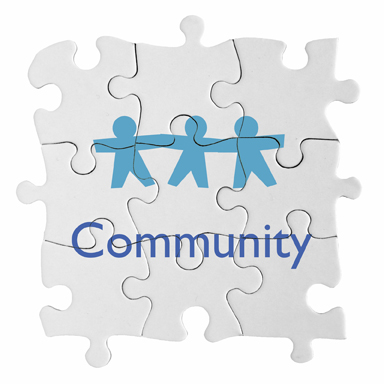
Com-mu-ni-ty.  My old college English dictionary defines the word as: “a social, religious, occupational, or other group sharing common characteristics or interests.”  Such a definition doesn’t really do much for me.  It certainly doesn’t stir anything in my heart.community three people

Biblical community is fellowship, partnership in the Gospel.  We are made to be in community because the triune God lives in and expresses itself through community.  However, as with the dictionary definition of community above, we struggle to see its actual importance to our day to day life.  Certainly, we can speak on biblical community and lead Bible studies in the value of community, but our practical experience of community may be somewhat limited or incomplete.

Bruce Milne, in his insightful work, We Belong Together, makes this statement in a section on the power of a loving community: “To love means to be vulnerable; it means accepting responsibility; it means giving ourselves away.”  Three short statements packed with meaning which demonstrate that biblical community calls for time, vulnerability and ‘one another-ing’ each other.

Starting in January 2014, we will begin a ‘global conversation’ about biblical community using a version of a white paper entitled: TC4u.  You’ll be hearing more about this working paper in the weeks ahead.

To start us thinking on the subject, consider this question: what elements are essential to a biblical transformational community?