• Our hope-filled future is bound up in sharing the story of Jesus, in discipling others, in bringing those disciples together into communities of believers, and in developing and releasing those believers to create other communities... till Jesus the King comes again!

Reset 2025

If we were to take a quick glance at what is happening in global missions, we would have to observe the growing presence of many more players, coming from everywhere and desiring to serve anywhere in the world.  

Rather than resources, initiatives, and missional ingenuity coming primarily from only one sector of the world, we can now identify numerous majority world and non-majority world agencies and organisations seeking to multiply disciples and communities of believers.

Lausanne 2024 organisers call this dynamic: a polycentric focus.

So, we would do well to push the ”reset’ button concerning our approach and engagement in what God is doing in the world.

Perhaps we might say that as a tangible demonstration of this polycentric focus, we (the WT community wherever we might be serving around the globe) pledge to serve as a “collective”.

In other words, we would commit ourselves to sharing more widely to learn of what God is doing in different places around the globe through multiple possible partners; to communicating more deeply the “we” of our community rather than the “me” so as to express the unity of Christ; to cooperating and collaborating more with one another and like-minded partners for greater expansion; and working together to provide all the resources needed around each initiative we would jointly hold as a collective.

That is our challenge for 2025! 

Five Coins

As I was heading my way to the gathering of WT Asia leaders this week, I remembered an article that I had read.  The basic gist of the article was that in many conversations with other colleagues, we tend to talk way more than we listen to the others in the room.  The author stressed that robust dialogue and discussion come when we give a majority of our time to listening as opposed to speaking.  Listening serves as the critical context for responding (speaking) well to others.

Now, we recognize that this principle is a basic biblical truth: “Know this, my beloved brothers (and sisters): let every person be quick to hear, slow to speak, slow to anger.”  (James 1.19)  I think the problem for many of us is that we know this truth, but we’re not sure the best way to actually practice it.  Oftentimes, we’ll try to practice this truth by talking to ourselves into being a better listener: “You know, David, in this next meeting, you need to just listen more and not talk so much.”  Then we get into that next meeting, and before we know it, we’re speaking up the bulk of the time!

Now there are certainly a number of possible applications, and we know that the only way we will become a better listener is by the working of grace in our hearts.  However, the author of the article I read suggested an idea that might provide some fuel for the Spirit in our ‘training’.

Here’s the author’s simple recommendation:  imagine walking into a conversation or discussion with five (5) coins in your hand. Each coin represents one time where you inject your thoughts into a conversation.  When the five coins have been ‘used’, your ‘microphone’ is turned off.

Now I’m not saying we should slavishly practice this idea, but I will say it causes you to think more carefully about the words you think are so important to share at each and every moment in a conversation.  It also pushes you to listen well and try to better understand what the other is really saying before speaking.

I’m hoping by the end of this week, I (and each of us) will have ‘made some progress’ in listening well and speaking with more wisdom … by using our five coins well.

What’s your method?

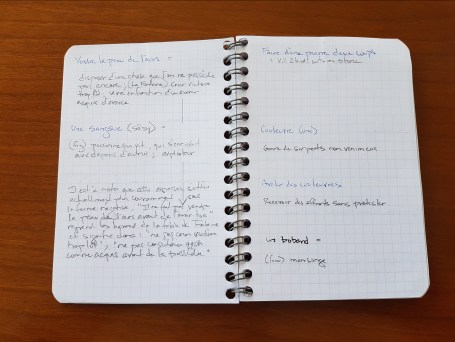
Truc’ is one of those all-purpose words in French.  It means a thing, an object, or just whatever it is you can’t think of the name for.  If you are at the hardware store and you’re looking at a piece of electrical equipment, but can’t remember the exact word in French, you can simply ask how this ‘truc’ works.

20180628_093648.jpgI have found it helpful to have a ‘truc’; some ‘thing’ that provides me a way to keep working on my language ability.  It’s a small notebook where I write down any new word or phrase that I hear, its definition and perhaps a simple example of how to use it in a conversation. The purpose of the little notebook is for me to keep learning so that there will be clarity in the Gospel message I share with French people.

It’s a method or technique that works for me.  It may not work for you.  However, you may have other ways, a ‘truc’ that has helped you in ongoing language learning. We would love to hear what that might be.

Watch your language

My mother used to tell my brothers and I, “Watch your language”, whenever a word thatWatch-your-language-1868661-ralphiesoap_super came out of our mouths that was not helpful or something said that would not build up others.  She didn’t primarily use that phrase because of bad language, but because of unhelpful or damaging language we were using.

When we live and minister among another people group other than our own, we need to ‘watch over our language’.  What I mean is we cannot accept a ‘global understanding’ of another’s language.  We should not settle for just passable language acquisition.

The apostle Paul writes in the context of our teaching and disciping: “For this I toil, struggling with all his energy that powerfully works within me” (Colossians 1:29).  We are to ‘work hard’ as an athlete does in all our efforts and work, including language acquisition.

When do not make this effort, we create a context where the Gospel message might be truncated; where our ‘language’ potentially ends up hindering the clear communication of the Gospel message in another cultural context.

Many of us have experienced a similar situation when we talk with someone from another culture who is trying to speak in our mother tongue.  If that person’s language skills are just okay, we find ourselves struggling to understand the real content of their ‘message’.  It feels like we are missing something, and we end up using reductionist language in order to continue the conversation.

Two principles should guide us as we seek to ‘communicate well’ with others.

First, remember that language acquisition is a lifelong project.  I still remember learning the word for ‘apple core’ while running with my teammate, David. He saw an apple core on the ground, turned to me and said “Do you know the word for that in French?”  I didn’t, but I learned it that day.  And I had already been in France for over seven years.

Second, regularly ask others for help.  If language acquisition is a lifelong project, then we should not slow down the learning process.  When your teammate, your national co-worker, or another friend encourages you to speak more in the national language, your language ability and your capacity to share the good news will grow and deepen.

Had any good conversations today?

A large portion of our work as cross cultural workers aconversationnd leaders consists in engaging people in conversation.  As I thought through my day today, I easily had over five significant conversations.

The question I am asking myself in light of all those conversations is: did I have any good conversations today?

When I say ‘good’, I’m asking myself if any of those ‘significant’ conversations built up another, brought hope back to someone, caused us as a ‘conversation’ group to move a project further along, allowed another ‘into’ my life  to hear my heart, or influenced a young believer in their walk with Christ.  That’s what I, we, should aspire to when ‘talking’ or conversing with others.

If we were honest, a number of our conversations are not ‘good’; not ‘good’ in the sense that there is no purpose or fruit from the time spent talking together. Sure, there are  times when our conversations are moments of jovial fun and laughter.  However, if the majority of our conversations consist of nothing more than lighthearted humor, we should probably ask more regularly: did I have any good conversations today?

Here are a few ideas to assess ourselves when we have a conversation in the next few days. Perhaps these might help us better see the import, the ‘good’ of our conversations:

  • If you were to summarize the conversation you just had in one sentence, what would you say?
  • How many questions did you ask, and how many questions did you answer?
  • If you were the other person in the conversation, how would you have felt when the conversation was over?

“… but only such as is good for building up, as fits the occasion, that it may give grace to those who hear.” 

Take your time

Last week, I shared a diagram about the different processes that team members might use to work through a decision (see the post: “Dig deeper”).  A question came to mind later: is it more biblical to take your time in making a decision?  In other words, are ‘quick’ decisions lesstake-the-time-fi well thought through or sustained by less prayer?

The answer is not a simple yes or no.  It is much more nuanced and shaped by the following elements:

Time

In any decision, we need to begin by asking the question as to how much time is needed to make the decision.  Deciding what restaurant to go to as a team for a team outing should not take a week of discussion.  However, deciding to change the strategy and direction of the ministry cannot be determined by an hour long discussion.  Establishing the time boundaries of any decision helps focus our energies towards making the right decision in the right time frame.

Opportunity

A decision may be motivated by a unique opportunity that presents itself to us.  This opportunity is time bound in some ways.  If we take an inordinate amount of time to process, it could mean that we would miss this divine opportunity.  However, an opportunity allows us to ask the question as to whether we should or should not respond to that opportunity.  The refugee crisis in Europe would be an example of such a divine opportunity that presented itself to many workers and teams in Europe.  Some of us ‘missed’ the opportunity, while others chose not to respond to the opportunity because it wasn’t where the Lord was leading them to invest their resources.

Heart Conviction

A decision, in our context, is always processed with prayer.  Prayer is a vital part of any decision making process.  However, when have we prayed enough to be able to move forward or make a decision?  Once again, this is not an easy question to answer. However, the question can call us back to our need to ‘go on’ in prayer for God’s wisdom and leading, if the heart conviction is not there. On the other hand, the question can also ferret out a spiritualized attempt to stall a discussion or decision.  This is where decision making can get ‘tricky’ as we need to listen well to others and seek to discern our heart convictions.

Decisions (made slowly or quickly) are an opportunity for God to work on our hearts and change us as we seek to ‘change the world’ around us.

Trust in the Lord with all your heart, and do not lean on your own understanding.  In all your ways acknowledge him, and he will make straight your paths.”  (Proverbs 3:5-6)