• Our hope-filled future is bound up in sharing the story of Jesus, in discipling others, in bringing those disciples together into communities of believers, and in developing and releasing those believers to create other communities... till Jesus the King comes again!

World Team Global Alliance (WTGA)

The first meeting of the new World Team Global Alliance will take place this week in Hong Kong. Several WT leaders and the WT-International board have been working diligently in preparation for this change. What will WT look like when WT-Hong Kong, WT-Philippines, and others eventually join as sending countries? How will we navigate the cultural, worldview and possibly even linguistic differences? Difficult questions, but necessary to answer if we are to truly become a global ministry with global perspective committed to a central focus and vision.

Recently the Toronto Star published an article about a petition that started in Bellingham, Washington, to have the local Costco store give specific shopping hours “for American citizens only”. There was much complaining about the number of Canadians crossing the border to shop at the local Costco, not leaving any parking spaces, or bargains for that matter, for Americans. Many international organizations and agencies are grappling with effects of a growing globalization. Becoming a “global” agency is not without some hiccups and bumps in the road.

As we move forward in developing as a global agency, country-of-origin issues will need to take a secondary role as we covenant together to move as one towards fulfilling our calling. Our unique cultural makeup will need to be exploited in a positive way that enables greater flexibility in recognizing and utilizing gifts and abilities, resources and experiences, which further our vision of multiplying communities of disciples among least evangelized people groups.  Learning from others will have a high value. We may do things differently than we did in the past and this is okay, even necessary.

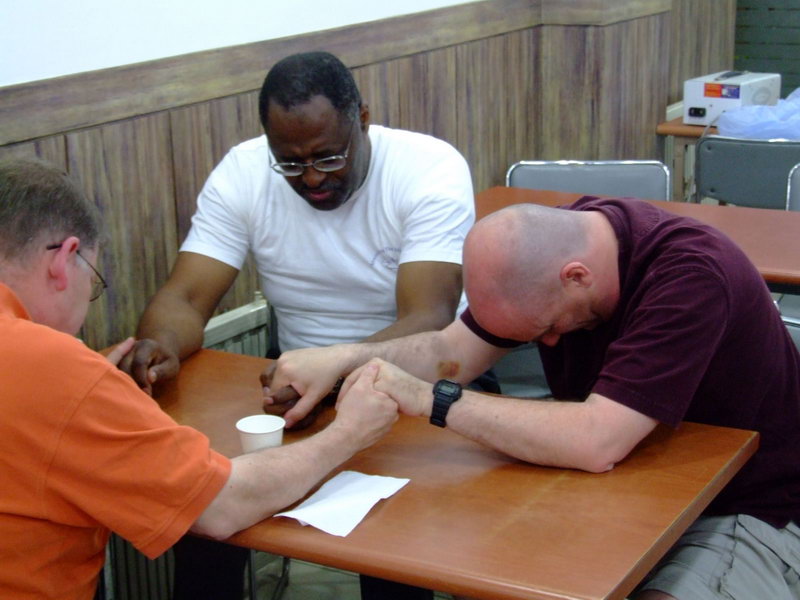
Please be in prayer for several meetings in Hong Kong, September 18-26; Sending Country Directors meet Sept.19-20, WTGA launches Sept. 22-23,  Area Directors & Sending Country Directors meet Sept. 21-25.  Please pray specifically for three things:


1.     Pray for unity. Pray that each participant, regardless of country of origin or nationality, would see others as brothers and sisters in Christ, – family. 

2.     Pray for vision to see the road ahead. The World Team Global Alliance is a radically new way of doing missions and in leading. Pray for boldness to move forward and humbleness to seek God’s face at all times. 

3.     Pray for the “hiccups”. Remember, our enemy does not want unity, peace and mutual respect. Pray for God’s protection from our adversary and from our own selfishness.


One little phrase

Sometimes when you’re reading an article, one little phrase seems to jump off the page at you. Such was the case when I read this little phrase recently in the International Bulletin of Missionary Research (Vol. 28, No. 3):  “I realized how few “traditional missionaries” are sent there by mission “agencies” (a horrible word, representing the disastrous shift from a closely bonded fellowship of fund-sharing teams to groups of independently-funded individuals for whom “agencies” are merely temporary flags of convenience.””  I felt the ‘sting’ of that comment and that criticism.

However, every criticism has elements of truth in it; otherwise it wouldn’t hurt so much.  That’s when I began to wonder how we as workers may have drifted from that ‘closely bonded fellowship’ to ‘independent subcontractors’, if you will.  In other words, have we become less of a ‘network of like-minded individuals’ and more of ‘convenient groups’ of workers who enjoy being with each other from time to time?

Kind of sobering to think that we may drifted more than we realize.  Let’s talk more in the coming days about why this might be the case, how it may have come about, and what we might do to restore an attitude of ‘bonded fellowship’.


Telling Stories

Joi wrote in response to my last post: “It seems that these principles enforce a certain ethos.  They describe a unique environment.  Could we find some stories that illustrate this?”  This is an excellent question.  Let me try to give an example or two, and hopefully this will encourage others to share.

Our first principle is to over communicate widely.  In launching the global mobilization project several years ago, we framed the plan from a ‘global’ perspective, thinking that all the resources could come from ‘global.’  What we quickly realized was that each ‘epicenter of mission’ needed to own the growing need for more workers and create the best processes for identifying, assessing, training and sending those workers to WT Global.  It was going to look different in each place, but each process could ultimately benefit everyone else and influence their process.  The breakthrough came when we launched the project through a month long prayer initiative with weekly biblical meditations written by workers from all over our WT community.

Our second principle is to have an open learning stance.  It may seem like an overly simplistic example, but we have for years talked about “strategic & tactical plans”, and then added in the idea of “project plans”.  These are terms that come from a US based approach to planning and there is nothing wrong with that.  When a worker joined my team from another cultural context, he found the terms confusing as they meant something completely different in his context.  He suggested that we start talking about three year plans (formerly ‘project plans’) and one year plans (formerly ‘strategic and tactical plans’).  It has been hard to change the vocabulary, but his suggestion has proved to be extremely helpful in approaching the planning process.

Our final principle is to seek to demonstrate humility.  It is always difficult to give an example of humility because the moment you do, it no longer is an example because you have now spotlighted the ‘humble’ person.  You know the person that comes to mind when you hear this principle.  Our desire is not to exalt this person, but to grasp anew how the Lord has worked out humility in their lives, and for us to then ask for the grace to live such a humble life.


Maybe you have some examples to share?  This would help all of us in this journey.

Central Office Calling (II)

Howard Brant writes: “God alone knows the exact numbers of workers coming out of the new initiatives.  What we can identify, however, is the epicenters of the largest movements.”  He then goes on to talk about Korea, China, Nigeria and other non Western countries that are sending out significant numbers of new workers to “participate in the Mission of God.”

One of the questions we raised in a previous post is how would new workers from such non Western countries join with the existing missions force?  What would common training look like across this multicultural work force?

A couple of principles come quickly to mind that should direct us in our mobilization and training.  A first principle would be to over communicate widely.  In the process of over communicating widely, we make people from many ‘epicenters of mission’ [other Support Centers, partners, other mission sending initiatives] aware of our own cultural expectations and assumptions as well as allow opportunity for these people to help us better frame our efforts in a more global manner.  A second principle would be to have an open learning stance.  An open learning stance means you see benefit in ideas and experiences shared from a variety of perspectives, different from your own, and that these ideas and experiences actually influence your own plans and strategies.  A final principle would be to seek to demonstrate humility.  The shift of the base of world Christianity to the southern hemisphere places many of us in a decreasing ‘power’ position.  We can no longer act as if we are the center, as if we are the ‘central office’ alone.  The Gospel drives us towards humility by the simple understanding of grace.  It should drive us to humility in  our relationships with this ever growing multicultural work force as we become one of many workers sent out into ‘the Mission of God’.

Navigating this shift can seem daunting. However, it is also thrilling to be part of God’s larger mission not only to gather people from all tribes, tongues and nations to His worshipping community , but also to send people from all tribes, tongues and nations out to reach others and invite them into His  worshipping community.


Central Office Calling

Yet arguably of greater significance, though certainly less widely acknowledged, is the enormous change in the demographics of Christianity worldwide.  Whereas in 1900 the majority of Christians were in Europe and North America, and Christianity was identified as a Western religion, today most Christians reside in the non-Western world, and Christianity is in decline in much of Europe.”  These are the opening lines from the collection of essays on belief and practice in an era of world Christianity entitled: Globalizing Theology

There is much that we could “mine” from these few lines, but one thought comes immediately to mind in light of the global shift we are experiencing.   The center from which our ministry emanates is changing.

When we look for resources [workers, funds, prayer, talents and other], where do we often turn?  We go to our ‘central’ or ‘home’ office.  What we learn from the global shift we are experiencing is that our ‘central’ office is no longer one specific Support Center.

Calling our ‘central office’ will mean connecting with Australia, Canada, US, European & Latin American partners and others who will join the larger World Team Global Alliance network.  Resources will be flowing from everywhere to everywhere.

Obviously, this shift raises lots of questions.  For example, what would be our common training across our community?  What would the support of workers from various locations look like and how would those funds be moved towards their support?   Navigating this shift, however, begins with a change in our own heart attitude as to how we see and approach the tremendous growth of the Church in the majority world.

Collaboration or what?

A little over two years ago, we as a World Team community launched a mobilization effort to increase the number of workers in cross cultural ministry by five to seven percent.  This is a laudable goal; an objective that requires we work together and respond corporately to this challenge.

One on-line author [http://blogs.hbr.org/ashkenas/2011/05/when-teams-only-think-they-col.html] describes three possible ways for teams to respond in such a situation.

One approach is compliance. This is where each individual independently responds to the challenge.   Now there is nothing wrong with this approach as it works to spread the burden across a large number of people.  However, working together is not a natural outcome of compliance.  In fact, people could comply without even talking with others.

A second approach is cooperation.  This is where individuals work on a response to the need, but share their ideas with others.  In spite of the sharing, though, the ultimate focus is still on individual efforts and not on a collective response.

A third approach is collaboration.  This is where the effort from the start is focused on the larger group rather than the individual.  How the group can discuss and work together towards a collective response becomes the objective.  There may be a sharing of resources across groups or areas in order to better respond to the challenge.

The on-line author (see link above) summarizes this way: “What’s interesting is that teams do not consciously decide not to collaborate.  Instead they do what comes naturally; which is to work either completely or partially on their own.  The reality is that true collaboration is difficult and time consuming.  It requires subordinating individual goals to collective achievement.”

To achieve our mobilization challenge, it is collaboration that we need.