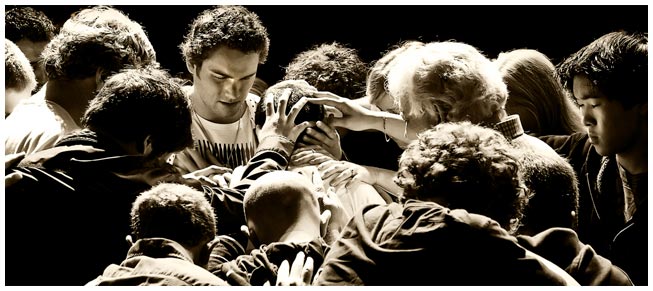
• Our hope-filled future is bound up in sharing the story of Jesus, in discipling others, in bringing those disciples together into communities of believers, and in developing and releasing those believers to create other communities... till Jesus the King comes again!

Mission11 Europe Update[1]

The conference started yesterday.  Here are just a few short impressions of the time together so far:

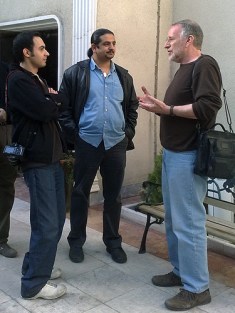
  • Sixty participants including our US Sending Country Director and board members from WT International and WT UK.
  • Each day begins with a significant time of prayer for one of the other Areas of World Team.  Today, the workers here prayed for the Americas.
  • Joi walked participants through the CPM Roadmap, giving them opportunity to consider implications of parts of the Roadmap for their teams.
  • Dick, the main speaker, began talking about “Discipleship that leads to transformation.”  He stressed how “transformation always occurs through community,” and the need for people to have others involved and
    investing in their lives.  You can check out some of his writings at: http://www.dickscoggins.com/


More later …


Talk with me

Sometimes when I look at our WT community, I see a multicultural network of workers driven by the same purpose and vision.  Sometimes though, when I look at our WT community, I see an innumerable series of silos or towers that are all located on the same paddock, but have no connectedness one to another.

Living and ministering out of a silo mentality can foster all sorts of troubles, not the least of which is a critical spirit.  When you can see nothing but what surrounds your own silo, it is quite easy to question or criticize what others are doing, even when they belong to the same community as you.

Verses such as Ephesians 4:29 can become lost to practical application when we choose to live disconnected from the larger community: “Let no corrupting talk come out of your mouths, but only such as is good for building up, as fits the occasion, that it may give grace to those who hear.”

Phrases such as “Well, he just decided that without asking us,” or “There’s no use sharing what I think because she doesn’t listen to me anyway” are nothing less than gossip, the evidence of a critical spirit.  True heart change will require more than just a renewed emphasis on community. Something will have to ‘displace’ that critical spirit.

Several hundred years ago, Jonathan Edwards wrote this: “For as long as a man or woman is not emptied of himself/herself and of his/her own righteousness and goodness, he/she will have a legal spirit.”  The only remedy is if God and His amazing grace and free righteousness ‘displace’ me out of the center of my life.  Only then can I truly begin to live as part of an interconnected community.

Maybe you need to ‘pick up the phone’ and talk with the Father about your heart, and as a natural outflow, pick up the phone and talk with someone with whom you are struggling with, or of whom you have spoken poorly.


Needing Others

“When God chooses to bring us to Himself (Ephesians 1:4), He brings us into community.  We are not brought into relationship with Him to simply remain alone in our own room to live out our faith by ourselves.    We are called to be part of a community; the people of God who belong to Him.  Our life in Him is understood and lived out in community with others.” This is my free translation of quote from an article by Paul Wells, professor of systematic theology at a seminary in southern France.

A worker needs to constantly have a learning posture.  We never reach the end of what we need to know or learn as it relates to our life and our work.  Over the past month, I found myself submerged by a host of details and activities that I needed to do. A good friend was gracious enough to point out that I was failing to delegate to others work that they could share and accomplish in more fruitful and timely ways.  I was not living out my life in Him in community.

Delegation means we entrust someone else with work that we believe we should do.  Yet delegation is a means to develop others and further the resources available to carry out God’s mission.  Delegation is not ‘just getting stuff off of one’s plate.’  Delegation is an expression of living out one’s life in God in community, and includes several elements:

  • Define the task – Confirm in your own mind that the task is suitable to be delegated.
  • Select the individual or team – What are your reasons for delegating to this person or team? What are they going to get out of it? What are you going to get out of it?
  • Assess ability and training needs – Is the other person or team of people capable of doing the task? Do they understand what needs to be done.
  • State required results – What must be achieved? Clarify understanding by getting feedback from the other person.
  • Support and communicate
  • Feedback on results – It is essential to let the person know how they are doing, and whether they have achieved their
    aims.

“Even as he chose us in him before the
foundation of the world, that we should be holy and blameless before him
.”

(Ephesians 1:4)

Urgent Need for Church Planters Revisited

I think it is worth sharing a rather lengthy quote from the book, Global Church Planting, to underscore again what we were talking about in Tuesday’s post.  This comes from a section titled: “New Coworkers Recruited from the Church Plants Expand the Missionary Force”:

“One of the most noteworthy features of Paul’s mission was his recruitment of coworkers from the various churches he planted.  He recruits from the harvest for the next harvest.  “The majority of Paul’s coworkers came from the new churches that he had established .… The ‘home churches’ of these workers acknowledge that they share in the responsibility for the expansion of the kingdom of God by providing missionary workers who help Paul” (Schnabel 2008, 255).  Though Paul’s initial church-planting teams were sent out from Syrian Antioch and were composed of Jewish background believers, he did not look to Antioch alone for new missionary recruits.  Rather he recruited them from the churches he had planted, and the coworkers were increasingly of Gentile, not Jewish, origin (Ollrog 1979, 62).  For example, about three years after the estimated time of Timothy’s conversion in Lystra on the first missionary journey (Acts 14) Paul took him on as a missionary apprentice (Acts 16:1-3).  Soon after that Timothy began working semi-independently of Paul in Thessalonica (Acts 17:14; 1 Thess. 3:1-5), Macedonia (Acts 19:22), Corinth (1 Cor 4:17), Philippi (Phil. 2:19), and Ephesus (1 Time. 3:14-15)”

What made this quote ‘come alive’ for me was when one of the leaders from the French church we attend approached me last week and said that the church should consider ways to send ‘workers’ to work with us.  This is a church that WT had a major part in establishing.

We need to be recruiting from the harvest for the next harvest.

Urgent Need for Church Planters

For the past year, we have been talking about the “crisis opportunity” we are facing in terms of our need for new workers.  We all recognize that there is an urgent need for more workers to multiply disciples and communities of believers.  Ask anyone of our teams and they will tell you that their number one need is for more people to participate in ministry.

Normally, we look to see this need fulfilled by workers coming from one of our Sending Countries: Australia, Canada or the US.  However, while recently reading through the book, Global Church Planting, I was reminded of a mobilization hub that I had been overlooking, that is, the very community of believers we are involved in establishing.  We often hear that “the resources are in the harvest”, but I don’t think I had ever fully made the connection between our need and the possibility of that need being fulfilled by some in our actual church plants.

If discipling is at the heart of what we do, it must include seeking to develop a heart for the world in those we are discipling.  These disciples would then in turn train
others to have this same attitude, this same heart for the world.

So praying to the Lord of the harvest to send out more workers means seeing workers mobilized from Australia, Canada and the US as well as from the very communities of believers we are establishing.

GQV Save

I have uploaded the Global QuickVIEW document to this TATJ blog post.  You can simply right click on the file below and save it to your reading.

Global QuickVIEW June 2011b

This document is the fruit of a working group that I put together in early January 2011.

As you read this document, reflect on these questions:

  • Which trend(s) are you recognizing the most already in ministry?
  • Which cited trend catches you most unaware…or perhaps you are doubtful of?
  • Which trends do you believe will more directly impact church planting?
  • For which trends is WT currently least prepared?    …best prepared?

In conjunction with reading the Global QuickVIEW, I would encourage you to listen to an audio interview with Fritz Kling, author of The Meeting of the Waters, at http://www.themissionexchange.org/media/leadersInterview/kling.mp3