• Our hope-filled future is bound up in sharing the story of Jesus, in discipling others, in bringing those disciples together into communities of believers, and in developing and releasing those believers to create other communities... till Jesus the King comes again!

Global Leader Gathering Recap

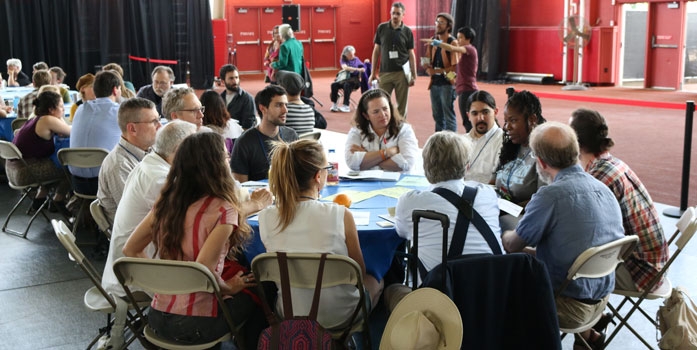
Earlier this month, we held Global Leader Gatherings to assess our current ministry progress and discuss global ministry priorities for the coming year.  These meetings were held virtually, and as a result were able to invite a number of others to join in our discussions. We are grateful for all of those who took the time to participate, make presentations and join in discussion together.
Let me highlight four main “take-aways” from this time. [If you would like more information and detail, I would encourage you to connect directly with your Area Director.]

First take-away: the WT Ministry Framework is “one of the best things we have going in WT”.  This was the thought that one of the participants shared.  The Framework summarizes well, and in one graphic, who we are and what we do.  Pat (WT Asia) led us through a “WT Framework Assessment” where we considered how we could use the Framework to assess ministry progress, our relationships, our team culture, and even how we might use the Framework to mobilise others to cross cultural ministry.

Second take-away: our critical areas for growth are setting priorities and mobilisation.  It is never easy to prioritise, but without prioritization our efforts will become greatly dispersed and have limited fruit.  Time was spent identifying our global ministry priorities for the coming years.  “500 in 5” was the mobilisation challenge we launched several years ago to respond to our people resource needs for several new global ministry projects.  Our goal was clearly not reached.  The question we were left with (and which we will be asking many of you in the coming days) was: What could we do together in the future to discover the people resources we need to launch these new global ministry projects?

Third take-away: life-long learning is more than just a nice sounding phrase.  We spent the final day of our Global Leader Gatherings in two different workshops.  One on design thinking and the other on situational leadership.  Each of us needs regular retooling in ministry skills and further growth in character. If you would like more information on either of these workshops, contact myself, your AD or one of the people from your Area that participated in these meetings.  We would be happy to share with you the material presented.

Fourth take-away: we have an incredible group of people working with us.  I was amazed by the quality of the presentations, the depth of the discussions, and the gospel attitude of wanting to serve the larger community in any way one could. 

Scott, Jeanne, Sam, Meagan, Tom, Chris, Dan, Ryan … and I know there were many other ‘new faces’ … thank youThank you for participating and serving your team, your Area and the larger WT Global community in this way.

A huge thanks to many of you who prayed with us during these days!

The ministry of incarnational living

Recently, I listed these four (4) possible applications for an incarnational lifestyle for us as cross-cultural workers.

  • We invest significant time in understanding the local culture in which we live and work at mastering the heart language of the people we serve.
  • Disciples and communities are trained to critically contextualize the gospel in a way that preserves the integrity of the gospel as it engages one’s local context.
  • We are not satisfied until we see the gospel multiplied by disciples making disciples, and communities multiplying themselves in other communities.
  • We are not the centre nor the ultimate motor of all this work.

Then I read the following in the prayer update of our one of our fellow WT workers and smiled at the thought that they mentioned, in some way or another, the four (4) possible applications above … as well as one or two others.  We do learn from one another!

Here is what they wrote:

The ministry of language learning?  Moving to the city has allowed us to use language a lot – which means we have a lot of embarrassing moments and some great stories!

But amidst our studies we are recognizing that there is ministry even in language learning. Crossing cultures means you enter into a world where you can barely communicate basic needs at times – much less navigate cultural cues. The things that give us confidence, identity, importance, or even just predictable stability are thrown out the window.

Anyone who has ever attempted to live in a context not their own can relate. Yet God is using the very stretching, awkward journey of learning language and culture to prepare our hearts and minds for the ministry ahead. The language skills and cultural understanding that we gain in this season will have a profound impact on how we serve others in the future.

But just as significant is the emptying (Phil 2) that we are experiencing in the process. Only when we are empty can Christ flow through us; only when we are weak is His strength perfected in us (2 Cor 12:7-10).”

What do we long for?

In our work as cross-cultural church planters, we are committed to being “incarnational”.  This is one of our guiding principles as World Team workers, and can be found in the WT Ministry Framework.

We describe what it means to be incarnational in this way: “As cross-cultural workers, we intentionally surrender our rights to our home culture, language, and ways and embrace those of the host culture. By this, we seek to model Christ, who emptied himself of the privileges and powers of divinity, taking on human form, in order to carry out his mission.”

How does this biblical principle, exemplified by Jesus Christ, work itself out in our daily life and ministry?  What is its relevance and impact?

There are at least four (4) applications of an incarnational lifestyle for us as cross-cultural workers.

  • We invest significant time in understanding the local culture in which we live and work at mastering the heart language of the people we serve.
  • Disciples and communities are trained to critically contextualize the gospel in a way that preserves the integrity of the gospel as it engages one’s local context.
  • We are not satisfied until we see the gospel multiplied by disciples making disciples, and communities multiplying themselves in other communities.
  • We are not the centre nor the ultimate motor of all this work.

In my recent reading, I ran across this quote: “… missionaries tend to be self-sufficient. It’s hard for the to be needy.  But not to receive from others make them look superior.”   The writer was speaking of a specific group of missionaries, but I think it applies to all of us in general.  None of the applications above could take root in our lives if we are not dependent on God for His grace and strength to learn one more phrase today in Tagalog, Khmer, Spanish or Portuguese.  None of the applications above could produce any fruit if we are not dependent on those we serve to carry the work of the gospel forward in their culture and context.

So, which one of the four applications is the hardest for you?  What small step might you take today to begin to work that application into your life and ministry this week?

A Joyous Celebration of the Resurrection!

May this hymn of Isaac Watts refresh our hearts in the truth of Christ’s death and resurrection. He is risen!

Alas!  And did my Saviour bleed,

And did my Sovereign die!

Would he devote that sacred head

For such a worm as I!

Was it for crimes that I had done

He groaned upon the tree!

Amazing pity!  Grace unknown!

And love beyond degree!

Well might the sun in darkness hide,

And shut his glories in,

When Christ, the mighty Maker, died

For man the creature’s sin.

Thus might I hide my blushing face

While his dear cross appears;

Dissolve my heart in thankfulness,

And melt mine eyes in tears.

But drops of grief can ne’er repay

The debt of love I owe;

Here, Lord, I give myself away,

‘Tis all that I can do.

We live in community

In Philippians 2, we read these words: “Do all things without grumbling or disputing, that you may be blameless and innocent, children of God without blemish in the midst of a crooked and twisted generation, among whom you shine as lights in the world.” 

It’s a description of what transformed relationships within the community of Christ should look like, and what they should not look like.  It’s a picture of how the Gospel works itself out in practical ways in our community with one another.

Grumbling, murmuring or disputing are not to be characteristics of our relationships with one another. It’s what got the people of Israel in numerous difficulties, undermining their witness to the surrounding peoples and nations. 

We might contextualize grumbling, murmuring and disputing today as disagreeing constantly, seeking to be right in any discussion, or just plain ornery with others.

What strikes one in this text is that the apostle Paul tells only us the negative elements to put off.  Paul implies that by putting off, we would recognize, in Christ, what needs to be put on.

That pushes us a bit deeper to consider what is really at the root of grumbling, murmuring and disputing.  The biblical writers put their fingers on one of two possibilities: pride or unbelief.  It’s either our desire to be the master of our destiny as well as that of others or it’s our inability, our lack of assurance in God’s love for us, despite what often drives us.

One writer put it this way: “We cannot present a reason for Christ to finally close off his heart to his own sheep.  No such reason exists.  Every human friend has a limit.  If we offend enough, if the relationship gets damaged enough, if we betray enough times, we are cast out. The walls go up. With Christ, our sins and weaknesses are the very resumé items that qualify us to approach him.  Nothing but coming to him is required – first at conversion and a thousand times thereafter until we are with him upon death.

As Christ works in our hearts through the Gospel, we should become more and more sensitive to the impact of our words on others.  He will open our eyes for us to see more clearly the needs of others and how we, by our words and actions, can minister to other members of the community.

The one guiding principle to rule them all

Our World Team Ministry Framework outlines six (6) guiding principles which define how we go about our work; what is it that motivates us to multiply disciples and communities of believers.  The six (6) guiding principles are: the Gospel, prayer, facilitation, teams, holistic and incarnational.

Often I find myself thinking about and speaking of these guiding principles as if they are all of equal value.  In one sense, they need to be as they tell us what drives us in the work God has called us to do.  However, as I continue to daily reflect on the Gospel, I become more convinced that there is one guiding principle from which all the others flow out or are subsets of the one guiding principle.  I am more and more persuaded that there is one guiding principle to rule them all.

All of who we are and what we do arises from one central truth: we are accepted in Christ.  We are not our own, we belong to Him, and find ourselves now cherished members of His family.

This one guiding principle stands apart from all the others.  It is the foundation to which we hold and to which we must return each and every day.

Richard Lovelace put it best when he wrote: “Few know enough to start each day with a thoroughgoing stand upon Luther’s platform: you are accepted, looking outward in faith and claiming the wholly alien righteousness of Christ as the only ground for acceptance, relaxing in the quality of trust which will produce increasing sanctification as faith is active in love and gratitude.  In order for a pure and lasting work of spiritual renewal to take place with the church, multitudes within it must be led to build their lives on this foundation.

In order to give ourselves to prayer, facilitation, working in teams, serving in holistic ways and living incarnationally, we must soak our hearts in the words of the Gospel: “this is my beloved child, in whom I am well pleased.”

I know that the analogy with the Lord of the Rings does not work well (the final ring of Mordor needing to be cast into the river of fire of Mordor), but Jesus Christ experienced the wrath and judgment of God in our place, so that we might be able to cry out: Abba Father; so that we might be able live and serve as an expression of our gratitude and thankfulness for His grace-full gift.

A question for each of us to consider: what aspect of the Gospel are you most needing to hear today, and that would strengthen your heart to live for Jesus?