• Our hope-filled future is bound up in sharing the story of Jesus, in discipling others, in bringing those disciples together into communities of believers, and in developing and releasing those believers to create other communities... till Jesus the King comes again!

the Rest

I read Keller’s comment in chapter four, “the Rest” where he says that the rest Jesus calls us to is more than just taking time off from work, that “there’s another level of rest, a deeper level,” and I immediately thought of the hymn: Jesus I am resting, resting.  You know how the verse goes.  It starts off: “Jesus, I am resting, resting in the joy of what Thou art. I am finding out the greatness of Thy loving heart. Thou hast bid me gaze upon Thee, and Thy beauty fills my soul, for, by Thy transforming power, Thou hast made me whole.”

Honestly though, on a day when things aren’t going so well, when the overload light comes on in red, it’s tough to find and experience that “rest”.

So where’s the source of our problem?  Tim Keller describes it this way: “Most of us work and work trying to prove ourselves, to convince God, others, and ourselves that we’re good people.  That work is never over unless we rest in the gospel.”  Basically we run ourselves into the ground trying to gain approval from someone else, be it God, our spouse, our colleagues or our friends.  Like a hamster turning around and around on its little wheel, we never come to the end of that self centered effort.

Experiencing anew real “rest” comes when a greater treasure displaces our constant search for acceptance from others.  “On the cross Jesus was saying of the work underneath your work – the thing that makes you truly weary, this need to prove yourself because who you are and what you do are never good enough – that it is finished.  He has lived the life you should have lived, he has died the death you should have died.  If you rely on Jesus’s finished work, you know that God is satisfied with you.  You can be satisfied with life.”

Going deep in thinking about, reflecting on and grasping further the message and meaning of the cross is the constant starting point on the journey towards the rest about which Jesus talks.  It is definitely not easy, and is certainly not my first reflex, but it is the path towards real rest.

Oh, how great Thy loving kindness,
Vaster, broader than the sea:
Oh, how marvelous Thy goodness,
Lavished all on me!
Yes, I rest in Thee, Beloved,
Know what wealth of grace is Thine,
Know Thy certainty of promise,
And have made it mine.

Where do you struggle most in learning how to rest in the finished work of Christ and accepting that God is satisfied with you?  Are there others in your life who help you go deep in reflecting on and thinking about the message and meaning of the cross?  What one step could you take in the coming days to help you truly rest in Jesus?

the Healing

Today’s post comes from Mark in Hong Kong.

When I was a young boy I shared a room with my brother. And every night just after we climbed into bed my mother would walk in the room with a soft smile carrying a children’s picture Bible under her arm. The book was thick and heavy, and by then well worn. And inside all of the great stories of the Scriptures were animated by colorful drawings. Every night one of us got to pick a story. My mother would read it to us, while we looked at the picture, and then we would sing a hymn together before the lights went out on that day.

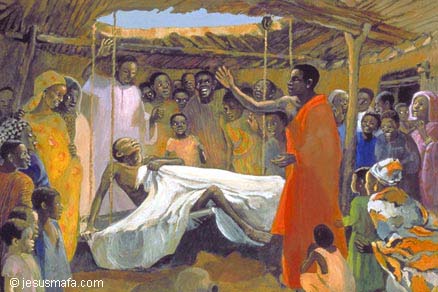
And my favorite story from that big picture Bible is the one our author, Tim Keller, re-tells for us in chapter three of The King’s Cross. It’s the story of the paralytic man being lowered through the roof by his friends (Mark 2). More than 30 years later I have never forgotten that story, most likely because I have never forgotten the picture that went with it. The open roof, the man being lowered by rope, the friends who went to great lengths to get him help, and then Jesus standing on the ground, looking up from the crowds as the paralytic was hoisted downward on his mat. Captivating.

Keller uses this story to expose what he calls our “much bigger problem” – that is the problem of sin. And he does so picking up on Jesus’ initial response to the man who has been lowered before the crowd. Jesus starts, “Son, your sins are forgiven.” That’s not what the man came for, and it startles the crowd. Certainly Jesus is merciful to the man’s physical affliction. He heals him of his paralysis and the man walks away. But he has walked away with something far more beneficial – the forgiveness of sins.

Hearing this story as a kid I focused on the healing, not the forgiveness. And I might be tempted to stay there now, except that I agree with Keller. I’ve got a real jim-dandy of a dilemma, a big nasty problem called sin. Those of you who work with me know it’s real. True, I had this sin problem back during the bedtime Bible stories, but I didn’t realize it was going to get this bad.

So I found myself grateful that very early in The King’s Cross pastor Keller identifies my real problem. Actually, he really doesn’t have a choice. It is not possible to write about Jesus and his cross without writing about sin as our biggest problem. But he pushes us further. Tapping into C.S. Lewis, as pastors are prone to do, Keller wrestles with this Biblical passage in light of a Lewis story and gives us another phrase – “not deep enough.” And he recommends this: Jesus will cut deep in dealing with our sin. He will pull back the scales. As he did with the paralytic he will identify our bigger problem and then he will go deep enough to provide the core healing that is needed.


As we reflect on this chapter, intentionally think about this:

1. What is the biggest, darkest, deepest sin you have?

2. Are you willing for Jesus to cut deep – painfully deep – to remove it?

3. Will you sincerely invite him to do so today?

the Call

Today’s post comes from Lynette in Cambodia.

When considering “the call”, most of us immediately go to salvation; as important as salvation is, Jesus had an even deeper call.  Remember the purpose of the book is to see how we fit by looking at Jesus.  We fit because of “the call”!  Using the metaphor from last week, the only way we can enter the dance is if we are invited in, without the call we only sense that we should be dancing, which in my opinion is the reason for so many religions in the world.  Keller points out that Jesus’ first words recorded in the Gospel according to Mark contain the phrase, “Repent and believe the good news.” The words “Good news” , same word as “gospel”, in this day and age has religious connotations, but during the time of Jesus, they did not. During the time of the writing of Mark, “A gospel [was] an announcement of something that has happened in history, something that’s been done for you that changes your status forever.”  That statement caused me to catch my breath! There has been a lot of talk in mission circles about our purpose statement, individually and corporately.  It seems that Mark allowed Jesus to speak His own purpose statement. He came so that we could have the opportunity for Him to change our status forever!  WOW!

Last week, we considered how self-centeredness keeps us from “joining in the dance” with God.  Self-centeredness, as depicted by Keller in chapter 2, also “destroys relationships” and leaves us very “static” people.  What a miserable way to be!  Going back to the very beginning we see in Genesis that “we were created to live in a world where relationships were whole-psychologically and socially perfect-because God was the King.” You know the story, we chose to be our own king thus we live in a broken world with broken relationships.  Left to ourselves, we continue in our brokenness. This is the reason His call is so significant, He is calling us from a self-centered, self-destructive life by calling us into a whole relationship which require sole devotion to Himself, so much so that “all other attachments in [our] lives look like hate compared to Him.” Jesus cannot and will not accept moderation, His call is for complete devotion, “He must be the goal”.

It is interesting how various people during Jesus’ earthly ministry reacted to Him, we see in the selection of Scripture in Mark for this chapter that “The people were amazed at His teaching because He spoke as one who had authority”.  Keller eloquently points out that Jesus’ listeners “sensed somehow that He was explaining the story of their lives as the author” and they were amazed, they were left speechless.  You see, this call we have was made by the author of our lives.  I know we all know that, but sometimes I just forget the impact of that statement on my life and ministry.  Too many times I slowly revert back to that self-centered life that I was called out of.  We have each been called into His story, He IS the author and finisher of our salvation.

Do we, as called-out ones, live like this good news has truly changed our status forever?  Jesus’ call has been the same the whole time, so do we live like Jesus is the goal? Like He is the author?  How would our lives, teams and ministries look different if we truly allowed Jesus to be what He is, the author, the goal?

the Dance

Today’s post comes from Kevin in the US office.

The first chapter of the King’s Cross, “The Dance”, is really about identity.  Jesus is referred to as “the Christ” and the “Son of God” in the first part of the Gospel of Mark, and Keller’s develops this further.  But he connects the Trinity’s love and submission to a “dance.”

Dancing.  Ugh.  I.  Don’t.  Dance.

I know dance is a metaphor used by CS Lewis and others, but it’s a tough one for me.  I just don’t get dancing.  I once saw the play “Cats” in London, and that set back my appreciation of dance even further.  I didn’t know what they were doing or were trying to communicate.   I just don’t understand dancing, and part of that is because I can’t do it.  There is nothing in me that screams–or even whispers–dance.   If there was a dance contest, and the contestants were me, a crazed elephant, and a piece of furniture, I’d come in third.  Not even close.

But this dance Keller is talking about is reality–the “really” real.  This reality is God Himself.  He’s completely unified, He’s totally self-sustained, and He’s resoundingly happy and content in Himself.  And this triune God, in love and service to each of the Godhead, can dance together in joy and complete harmony.

Matt Chandler’s new book Explicit Gospel really develops the God-centeredness of the Gospel as he reminds us of God’s self-sufficiency: “I’m not served by human hands as though I need anything” (Acts 17:25).  He created us for His glory.  His identity is in Himself.  Our identity should be in Him.

Did you get that?!  We were created to join Him!  The God of all creation, Who is thoroughly content in His Own identity, is reaching out to us–to me!–to join in this dance.

The challenge is for my self-absorbed brain to break away from my selfishness long enough to see and understand His love.  When things don’t go my way here on earth, I’m prone to ask the me-focused question, “Why me?!”  My identity somehow drifts into me, my circumstances, my dreams, etc.  However, if I really understand God, and if I’m truly amazed by Who He is and what He has done, then I would live a life full of devotion, focused on Him.  I’m asked to join Him in this dance, ignore my inhibitions and ignorance, and humbly ask, as I dance with my Savior, “Why me?!”  I don’t deserve the opportunity to join in the dance, but that’s just it.  It’s all about Him inviting me, not what I deserve.

It’s really about identity–what His is, and what mine should be.  He’s already dancing, and somehow I can awkwardly join Him.  Amazing.

reflection question: how does self centered talk or living keep you from ‘joining in the dance’ with God?

Join Us

Join us each Monday for the next few months as we read and discuss together Tim Keller’s book, King’s Cross.

Each week a different member of the WT community will be writing a post about a chapter. A question will be included to help us interact further throughout the week.

Join us this coming Monday, May 7th, when we will be looking at chapter 1: “The Dance” (pages 3-13 in my copy). 

Let forward to you talking with you!

Collaboration or what?

A little over two years ago, we as a World Team community launched a mobilization effort to increase the number of workers in cross cultural ministry by five to seven percent.  This is a laudable goal; an objective that requires we work together and respond corporately to this challenge.

One on-line author [http://blogs.hbr.org/ashkenas/2011/05/when-teams-only-think-they-col.html] describes three possible ways for teams to respond in such a situation.

One approach is compliance. This is where each individual independently responds to the challenge.   Now there is nothing wrong with this approach as it works to spread the burden across a large number of people.  However, working together is not a natural outcome of compliance.  In fact, people could comply without even talking with others.

A second approach is cooperation.  This is where individuals work on a response to the need, but share their ideas with others.  In spite of the sharing, though, the ultimate focus is still on individual efforts and not on a collective response.

A third approach is collaboration.  This is where the effort from the start is focused on the larger group rather than the individual.  How the group can discuss and work together towards a collective response becomes the objective.  There may be a sharing of resources across groups or areas in order to better respond to the challenge.

The on-line author (see link above) summarizes this way: “What’s interesting is that teams do not consciously decide not to collaborate.  Instead they do what comes naturally; which is to work either completely or partially on their own.  The reality is that true collaboration is difficult and time consuming.  It requires subordinating individual goals to collective achievement.”

To achieve our mobilization challenge, it is collaboration that we need.