• Our hope-filled future is bound up in sharing the story of Jesus, in discipling others, in bringing those disciples together into communities of believers, and in developing and releasing those believers to create other communities... till Jesus the King comes again!

Com-mu-ni-ty

Com-mu-ni-ty.  My old college English dictionary defines the word as: “a social, religious, occupational, or other group sharing common characteristics or interests.”  Such a definition doesn’t really do much for me.  It certainly doesn’t stir anything in my heart.community three people

Biblical community is fellowship, partnership in the Gospel.  We are made to be in community because the triune God lives in and expresses itself through community.  However, as with the dictionary definition of community above, we struggle to see its actual importance to our day to day life.  Certainly, we can speak on biblical community and lead Bible studies in the value of community, but our practical experience of community may be somewhat limited or incomplete.

Bruce Milne, in his insightful work, We Belong Together, makes this statement in a section on the power of a loving community: “To love means to be vulnerable; it means accepting responsibility; it means giving ourselves away.”  Three short statements packed with meaning which demonstrate that biblical community calls for time, vulnerability and ‘one another-ing’ each other.

Starting in January 2014, we will begin a ‘global conversation’ about biblical community using a version of a white paper entitled: TC4u.  You’ll be hearing more about this working paper in the weeks ahead.

To start us thinking on the subject, consider this question: what elements are essential to a biblical transformational community?


It’s all about context

Sometimes people will say to me: “Didn’t you notice that my sweater was inside out?”  Or: “Didn’t you see the look on Dan’s face when you made that comment about their team’s strategy?” insideoutv2b

It’s all about context.  However, there are times when I am simply not ‘aware’ of what is going on or how I am being received by others. I can certainly be fully ‘aware’ when the context turns around my agenda or my ideas. However, I have a more difficult time listening and grasping the context that others are painting.

I don’t think I am alone in this because independence rather than interdependence runs deep in our hearts.  We may be strong in spiritual intelligence and yet extremely weak in ‘emotional intelligence’.  Put another way, we can be strong in our grasp of biblical principles, but stumble when it comes to knowing the impact that our words, actions and decisions can have on others.

It is not easy to become more self-aware. It’s actually something that can only be done in community.  We are incapable of stepping outside our own skin and assessing how we are coming off to others.  I need others to tell me, to engage me in this conversation so that I can serve others better.  We need others to tell us, to engage us in this conversation so that we can serve one another better.

Do you have such people speaking into your life?  What keeps you from asking?


It only takes a few

loadgame_tippingpoint_logoInnovation, the act of bringing creative ideas to life, is one of the pillars of our global vision.  I would love to see groups of WT workers contextualizing innovative approaches to discipling others in Christ.  If a fire could be lit to stir all of us towards innovative, entrepreneurial approaches, just imagine what fruit might be born.

However, trying to move a whole community in this direction at once is tough.  It really only takes a few, who are ‘full on’ in that direction, to inspire and enthuse the rest of us.

Malcolm Gladwell in his classic work, The Tipping Point, relates one of many scenarios where dramatic change was observed: “What happened is that the small number of people in the small number of situations in which the police or the new social forces had some impact started behaving very differently, and that behavior somehow spread …

Just a few ‘started behaving very differently’ and others were influenced.  A biblical example would be found in Acts 11 where a few started behaving differently by sharing the Gospel with Greek speaking Jews.  They stepped out of their then known cultural context of sharing Christ only with their people to go to a different people group.

We need to give space to ‘a few’ to inspire and motivate us towards more innovative, risk filled ministry.  We need to pray, support and facilitate ‘a few’ so that we can learn from them and be influenced by them.

Maybe you are one of the ‘few’?  Maybe you are one those willing to pray and facilitate ‘the few’?

Innovative teams mean ‘we’ work together

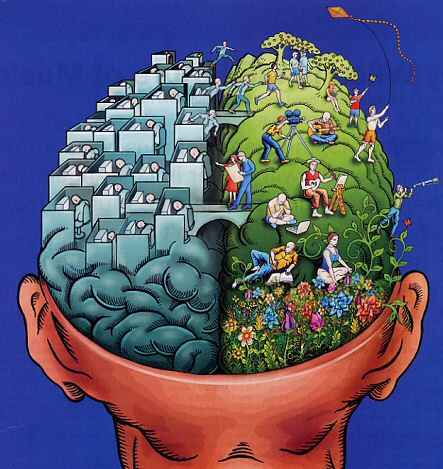
Innovative, creative types are usually right brain people.  At least that is what we have been telling each other for years.  The thinking is that if we are to get innovative, entrepreneurial approaches going in our agency, we need to bring in more right brain people, more “creative” types.left-brain-right-brain

In a recent scientific article, “The Real Neuroscience of Creativity,” this long held idea is challenged.

Scott Kaufman states: “The latest findings from the real neuroscience of creativity suggest that right brain/left brain distinction is not the right one when it comes to understanding how creativity is implemented in the brain … the entire creative process – from the initial burst of inspiration to the final polished product – consists of many interacting cognitive processes and emotions.”  This all sounds pretty dry up to this point.

However, Kaufman goes on to say: “Importantly, many of these brain regions work as a team to get the job done, and many recruit structures from both the left and right side of the brain.”  It was at this point that I made the jump to us as an agency.  Basically, Kaufman is stating one of our values, but in scientific language.  We need one another.  Creativity and innovation happen because all different kinds of people get involved in the process.  It is not the domain of one kind of person or personality type. Innovation happens best in community.

Working on innovation through community is where things can get messy. Others may put ideas on the table that you or I consider outlandish.  Others may challenge our ‘creative and innovative’ ideas, forcing us to re-think their realistic application.  Yet, as I appreciate each person in the process, I gain a different perspective and participate in the creation of truly creative and innovative ideas.

Ten reasons why World Team will change

Reason number 6: WT workers recognize that our calling remains the same, but the means or mode for communicating the message of Christ is in constant flux.top-ten-reasons-married

Reason number 7: The WT community knows that the global base of missions has shifted.

Reason number 8: Two conceptions of ministry come together to create a movement that has both structure and Spirit led freedom.

Reason number 9: WT workers relish wrestling with change

Reason number 10: God is moving history towards His desired objective

In my mind, reason number 10 should be the most compelling as it’s the ‘last’ one.  However, reason number 10 should send us back to reason number 1; back to the heart of who we are and what we do as a result.

God is at the centre and the one who moves and directs history according to His plan.  Oftentimes, His desired objective may upset or change our comfortable pattern.  Joe Conley called it ‘divine disruptions’:

God’s man or woman must be sensitive to change, ready to see in disruption divine leading to new avenues of service and fresh modes of operation. For Elijah, the supply of brook and raven had been God’s provision.  It was familiar.  It was comfortable.  But the brook dried up.  The comfortable pattern was disrupted, the familiar shattered.

We do not like such changes in what is comfortable for us.  Our normal response to such a shift in plans or a change of course is complaining.  This is an indication that we still want to be the masters of our lives.

Divine disruptions are a reminder that there is one God and that He is active in this world to bring about what He desires.  World Team will change not because we are change agents, but because our God is moving in this world, disrupting our ways and patterns in order to open up new avenues, fresh modes of ministry; all for the purpose of seeing that the Gospel is preached to all peoples.


Ten reasons why World Team will change

Reason number 6: WT workers recognize that our calling remains the same, but the means or mode for communicating thetop-ten-reasons-married message of Christ is in constant flux.

Reason number 7: The WT community knows that the global base of missions has shifted.

Reason number 8: Two conceptions of ministry come together to create a movement that has both structure and Spirit led freedom.

Reason number 9: WT workers relish wrestling with change

I have often heard that one of the knocks against WT is the fact that we change too often.  Granted, there is a realistic drawback to constantly changing.  However, the fact that one is willing to change, that one is willing to regularly question the course of action undertaken, is also an indication that one’s heart is attuned to needed Spirit-led adjustment.  I think WT can be characterized by this desire.

WT workers relish wrestling with change.  Two years ago, I asked a number of working groups to consider innovative responses to the global trends missions are facing today.  I was amazed by the depth of creative ideas that were shared with us as a leadership team, and how quickly these groups responded back to us.

WT workers relish wrestling with change.  There is a dark side to our wrestling though.  We may be so enamored with wrestling that we never get around to implementation.  Or we may be so taken with the way certain ministries or work are structured and carried out that we shy away from putting them into question.  J.D. Payne put it this way: “Christians are the ultimate conservatives when it comes to making necessary institutional adjustments for missions.  And in many cases, until our pet preferences become a burden to us, or are cataclysmically removed from our control, we are likely to hold on to them, grieving the Spirit yet believing we are walking the straight-and-narrow path for gospel advancement.

The truly bright side is that we as workers (plural) relish working together with change.  We need one another to work through, to question, to suggest adjustments and change. We need one another to hold each other’s feet to the fire to ensure we carry through with those changes.  We need one another to do the work of ministry.

I see this spirit alive in many of us today and for that reason, WT will change in the days and months ahead.