• Our hope-filled future is bound up in sharing the story of Jesus, in discipling others, in bringing those disciples together into communities of believers, and in developing and releasing those believers to create other communities... till Jesus the King comes again!

Learning what it means to pray to our Father

The Lord’s Prayer begins in such a simple way that many of us can miss the thrust of what Jesus was teaching us by this prayer: “Our Father in heaven, hallowed be your name” (Matthew 6:9).  That small statement: “Our Father”, speaks volumes as to the place where our prayers should begin and end.  The truth expressed in that one statement forms the context of all our prayers and has to be driven home to our hearts each day.our father
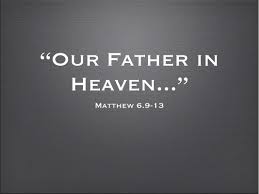
Knowing God as my Father means that I understand, I have taken deep into my heart the truth that when God turns His eyes from all His creative activity in the world and he looks at me, He cries out: “Here is one of my beloved children!

Praying the Gospel begins when I choose to rehearse the Gospel to my heart as I begin my prayers.  Praying the Gospel begins when I choose at times not to move further in my prayers until my heart is settled in the assurance that God is my Father, that I am His beloved, and that as I start, continue or end my day, He is faithful and just to forgive me of all my sins and apply the righteousness of Christ to my life again.

I find for myself that I too quickly move away from “praying the Gospel” to all that weighs on my heart that day.  Certainly, I acknowledge God as the centre of my life, but I don’t always allow that truth to become the context in which I share all that is on my heart with my Father.  We encourage one another by praying that the Gospel will go deep in each of our hearts.

Obviously, I have primarily focused on how “praying the Gospel” impacts my own personal life. However, it should impact our community prayer life as well.  What might that look like?


Praying the Gospel

Prayer is fundamental and foundational to the work of calling people into relationship with Jesus, growing them up in Him, and uniting them to transformational communities.  We all know that truth.  We all believe that truth.praying the gospel

However, just looking at the overall time I commit to prayer – actually praying, sharing requests with others, meeting with others for prayer – you might argue that prayer is more an aspirational value than a worked out value in my life.  I’m probably not alone in this.

At least two reasons come quickly to mind for this dissonance between what I say and what I actually do as a worker.

First, I live more as an independent worker than as a dependent worker.  Honestly, I often act as if the ministry actually does depend on me.  Praying the Gospel reminds me that everything flows from the Father’s active work and investment in this world.

Second, when I do pray, it’s a lot about “my stuff” more than it is about God’s desires and His interests.  Praying the Gospel refocuses my heart on what is most important.

So, what do I mean by “praying the Gospel”?  What does that look like for me on a day to day basis?  In other words, how can I move prayer from an aspirational value to one that is part and parcel of my daily walk with Him?

The ‘why’ behind what we are doing

core_values_written_in_chalk_on_blackboar_450Every organization has a culture. In other words, every group of people teamed up to fulfill a common purpose creates a context within which they work. That context is shaped by the values or working principles which the group accepts as foundational to how they will live and work together.

World Team has a culture. World Team has a clear set of working principles or values.

Where problems arise is when the values we espouse are not the values by which we actually live. This can happen because past history exercises an undue influence. Or this can happen because we enjoy theological word jousting more than soul exercising discussion. Or this can happen because we’re just tired of trying.

To overcome these problems, it is important to rehearse often with one another what we hold as ‘self-evident truths’ that guide how we minister together.

So, here goes. As a World Team community, we centre our entire lives and work around one foundational value: the Gospel. The Gospel is so simple a child can understand it, but so rich and deep that we as adults can never plum its depths. The Gospel is first of all the message that we can do nothing to either merit or earn our salvation. It has all been done for us in Christ. From there, the Gospel ripples out to ‘touch’ every aspect and area of who we are as His child.

Let’s just look at one element which should characterize the WT community if the Gospel is truly our central and foundational value. As we work together, we should be thinking more about our co-worker, our teammate than ourselves. TJ Addington put it this way: our relationships, our work environment should be “life giving rather than life taking”. Rather than pulling out of others what can serve oneself, one will look for ways to build into the other person.

Wasn’t this Christ’s model, His value?  “For even the Son of Man came not to be served, but to serve, and to give His life as a ransom for many.


community: part 3 of 3

Community_titleBill (WT Canada) has been writing some exceptionally good stuff on community and I couldn’t resist sharing his final installment:

“I want to end this three part series by talking about fruit. I like fruit; apples, oranges, grapes, I like them all. Fruit is the result of a larger process. Planting, cultivating, pruning, pollination, flowering and finally the fruit, the enjoyment, the end result. But fruit is not a guarantee. Some trees look good, look healthy, but they fail to produce.

Our Christian community should be that of fruit producing. The sweetness of the fruit, the way the vine and the branches are interconnected and together produce the fruit. Jesus himself says in John 15:4-5; “Abide in me, and I in you. As the branch cannot bear fruit by itself, unless it abides in the vine, neither can you unless you abide in me. I am the vine, you are the branches”.  There is an interconnectedness of the vine (Jesus), the branches (you and I) and the fruit that results from this relationship.

However, the real secret of the fruit are the seeds. The ability to reproduce “in like kind” and thus continue to bear fruit each season is something that we also need to have within our Christian community. We must become reproducers of good fruit. We must allow, even look for at times, the necessary pruning in our lives that make “abundant fruit” possible.

It’s easy to just look good, to have the appearance of community, maybe even some perception of fruit. But the real test is in the seeds, the ability to reproduce. Our Christian community needs to be multiplicative by nature, inviting, discipling, training, nurturing and sending out that the seeds of our community self-propagate, grow and produce new fruit wherever they fall.

Are we willing to allow ourselves to be pruned by the master vine-dresser so that our fruit extends beyond our community and reproduces itself in other areas?”

Bill’s last question is a challenge for each of us to consider. Join us as well on ‘the Hub’ at the Global Conversation Café for an ongoing discussion of community.

we have a dream

Thanks to many of you who are ‘dreaming’ with me in the way I described in my last post.  Maybe it might be more appropriate to say:

we_have_a_dreamWe have a dream for World Team.

We have a dream that one day all World Team workers, all staff serving with World Team will be looking for ways to participate in teaming up potential workers with existing or new initiatives.

We have a dream that World Team workers will more quickly say: “We need to mobilize more workers into cross cultural church planting, so how can we work together on this,” rather than “WT Australia needs to do a better job of getting us workers”.

We have a dream for World Team.

We have a dream that World Team workers, the World Team community will invest deeply in potential workers: reaching out to them relationally, training them on the job, and developing them through delegation.

We have a dream that all of us as a World Team community will always be growing in our character in the Gospel, always learning new ideas and more helpful skills, and always reaching out to draw others into His mission.

We have a dream for World Team.  We hope and pray that many more will join us in sharing this dream.

i have a dream

Many of us are familiar with Martin Luther King’s famous speech, “I have a dream” where Dr. King cast a vision for what freedom and justice might look like in one country of the world.  By using a series of word pictures, he built a desire in people’s hearts for such an internal and societal change.I-Have-a-Dream-520x336.png bis

I have a dream for World Team.

I have a dream that one day all workers, all staff serving with World Team will speak of others with respect, honesty and appreciation; that people from World Team will choose to video Skype rather than send an e-mail to say things that may be hard or difficult to say.  I have a dream that World Team workers, World Team staff will send more tangible gifts of appreciation than just an occasional ‘thank you’ at the end of a note.

I have a dream that speaks to cultural issues; organizational culture issues.

I have a dream for World Team.

I have a dream that World Team workers and staff will value both leaders and followers.  I have a dream that each of us will choose to hear and follow leaders so that they ‘may do it with joy’ (Hebrews 13).  I have a dream that leaders will listen well to followers (James 1), reflecting deeply on and integrating the insights they share.

I have a dream for World Team.  I hope and pray that you share that dream with me.