• Our hope-filled future is bound up in sharing the story of Jesus, in discipling others, in bringing those disciples together into communities of believers, and in developing and releasing those believers to create other communities... till Jesus the King comes again!

An old word, but a vitally important one

We are a movement. 

We are a group of committed believers who focus on advancing and facilitating a multiplying expression of disciples and communities of believers.

Being part of a movement implies that the work (the ministry) of the movement is done collaboratively, collectively, and not individually. Resources (people, prayer, finances, gifts, etc.) are leveraged together for the growth and development of the movement. Its energy and activity is focused on the ministry that the group has been called of God to accomplish.

We who participate in this movement seek to live out the truth that every member is important. In fact, we believe that we need one another in order to accomplish the task; that every member brings knowledge and experience to the community, to the movement.

However, the key is that ownership by all movement members, of this way of working, is based on trust and understanding.

It’s an old word, but a vitally important one in the current context in which we live and work.  Spread out across several continents, with meetings often held via Zoom, it’s easy for trust to be undermined or simply not granted to others within the network.

Core behaviours need to be fueling and nurturing trust on a regular basis.

I often fail in this task. As I’m sure many others do as well.  However, here are a few ways we can seek to fuel and nurture trust among us in this New Year 2023:

  • Seek to over-communicate with others in the movement.  Think about what would be helpful for you to know about what is going on, and then work to share what is happening in your part of the world with others for their input and help (a tangible way of demonstrating that we need one another in order to accomplish the task).
  • Ask more questions rather than answer questions.  This means putting others first in any given conversation, to better understand their perspective and ideas.
  • Reflect with others on the text in 1 Corinthians 13:7. How might this biblical text work out in practical ways in our relationships with others in the movement?

Working together to envision tomorrow.  That’s our objective for the Global 3C Conference this coming July.  To get there, we will need to fuel and nurture trust and understanding over the coming seven (7) months.

Moving mountains

We as a global community of cross-cultural workers are committed to facilitating movements of disciples and churches among those who are lost.  As many writers have observed, church planting or church multiplication movements do not come about as a result of our efforts. They are first and foremost the work of God’s Spirit among a people group.

So, one of the primary means by which CP movements arise is by prayer – fervent, perseverant, and informed prayer on behalf of a people group where the number of believers is extremely minimal. 

It is prayer that is at the top of everyone’s list of CP movement characteristics.  However, two obstacles may keep us from this kind of movement prayer. 

The first obstacle is our desire to “do something”.  Prayer seems like such a passive activity in our minds. We want to be able to engage in some tangible work that would, in our minds, lead to a demonstration of God’s work among a people group.  And yet God calls us again and again to pray.

The second obstacle is a misplaced faith.  Jesus in Mark 11:22-24 says: “Whatever you ask in prayer, believe that you have received it, and it will be yours.”  Alistair Begg comments on this verse this way: “In this bold command, Jesus reminded His followers to trust God, because it is actually faith’s foundation in God that gives that faith significance.  We should not have faith in faith or faith in ourselves, but faith in God alone.”

Once again, we can be tripped up by our own desire to “do something” first, rather than putting our faith in God alone and letting Him direct our actions as He builds a movement among people groups.

Begg goes on to write: “When God is the object of our faith, we can have an audacious faith – a faith that believes the impossible to be possible with Him.  We can know that we are speaking to someone who is able to do far more than we can even imagine (Ephesians 3:20-210. Jesus essentially says to us, I want you to pray in a way that says you actually believe in a God who is too wise to make mistakes, who is too kind to be cruel, and who is too powerful to be subdued by the normal forces of the universe.”

As we look forward to 2023, let us ask God to give us this kind of audacious faith as we pray for CP movements among people groups across this world.

Team, team and teams

The idea of working in teams is one of our guiding principles.  You could say it’s one of the reasons why we are called: World Team(s)

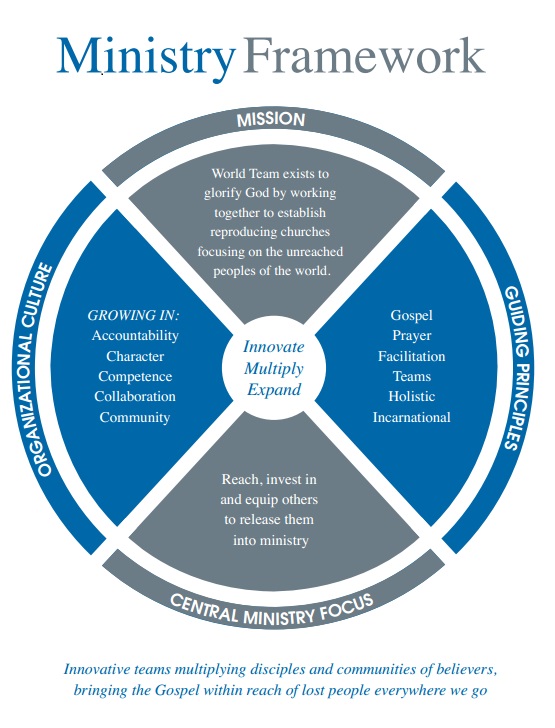
In our World Team Ministry Framework, we describe a team as: “A team is a group of individuals united in healthy relationships who work together toward a shared vision. They serve each other, listen to each other, rely on each other’s gifts and strengths, and bolster where each is weak. Our teams accomplish more together than the individuals can working alone.”

There are a good number of applications that we can draw from this principle, but let’s focus on one in particular: that the members of any team “pool” their resources, offer their gifts and talents to serve the group to accomplish something larger than their own personal mission or vision.

We say that no one has all the gifts and skills needed to establish a community of believers on their own, but we can often act as if we do.  It is in allowing different team members to exercise their gift(s) that the team finds forward traction in the Spirit.  It is one of those times when we clearly recognize how much we need one another.

Sometimes when we read this guiding principle, we can read ‘team’ instead of ‘teams’ (plural).  By doing that, we may miss an important insight.  No team is an island by itself.  As World Team, each team is part of a larger group of teams that need each other in order to gain traction towards accomplishing the vision God has laid on our hearts as a global community. As teams which make up World Team, we also need one another. There are resources and gifts in other teams within World Team that would be useful and helpful to other teams; gifts and capacities that could be shared for the growth of the entire group.

One small practical application might be how one or several World Team team(s) in another part of the world could find, mobilize, and coach new workers to join a team in another very different part of the world.  I know there are plenty of other applications, small and larger.

Raw authenticity

Two stories or events came to mind when I think about raw authenticity.  What I mean by raw authenticity is simply the clear, honest, and straightforward expression of one’s character or that of a group.

The first story.  Talking with a friend recently, I noticed that the organization he worked for had processed 35+ new workers during the pandemic. “How were you able to bring in so many new people in the midst of one of the most difficult times?” I asked.  His answer was enlightening. He told me that they had no idea as to why they drew in so many new workers.  They hired a consultant to help them figure out “what they were doing right”. 

Basically, the consultant said that the organization my friend worked for had not varied from their guiding principles over many years.  In other words, their strategy may have changed, but who they were and how they lived together as an organization had not altered. 

The second story or event.  I once worked for the administrator of a long-term health care facility.  He often ‘preached’ about the value and dignity we were to give or show to the residents of this facility.  They were our focus. We were there to serve them.  The way he personally demonstrated his commitment to this guiding principle was that his office door was directly accessible from the main hallway of the facility.  No need to go through someone else to get to his office.  And that door was almost always open.  Any resident could simply walk right in if they wanted to talk to the director of the facility.

In both cases, what was said to drive their relationships, drove their relationships.  And people were drawn to that authenticity of life and openness.  Yes, there was an organizational culture and work strategy that people adhered to and believed in. But what seems to keep them or have kept them onboard was the outworking of the principles to which they held.

We talk a lot about the Gospel as the driving guiding principle of our mission (see the WT Ministry Framework). Perhaps we need to reclaim that principle as the driving force behind our actions and the way in which we work and will work together.  And we would do well to look for daily expressions of that Gospel expressing itself in love, in and through our lives (Galatians 5:6).

What that might look like is fodder for ongoing discussions … and certainly a next blog post.

Why asking questions is so important

Sometimes in conversations with others, without realizing it, we work from certain assumptions.  For example, we assume the person we are speaking with is more of a talker than a doer.  So, we may have a “good” conversation, but in the end, we assume nothing will really come of the discussion. 

Our assumptions keep us from asking good and powerful questions in those conversations.  Our assumptions keep us from moving forward in our relationships with others to better understand where they are coming from and how we can better serve and work together with them.

Asking powerful questions is a skill each of us needs to learn and in which we need to grow more. 

The book, Crucial Conversations, is required reading for each Leader Cohort group (young emerging leader training).  One thought that the book drives home is the importance of building a “pool of shared meaning”.  That “pool” contains the ideas, theories, feelings, thoughts, and opinions that each person has as they come into a conversation.  The more information we have in the pool, the better prepared we are to understand another, make decisions together, and see results.

Asking powerful questions will help us better understand the other person and clear away assumptions that may be clouding and influencing how we see the other person. Answering questions or making statements are our default mode. But as a friend once said to me: “It’s the person asking the questions who is directing the conversation, not the one answering the questions.”

Let me push the idea a bit further. We as a community of cross cultural workers are called to share the Gospel with those who have not heard the message of Jesus and turned their back to Him.

At the same time, we as a community are called to live out, to demonstrate the work of the Gospel in our own community. The Gospel has to change us at the same time we call others to acknowledge Him as Lord and Savior.

One way to ensure this happens is to grow in practicing asking powerful questions of one another.  Questions that challenge one another to love well and build that “pool of meaning” so we might understand and serve one another better.  As an overflow, those around us will see a model for engaging others well and learning to work through struggles and conflicts we have with one another.

There is a vision and there is a plan

Vocabulary.  How we say or express things is important. Important not just for clarity, but also for helping us to focus on what we are called to do and how we are called to carry out that calling.  If we mix up the “how” with the “what”, we risk missing the mark of the right motivation and purpose of our good efforts.

There is a vision and there is a plan.  A vision is that dream, that larger purpose that gets you out of bed every morning.  A plan tells you how to carry out that vision in that context or situation your find yourself.  To put it in other words, it puts ‘feet’ to the vision.  A vision inspires, a plan actions.

A difficulty arises, as we said, when the vision and plan are made synonymous with one another; when they are used to mean more or less the same thing.

Two things happen when plans and vision are confused.  First, we begin to think that we can make this project, this work, this vision happen. Self-sufficiency can easily rear its head and distract us from the Author, the Driver of His glory being declared to the nations.  Nehemiah is a classic example of one whose heart was first captured by the vision, from which flowed a plan (Nehemiah 1 -2)

Second, we may think that a plan can be applied anywhere; that the vision can be worked out in the same way in Singapore as it was in Melbourne.  A cursory reading of the book of Acts will help us see that God’s vision, God’s Gospel proclamation was explained, demonstrated and carried out in different ways, in different contexts and cultures.

World Team has a vision. It is clear and pushes us to rely solely on God to see it happen. World Team has numerous plans, innovative plans to carry out the vision.  May God drive the vision deeper and deeper into our hearts, and may the fruit be actionable plans carried out by His Spirit’s work in us to declare His glory to the nations and see communities of believers raised up and multiplied!