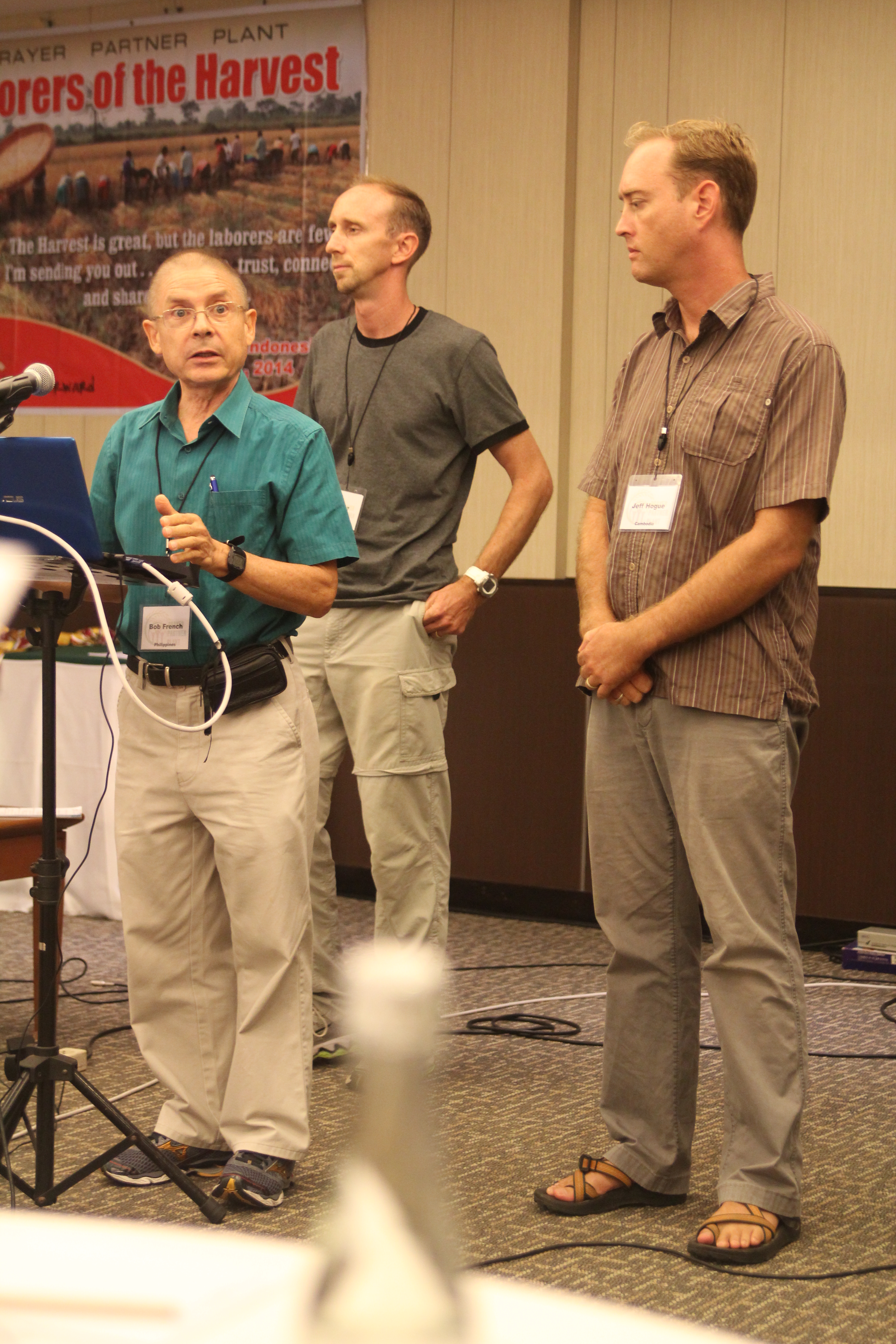
• Our hope-filled future is bound up in sharing the story of Jesus, in discipling others, in bringing those disciples together into communities of believers, and in developing and releasing those believers to create other communities... till Jesus the King comes again!

The art of sacrifice in a region (Africa)

The Mission¹⁴: Vision Forward Africa conference was the second of Area conferences in 2014.  The conference focused on our WT Ethos (purpose, vision, values and ‘culture’) as well as getting input from national leaders about partnering to reach the unreached.  The large group and small group interaction times were fruitful, with many opportunities to talk further about the issues being raised.20140524_123751
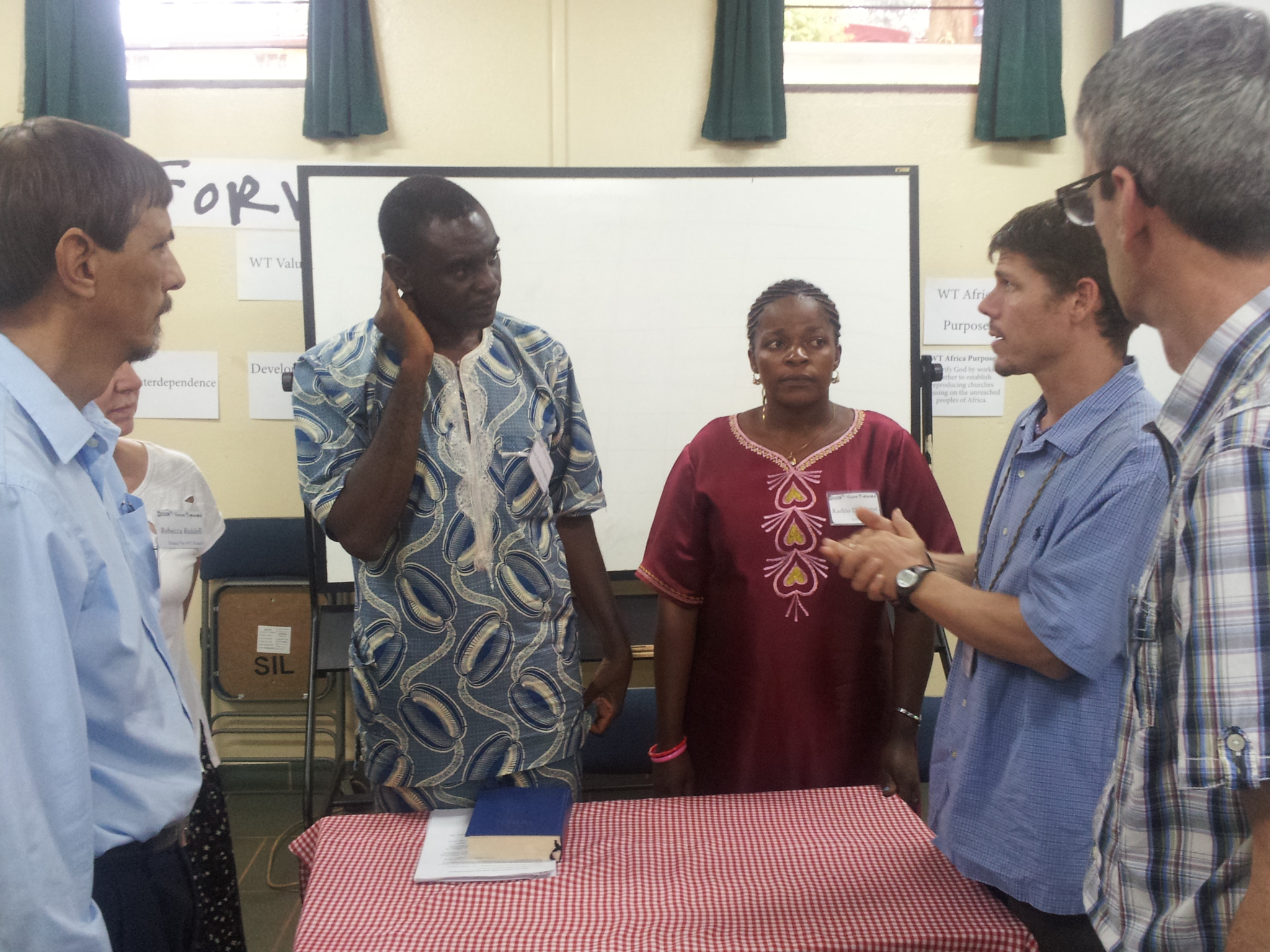
As I wrote in the previous post, “I shared a number of challenges with each region or Area.  The purpose was to affirm and celebrate what God has done through us over the past few years as well as to challenge Area members to “excel still more” in their work and ministry for Jesus.”

During the WT Africa conference, I shared the following challenges.

First challenge: learn to say ‘no’. Learn to say ‘no’ to one thing in order to build a heart for a new team.  World Team Africa has historically focused its work(s) in one specific region.  The outgrowths of these efforts have been progress in translation projects, multiplying small groups and leader development.  That good work now needs to be turned towards other projects in other locations and countries. In order to do that, it will mean that workers will need to say ‘no’ to one thing to have the time to give towards researching and building new teams to reach new unreached people groups.

Second challenge: ask the hard question. “When is the time to move on?”  This hard question is not restricted just to WT Africa workers. It is the question that we all need to ask ourselves at certain times.  “When is the time to move on?”  In other words, at what point do we need to transition to a new work and project?  How might our ongoing presence be inhibiting others (national believers) to take leadership of the work?  This is neither an easy question nor an easy discussion.  However, we must help one another to regularly think through this question.

Third challenge: offer and accept outside-in input.  Each of us has experience and wisdom gained from our unique journey with Jesus.  However, we are each easily blinded to our faults and shortcomings.  Offering and accepting outside-in input is a way for each of us to come alongside other workers by investing in their lives.  However, we must be equally willing to accept the same input from those outside our contexts.  I often hear workers, in response to the offer of outside input, say that ‘those people would not understand our context.’ Granted there is an element of truth in that statement, but people from the outside are also able to see things to which we can easily be blinded.

I share these challenges to the WT AFrica workers with all of us both as a reminder of the challenges given, but also as a motivation to pray for one another as we seek to learn the further change and growth to which God is calling us.


The art of sacrifice in a region (Americas)

The Mission¹⁴: Vision Forward Americas conference kicked off our year of Area conferences in 2014.  The conference focused on examining elements that promoted or encouraged church multiplication.  Topics such as: “Seeing with Pilgrim Eyes”; Engaging the Excluded Middle”; and “Thinking with the End in Mind” were parts of the daily discussions.  Large group and small group interaction provided opportunities to dig deeper into each topic and consider specific applications to current ministries.small group prayer

As I wrote in the previous post, “I shared a number of challenges with each region or Area.  The purpose was to affirm and celebrate what God has done through us over the past few years as well as to challenge Area members to “excel still more” in their work and ministry for Jesus.”

During the Americas conference, I shared the following challenges.

First challenge: restructure. WT Americas is historically one of our longest standing Areas.  It is where one part of our mission found its start.  God has blessed through the number of people who have come to Christ and the communities and church associations that have arisen as a result of our WT Americas workers.  However, the number of WT sent workers has diminished over the years and we find ourselves in situations where there is only one couple or unit in a location.  We need to ‘restructure’ WT Americas in its ministry oversight so as to better serve our current workers and create opportunities for new workers, wherever they might come from.

Second challenge: partner to send.  The Latin America church is now sending workers to serve Christ around the world.  We need to initiate dialogue with one or more like minded agencies as to how we can come alongside them and serve them in seeing more workers from the Global South to be sent into cross cultural ministry.

Third challenge: develop and release to younger people.  WT Americas has a large number of highly experienced workers with significant longevity in ministry.  This wealth of experience should be shared with the younger generation.  Becoming mentors and coaches for the younger generation will open up new avenues of service for our highly experienced workers.  It will also mean that we will be quicker to release these younger workers into ministry and leadership so that they can begin to develop and grow in those ministry functions.

I share these challenges to the WT Americas workers with all of us both as a reminder and as a motivation to pray for one another as we seek to learn the further change and growth to which God is calling us.

 small group prayer

The art of sacrifice in a region

At the Mission¹⁴: Vision Forward Area conferences this past year, I shared a number of challenges with each region or Area.  The purpose was to affirm and celebrate what God has done through us over the past few years as well as to challenge Area members to “excel still more” in their work and ministry for Jesus.

We can each settle in to a ‘comfortable’ way of doing ministry and lose that edge of daily learning what it means to “die to our fleshly love of impressing people in this way for glory for ourselves.”  I will often fend off challenges that may be given to me by ‘defending’ the good stuff that I’m already doing, and concluding by saying something like, “besides you don’t really understand what I am dealing with here in my ministry.”

We all need others to help us gain better perspective and grow in our character, gifts and abilities.  Naaman (2 Kings 5) was fortunate enough to have a number of servants who were willing to “bring him up short” in a crisis situation.  Otherwise, he probably would have walked away from the redemption and healing he sought.

Over the next few posts, I would like to share what I shared with each Area: both as a reminder of the challenge, but also as a motivation to pray for one another as we seek to learn the further change and growth to which God is calling us.

The lost art of sacrifice

“Then Jesus said to His disciples, “If anyone wishes to come after Me, let him deny himself, and take up his cross, and follow Me.””  (Matthew 16.24)living-sacrifice1

A fellow pastor named Jack used to say that Jesus’ message here was not one that would resonate with many. Basically, He was declaring, “If you want to follow Me, come and die.”  The message of the Gospel is the message of the cross, the message of sacrifice.

Oftentimes when this subject comes up, the lost art of sacrifice, two thoughts are most on people’s minds. First, it’s a generational issue.  Second, sacrifice is mostly about material possessions.

I’m afraid the first thought misses wide the mark of what Jesus was talking about in this text. Sacrifice is an inter-generational issue.  It’s something with which everyone struggles.  True, the younger generation may be more connected to technology than the older crowd.  However, the older crowd may have settled in comfortably to their cross cultural worker lifestyle and believe there is no more ‘sacrifice’ to be made.

The second thought clearly demonstrates our superficial understanding of the deeper work of the Spirit in our lives. Material possessions are part of the sacrifice Jesus may call us to make, but so is our time, our relationships, our thought life or our work.

Take a minute to consider this thought below and its application of sacrifice to our work today. Replace the word, ‘pastor’ with ‘cross cultural worker’:

“To have power in your life as a pastor, it is supremely important that you make it a first order of business for the rest of your life not to do things to impress people or gain a reputation or protect your reputation. It is very clear from the Gospels that Jesus is calling us to deny some basic things in our personality–things that need to die. Jesus says in Matthew 16:24 to deny yourself; take up your cross and follow me. And I think that means dying to our fleshly love of impressing people in this way for glory for ourselves.”

Can’t stop being intentional bis

A fellow WT colleague pointed me to the following short article by Ed Stetzer which I thought was a great follow up to our recent discussions on intentionality.

Read the article at: http://www.christianitytoday.com/edstetzer/2014/october/learning-to-lead-differently-as-you-age.html?utm_source=edstetzer&utm_medium=Newsletter&utm_term=14203663&utm_content=309428335&utm_campaign=2013

I would particularly draw your attention to his questions at the end of the article. They are worth reflection and discussion:

  • What have you learned about leadership transition that comes with age?
  • How can a leader overcome the challenges that come with age in a culture that is constantly seeking the newest idea, approach or technique?
  • What can we learn from Scripture in regards to leading into the later years?learncomm-hands

Can’t stop being intentional

The Gospel frees us to intentionally move towards others.

Another thought came to mind as I read a blog post by Aaron (http://www.bloggingtheologically.com/2010/08/03/book-review-rescuing-ambition-by-dave-harvey/):

“As God rescues and redirects our ambitions, we have to understand that there’s a cost. We might fail. We might never see our ambitions fulfilled. But our ambitions are to have one goal in mind: serving our Savior. This is where we’re to find our contentment: not in the accomplishment, but in Him who has redeemed us and created us for these works.

In other words, godly ambitions are humble ambitions. To pursue godly ambitions means that we can forsake our comfort and well-being because Christ is sufficient. So it doesn’t matter if we fail. It doesn’t matter if we don’t’ see our plans play out. Jesus is enough.intentional-300x228

“Finishing well” actually means preparing the next generation to finish the work we begin. “True success means we will turn things over to the younger generation in such a way that enables them to run stronger and faster, with us cheering them all the way.””

Intentionality includes a multiplicational dynamic. If I choose to be intentional and invest in the lives of others, it will mean that at a given moment I will turn things over to them.  I will be intentionally investing in them for their development, intentionally preparing them to take the ministry and intentionally coming alongside them to platform and support them.

Such a multiplicational dynamic should impact the way I intentionally invest in others. A number of questions might come to mind that could help as one assesses his or her work with others:

  • How am I preparing another (or others) to take the current ministry even further?
  • How am I am impediment to that intentional desired growth of another? How am I a ‘multiplier’ of that intentional desired growth of another?
  • What needs to be part of my intentional investment that will ‘multiply’ its fruitfulness?

The Gospel frees us to intentionally move towards others. The Gospel frees us to honestly assess and grow in our intentional investment and ministry to others.