
• Our hope-filled future is bound up in sharing the story of Jesus, in discipling others, in bringing those disciples together into communities of believers, and in developing and releasing those believers to create other communities... till Jesus the King comes again!

This is who we are

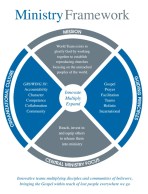
wt-ministry-framework-jan-2016A couple of months ago, we ‘launched’ the World Team Ministry Framework.  It’s our best attempt as a global community to describe ‘who we are’ and ‘what we do’.  You hopefully have seen this graphic or other slightly different ‘versions’ of it around World Team.  We’re trying to ‘contextualize’ this graphic to our various contexts.  However, the point is not having a ‘nice’ graphic that you and I like; the real point is calling each other to live and work in line with what we have decided best describes who God has called us to be.

We are at times better ‘word-smithers’ and discussion activists than implementers.  However, the world around us watches to see if all our ‘words’ will actually cause transformation and change in the way we work with one another, in the way we treat one another, in the way we freely forgive one another.

What should get us out of bed everyone is the call to “reach, invest in, and equip others to release them into ministry.”  Obviously, this focus centers on our primary stakeholders who are the lost (see Matthew 28:16-20).  However, this same focus should drive the way we support one another build up another, and forgive one another, so as “to release one another into ministry”.

I pray that our Ministry Framework will ‘frame’ the way I build into other’s lives and the way I reach out to those who do not yet know Jesus.

Influencing one another

I really do like the World Team Ministry Framework. It captures the essentials of who we are and what we do.  However, at times, I can look at the World Team Ministry Framework as a collection of individual elements or pieces to which I need to give attention.  I do not always look at it as an ‘interactive highway’ of fundamentals that are constantly influencing each other.interactive highway

For example, how does the Gospel influence our call to ‘reach’ and ‘invest’ in people each day? Or how does our growth in collaboration influence our call to act more ‘holistically’ in our ministries?  Or how do facilitation and our work in teams impact releasing others into ministry?

There are obviously a host of combinations to consider, but all that to say that we have so much more to learn from each other about how the World Team Ministry Framework works itself out in our lives and ministries.

So, this is my invitation to you to explore together how some of these ‘combinations’ work themselves out and influence our lives and ministries.

Let’s ‘talk’ about the first combination I suggested: How does the Gospel influence our call to ‘reach’ and ‘invest’ in people each day? 

Post your comments to this post and I’ll try to summarize what we ‘discover’ together in a future post.

Are you kidding?

We are a discussion oriented mission ‘culture’. In other words, we enjoy talking, discussing, and debating topics that relate to our global ministries. Sometimes our discussions can keep us from actually implementing outcomes of the topic under discussion.

The World Team Ministry Framework is a tool to help us review who we are and what we do. Our mission, guiding principles, central ministry focus and organizational culture provide talking points which should give way to concrete applications (and changes) in our work and ministry.

Take for example the element of ‘facilitation’ under our guiding principles.  The descriptor for this element reads:

Facilitative ministry is a mindset regarding one’s role, function, and end result.  It means to support and assist others so that they are able to do the ministry. Facilitation includes drawing out the gifts, talents, experiences and desires of others, and encouraging them to do ministry.  Multiplication is inherent in facilitation because the end result is that others perform the work of disciple making and church planting as well.”

We can certainly talk about the benefits of facilitation; the relationship between facilitation and pioneer work; or the picture of a facilitative approach to ministry. Nevertheless, the struggle will be to answer and apply our answers to this question: what will a facilitative approach look like for me in ministry today?

It could mean at least two things today. For one that I learn to deliberately say ‘no’ to a ministry are you kiddingopportunity in order to allow another to take up that opportunity, and be ready to provide feedback and support.  For another that I regularly ask the question: who could do this ministry task?  What training would they need?

You might be saying at this moment: “Are you kidding? I have enough trouble just trying to do ministry, let alone giving time to training another.”  Here’s where the real work of the WT Ministry Framework begins.  It’s more than just a means for good discussion. It’s meant to be an assessment tool which causes us to better align our work, and change, if needed, our current ways of doing ministry.