• Our hope-filled future is bound up in sharing the story of Jesus, in discipling others, in bringing those disciples together into communities of believers, and in developing and releasing those believers to create other communities... till Jesus the King comes again!

Not a mixture

We are a movement.  Those who participate in this movement seek to live out the truth that every member is important. In fact, we believe that we need one another to accomplish the task.

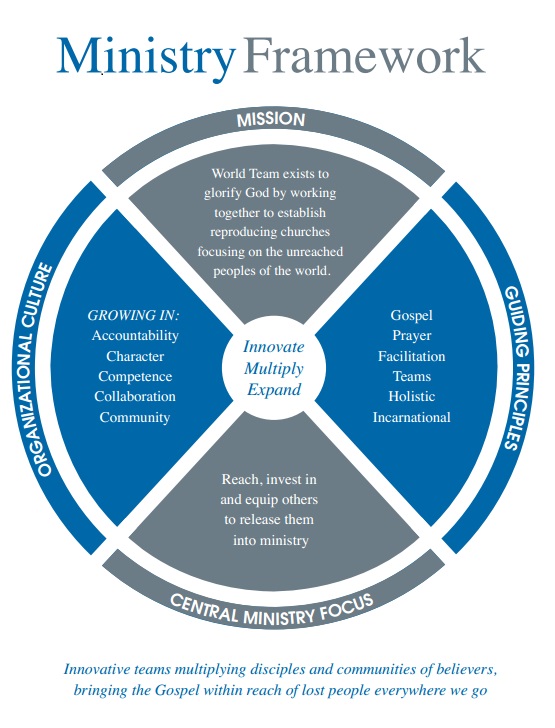
As a movement, we are committed to the same mission, vision, and guiding principles (WT Ministry Framework).  Our framework for ministry is not a mixture or conglomeration of each individual’s mission, vision and what one may believe is important. 

This is another reason why we need one another: to ensure that we are all pulling and working together to go in the same direction.  When one rower begins rowing against the work of the others, the boat pulls to the left or to the right.  The other rowers must help this rower to bring his/her work (rowing) back into alignment with the overall direction.

This is where difficulties often arise.  When someone begins pulling a team in a direction that is counter to the overall direction of the movement, several responses can happen:

  • None of the other team members say anything.  Team members are afraid of hurting the lone team member if they say something; or believe that the “pull” in a counter direction will simply go away over time.
  • One (or more) of the team members take the person to task in an overly critical way, lacking grace and empathy.  This is the offensive approach and often is at the start of larger team conflict.
  • Team members ignore and stop listening to this person.  We might call this the ‘silent’ treatment where the member who seems to be pulling the team in another direction is paid no attention.  The team misses an opportunity to learn together from such a crucial conversation.

None of these responses are helpful to the growth and re-alignment of the team; nor do they help the team pull back around the larger mission and vision of the movement.

Perhaps Galatians 6:1-2, though not speaking specifically to this situation, might give us some help and principles to guide our efforts to keep rowing together in the same direction: “Brothers & sisters, if anyone is caught in any transgression, you who are spiritual should restore him/her in a spirit of gentleness.  Keep watch on yourself, lest you too be tempted.  Bear one another’s burdens, and so fulfill the law of Christ.”

How can we best, with much wisdom, keep one another aligned with the larger mission and vision to which God has called us?

There is a vision and there is a plan

Vocabulary.  How we say or express things is important. Important not just for clarity, but also for helping us to focus on what we are called to do and how we are called to carry out that calling.  If we mix up the “how” with the “what”, we risk missing the mark of the right motivation and purpose of our good efforts.

There is a vision and there is a plan.  A vision is that dream, that larger purpose that gets you out of bed every morning.  A plan tells you how to carry out that vision in that context or situation your find yourself.  To put it in other words, it puts ‘feet’ to the vision.  A vision inspires, a plan actions.

A difficulty arises, as we said, when the vision and plan are made synonymous with one another; when they are used to mean more or less the same thing.

Two things happen when plans and vision are confused.  First, we begin to think that we can make this project, this work, this vision happen. Self-sufficiency can easily rear its head and distract us from the Author, the Driver of His glory being declared to the nations.  Nehemiah is a classic example of one whose heart was first captured by the vision, from which flowed a plan (Nehemiah 1 -2)

Second, we may think that a plan can be applied anywhere; that the vision can be worked out in the same way in Singapore as it was in Melbourne.  A cursory reading of the book of Acts will help us see that God’s vision, God’s Gospel proclamation was explained, demonstrated and carried out in different ways, in different contexts and cultures.

World Team has a vision. It is clear and pushes us to rely solely on God to see it happen. World Team has numerous plans, innovative plans to carry out the vision.  May God drive the vision deeper and deeper into our hearts, and may the fruit be actionable plans carried out by His Spirit’s work in us to declare His glory to the nations and see communities of believers raised up and multiplied!

It’s not about us; it’s all about God

Most of us were excited when we joined our first church planting team; excited to be part of something bigger than ourselves. Whatever form that church planting team took (translation, mercy ministry or small group outreach), we quickly recognized the benefit of being part of a team that was more than just one (1) person engaged in the work.

However, at some point, the team or a team member called us to account for the work that we had or had not been doing.  It may not have been something major, but our reaction made the proverbial ‘molehill into a mountain’.  To put it in other words, we took it personally.  Someone else was taking us to task; our work was being put into question. 

In that moment, we made the conscious choice to centre the work in which we were engaged around ourselves.  It was more about us in the end than it was about God’s purposes in this world.

I would argue that many of us easily slip into this mindset and way of thinking. And in many respects, it’s a natural reflex. However, the Scriptures are clear that the work that God has called us to is His work: “I will build My church”.  We don’t read that text as “David, Paul, Laura or Heidi will build God’s church”.  And yet, by our actions and reactions, we often say that very thing.

The mission, the vision that God has called us to as a community beats or trumps all!

When you find yourself reacting to the feedback or criticisms of others by defending yourself and putting yourself at the centre of what God is doing in the world, step back and take a deep breath.  And remember, or ask someone else to remind you, that the work is first and foremost about Him and His vision, His project for this world.

That’s why we need the larger community. That’s why we work in teams.

Just to be clear

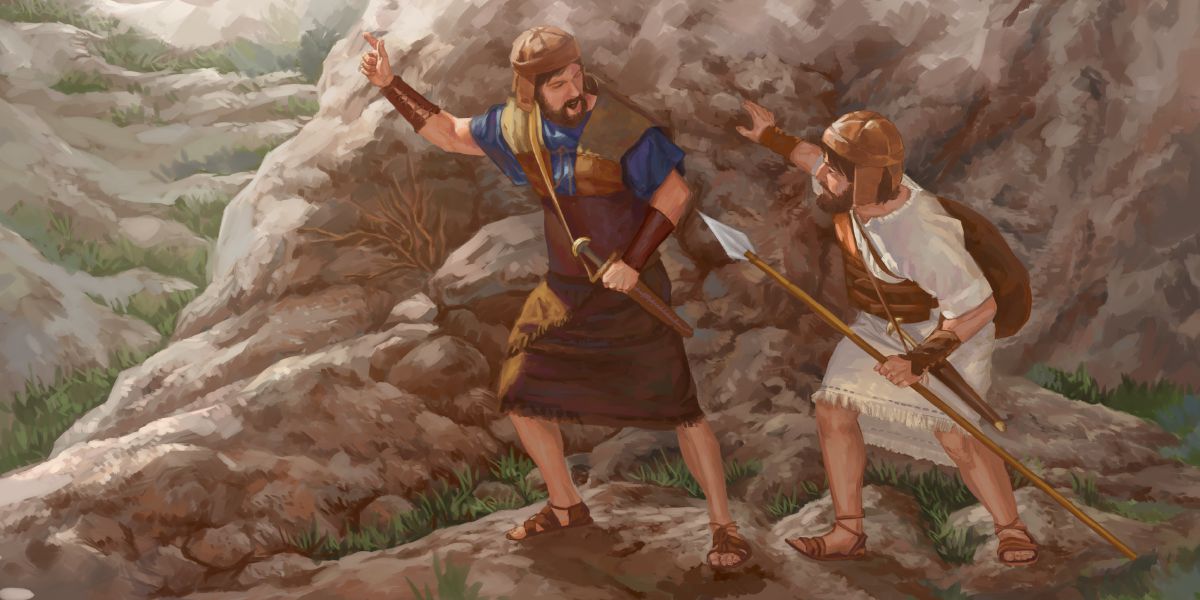
In his landmark book, Good to Great, Jim Collins wrote that if there was one thing you are passionate about and you can be best at, then you should do just that one thing.  We know from the Scriptures that we are to love the Lord our God with all our heart, mind, soul and strength (Matthew 22:37; Mark 12:30).  That is what we are to be “best at”.  But there is an interesting verse in 1 Samuel 14:7 when Jonathan asks his armour bearer for the two of them to go up alone against the garrison of the Philistines.  Listen to the armour bearer’s response: “Do all that is in your heart. Do as you wish. Behold, I am with you heart and soul.”  That sounds like a passionate commitment to a godly cause.

Just to be clear: we as World Team workers are passionate about seeing people come into relationship with Christ and experiencing the community of God’s people. And then sharing this same passion with others.

In mission jargon, we would say that we are passionate about church planting, or multiplicational church planting.  However, that can sometimes sound overly technical, dry, or even passion-less.  Re-discovering the passion of church planting can come by saying in other ways what drives us to love God more and what gets us out of bed in the morning.

World Team workers build healthy relationships with others.  As trust is established, they engage others in conversations about spiritual matters.  As interest arises, WT workers offer the opportunity to discover the message of the Bible together.  If interest wanes, WT workers remain strong and consistent friends.  However, as the message of the Bible draws people to Christ, they are equipped by WT workers to grow in their walk with Christ and to do the same with others.  These new believers come together in community and learn together what it will look like for them to be a witness for Christ where they live and work. And then whole process starts over again.

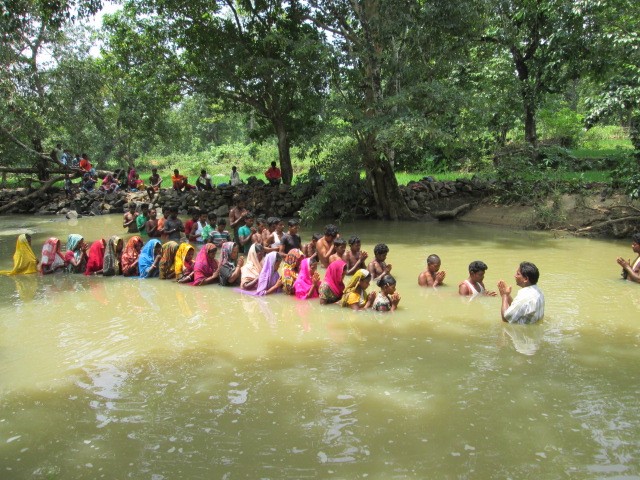
The exciting part is this passion is worked out in a variety of ways in World Team.  Yet it is all focused on the same end point: a living, vibrant community of believers that is growing, multiplying itself out to three, four and five generations of new believers.

That is God’s passion for the world.  May we say like that armour bearer: “Behold, I am with you heart and soul.

Considering the STRATUS-Sphere

There is a new online global database which is worth a look.  It’s called STRATUS. Simply click on the word and the hyperlink will take you to the site.

As you consider the STRATUS-Sphere, you will quickly realize that among the top 30 locations [where access to the Gospel is limited and where spiritual investment is most needed] are two locations where we are committed, as a mission, to working in the future.

What the STRATUS-Sphere did for me is to re-ignite a heart commitment to pray for these two locations. Prayer is a guiding principle for us, that’s a given, but prayer is also our main access to the Father who opens doors and hearts that we could not open.

The STRATUS-Sphere also caused me to ask myself: what can I practically do to help put a team of workers on the ground among these two people groups?  I don’t have an answer to that question just yet, but it will be one of my prayer points in the coming weeks.  You might want to reflect on a similar question: What can you practically do to help put a team of workers on the ground?

The STRATUS-Sphere also caused me to wonder why I am not praying more often for the other locations which are in the top 30 locations in need of Gospel witness.  More about that later.

Might we not PRAY BIG for the peoples of these different countries where Gospel witness is so limited, that the light of Christ might shine among them?

Just the start

Earlier this week, each of us as members of the World Team Global community received a copy of our global outcomes.  Global outcomes are those faith-stretching desires we as teams long to see God bring about through us.

There are three facts we should keep in mind about these global outcomes.

First, global outcomes are not just about numbers.  They are about people, relationships, heart desires, and the call God has placed upon us as a community to see a multiplying movement of disciples and communities.  Numbers push us to think beyond ourselves, and they are a way to cause us to recognize that to accomplish this God given vision will require God’s work in us and through us. 

Second, global outcomes implicate all of us.  Global outcomes are the fruit of discussions we have had with one another.  These are not just objectives for one part of our community.  They are outcomes that call for each of us to get involved in some way in seeing them become a reality. 

Finally, global outcomes are not something we are going to ‘put in a drawer and forget about’.  This effort is not a ‘one off’, but a long term team effort we trust will lead us to see God do even more among us and through us.  One member of the World Team Global Alliance (WTGA), when he first heard about the global outcomes, commented (with much passion) as to “how these outcomes would unite all of the World Team community (WT workers, staff, boards, and partners)!

However, we are just at the start.  Working our global outcomes means that we need to start now to more intentionally engage others with the Gospel.  It means that we need to begin now to prayer about and research those seven (7) new UPGs among whom we believe God desires us to work in 2021.  It means praying for one another now as new church starts begin each year (2019, 2020 & 2021); that these church starts would become viable communities of believers, capable of multiplying themselves.

Let us run the race together, keeping our eyes fixed on the author and perfecter of our faith!