• Our hope-filled future is bound up in sharing the story of Jesus, in discipling others, in bringing those disciples together into communities of believers, and in developing and releasing those believers to create other communities... till Jesus the King comes again!

the Mountain

Today’s post comes from Kevin in the US.

The mountain—the transfiguration—provided an opportunity for true worship.  A sick (and dying) daughter provided an opportunity for true worship.  Both of these situations are written about in Mark 9.  In an exercise of pure focus on the only person worth complete attention and adoration, a person can seek to ascribe to God the worth that only He is due. 

But there’s more, according to Keller.  I was fascinated by Keller’s term ”repentant helplessness” as necessary in true worship.  I’m not fascinated in a “what-a-cool-phrase” kind of appreciation, but a gut-wrenching, face-slapping, wake-up call that helped me to see worship in yet another helpful light.

Repentant helplessness.  Yes, in my efforts to ascribe worth to our Savior, there is often a lot of me involved.  My comfort, my setting, my surroundings, my mood, and many other factors often play a role in my worship.  The type of music, the style of dress, the “spiritual temperature” of those around me often affect my focus—and appreciation—of Him.  But how selfish is that?

If my focus is on Him, and if (as I believe) “the things on Earth will grow strangely dim” in light of Who He is, I need to repent of my demand for proper circumstances to influence my worship.  I need to acknowledge my utter helplessness in absolutely everything—even in the fact that I can approach the God of all creation!—in order to really and truly worship.

We are already accepted by Him, but not because of anything we did—or do.  It’s what He has done in light of our selfish ways.  Pursuing Him also empowers us to live for Him in this broken and hurting world.  Like Peter, James, and John on the mountain, we can experience this.

Is there “repentant helplessness” in your worship?  What does that look like?


Next week: chapter 11 – “the Trap”

No time to think

Peter Bregman puts the problem this way in an article in the Harvard Business Review: “I have no time to think.  Possibly the six scariest words uttered by a leader. But they don’t scare us anymore because they are so commonplace.” [To read more of his article, go to: http://blogs.hbr.org/bregman/2011/06/what-to-do-when-you-have-no-ti.html.] Though he attributes these words to leaders, I’m guessing that most of us feel the same way.  There is just not enough time in a day to accomplish the work we have, let alone to consecrate time to “slow down long enough to learn.”

This slowing down, however, was the model that Jesus often demonstrated.  He disrupted the rush of life to slow down for a time: “And He (Jesus) said to them (the disciples), “Come away by yourselves to a lonely place and rest a while.”  (For there were many people coming and going, and they did not even have time to eat.)”  (Mark 6.31)  Mark’s description sounds like some days in ministry: pushed to the limit, we don’t even have time to catch a bit to eat.

We are called to be fruitful and good stewards of what God has entrusted to us, but our fruitfulness and stewardship will be enhanced when we take the time to step back and reflect.  Slowing down from time to time allows us to better evaluate the choices and decisions we are making.  It also gives opportunity to the Spirit to search our hearts, show us our hurtful ways and drive us back to Christ (Psalm 139:23-24)

This slowing down is not time defined.  It can take place in five minutes, half an hour, two hours or a day.  It is defined more by its heart direction than by the actual amount of time spent.

How do you disrupt the busyness of life and ministry in order to think and learn?


the Waiting

We had just arrived home that morning, caught a quick nap and then got ourselves ready to head to the wedding of the daughter of some good friends.  We arrived in plenty of time and got seated along with the hundred or so other guests.  Then we waited … and waited … and waited.  Several announcements were made from the front to the effect that the bride was on her way.  “We have never been to a wedding that started this late.  What could she possibly be doing?” were thoughts that ran through our minds.  Then the bride showed up and all that complaining disappeared in the joy of the ceremony that followed. 

When Tim Keller writes: “God’s sense of timing will confound ours, no matter what culture we’re from.  His grace rarely operates according to our schedule,” we can readily identify with the frustration that arises from our lack of patience in regards to His timing.  Just as we felt when our friends’ daughter was “late” for her own wedding, so we wonder in frustration what God is up to when He doesn’t seem to come through “in the right time.”

However, it is in the delay that God often speaks to us, and we can easily miss His message.  Keller writes: “But precisely because of the delay both Jairus and the woman get far more than they asked for.  Be aware that when you go to Jesus for help, you will both give to and get from him far more than you bargained for.”  What we may learn to give is a deeper commitment and call to follow Him, shedding our self focused way of living which may treat God only as a help in time of need and not a Redeemer needed every day.  What we may learn to get is a richer appreciation of His presence with us, of His love for us despite how we may feel or think.

Keller is right that often in our response to life situations we try to “hurry Jesus” and demonstrate “impatience with the waiting.”   I think it might be a good thing to adopt Thomas Cranmer’s prayer as our own: “Grant that we may both follow the example of his patience, and also be made partakers of his resurrection.”


What words would you use to describe your struggle with impatience when it comes to God’s timing?  What would it look like for you to trust His timing and His seeming delay to act according to your timetable?  What one or two thoughts would you share with someone you are discipling about learning or growing in one’s patience and ability to wait?

the Power

Today’s post comes from Barry in Cameroon.

I like Mark’s style. I like the fact that he didn’t leave out the ‘irrelevant details’, mainly because I don’t think that they are extraneous. The first example that the author mentioned (the extra boats) draws a picture of the pressures mounting on Jesus and His disciples at the time of the story. Jesus and the disciples ‘leave the crowds behind’. Obviously it is time for rest.  The seemingly impertinent detail that ‘there were other boats with him’ reminds us how difficult it is to find solitude and rest especially when it is most needed. Who were the folks in these others boats? Could it be that some of the crowd had their own vessels and desired to follow them? We don’t know. All we know is that they were not alone.

I remember a commercial that used to be on TV. A woman is listening to her children screaming, the doorbell sounding, the phone ringing. The screen divides into the many views of the problems that surround her.  She is in the center clutching her head as she shouts out the name of the product that will ‘take me away!’ If you know it, you are officially dated. Next frame we see a contented housewife surrounded by the bubbles of her long awaited retreat from the world of chaos. The thing is, we all need to get away.  Jesus did it. Only His faith was in something greater than bubble bath.

The second ‘irrelevant detail’ (Jesus sleeping on a cushion) is a great picture of how He did it.  He actually prepared a comfortable place to sleep. He didn’t just fall asleep somewhere out of pure exhaustion. He got a pillow. Probably fluffed it up and got it just so under his head and neck. He was purposed about resting. The furious squall was in perfect contrast to the rest into which He had already entered. The disciples were in perfect parallel with the storm. What would they do with this overly phlegmatic crew member? He needed to understand that rest was contrary to His wellbeing. He needed to understand that this was action time, not quiet time.

Yet the first word he said when he got up was, ‘Quiet!’  The next two were, ‘Be still!’ What was the return message to the frantic seamen? ‘Where is your faith?’ Is it in the storm? Or is it in me? Oh, to be like You Jesus. That’s what I feel when I read this. I have a hard time resting. I know I need it.  Jesus was sure it was time to ‘get away’. He knew that there was just so much a person can handle . . . and He is God! When He spoke to the wind and waves, there was ‘dead calm’, much like a guy sleeping on a cushion. He didn’t need the storm to stop for His own rest. Perhaps He did it for His disciples so that they could see His ability to take care of them. Perhaps He was just proclaiming the importance of rest in a dramatic way . . . reconciling the world to Himself in inexplicable ways.

His is Uncontrollable! Unmanageable! Untamable! Unbounded power, wisdom, and love! He does allow the storms to rage around us. Sometimes He is even orchestrating the storms. Yet to find our rest in any other place is at best temporary and at worst self-destructive. To be at the mercy of the storm is to subject ourselves to an unloving force of nature . . . one that doesn’t care if we survive.  To trust in Jesus . . . to cling to Him in the midst of the storms of this life . . . is to place ourselves at the mercy of the One who paid the ultimate price for love. He has endured the ultimate storm for our sakes and the sake of His name. He will deliver fully one day. Faith in the midst of the storms is His gift to those who continue to cry out to Him.

In what ways are you at the mercy of the ‘storms’ of life? Are you frantically trying to combat or control the forces that are raging around you? Are you simply waiting for the storm to pass or are you clinging to the One who loves you?  If you are clinging, how does that happen for you?  I would love to hear how you are preparing to rest in Him.

the Rest

I read Keller’s comment in chapter four, “the Rest” where he says that the rest Jesus calls us to is more than just taking time off from work, that “there’s another level of rest, a deeper level,” and I immediately thought of the hymn: Jesus I am resting, resting.  You know how the verse goes.  It starts off: “Jesus, I am resting, resting in the joy of what Thou art. I am finding out the greatness of Thy loving heart. Thou hast bid me gaze upon Thee, and Thy beauty fills my soul, for, by Thy transforming power, Thou hast made me whole.”

Honestly though, on a day when things aren’t going so well, when the overload light comes on in red, it’s tough to find and experience that “rest”.

So where’s the source of our problem?  Tim Keller describes it this way: “Most of us work and work trying to prove ourselves, to convince God, others, and ourselves that we’re good people.  That work is never over unless we rest in the gospel.”  Basically we run ourselves into the ground trying to gain approval from someone else, be it God, our spouse, our colleagues or our friends.  Like a hamster turning around and around on its little wheel, we never come to the end of that self centered effort.

Experiencing anew real “rest” comes when a greater treasure displaces our constant search for acceptance from others.  “On the cross Jesus was saying of the work underneath your work – the thing that makes you truly weary, this need to prove yourself because who you are and what you do are never good enough – that it is finished.  He has lived the life you should have lived, he has died the death you should have died.  If you rely on Jesus’s finished work, you know that God is satisfied with you.  You can be satisfied with life.”

Going deep in thinking about, reflecting on and grasping further the message and meaning of the cross is the constant starting point on the journey towards the rest about which Jesus talks.  It is definitely not easy, and is certainly not my first reflex, but it is the path towards real rest.

Oh, how great Thy loving kindness,
Vaster, broader than the sea:
Oh, how marvelous Thy goodness,
Lavished all on me!
Yes, I rest in Thee, Beloved,
Know what wealth of grace is Thine,
Know Thy certainty of promise,
And have made it mine.

Where do you struggle most in learning how to rest in the finished work of Christ and accepting that God is satisfied with you?  Are there others in your life who help you go deep in reflecting on and thinking about the message and meaning of the cross?  What one step could you take in the coming days to help you truly rest in Jesus?

the Healing

Today’s post comes from Mark in Hong Kong.

When I was a young boy I shared a room with my brother. And every night just after we climbed into bed my mother would walk in the room with a soft smile carrying a children’s picture Bible under her arm. The book was thick and heavy, and by then well worn. And inside all of the great stories of the Scriptures were animated by colorful drawings. Every night one of us got to pick a story. My mother would read it to us, while we looked at the picture, and then we would sing a hymn together before the lights went out on that day.

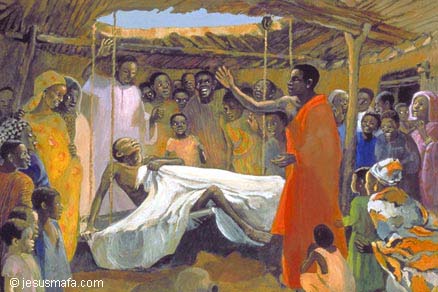
And my favorite story from that big picture Bible is the one our author, Tim Keller, re-tells for us in chapter three of The King’s Cross. It’s the story of the paralytic man being lowered through the roof by his friends (Mark 2). More than 30 years later I have never forgotten that story, most likely because I have never forgotten the picture that went with it. The open roof, the man being lowered by rope, the friends who went to great lengths to get him help, and then Jesus standing on the ground, looking up from the crowds as the paralytic was hoisted downward on his mat. Captivating.

Keller uses this story to expose what he calls our “much bigger problem” – that is the problem of sin. And he does so picking up on Jesus’ initial response to the man who has been lowered before the crowd. Jesus starts, “Son, your sins are forgiven.” That’s not what the man came for, and it startles the crowd. Certainly Jesus is merciful to the man’s physical affliction. He heals him of his paralysis and the man walks away. But he has walked away with something far more beneficial – the forgiveness of sins.

Hearing this story as a kid I focused on the healing, not the forgiveness. And I might be tempted to stay there now, except that I agree with Keller. I’ve got a real jim-dandy of a dilemma, a big nasty problem called sin. Those of you who work with me know it’s real. True, I had this sin problem back during the bedtime Bible stories, but I didn’t realize it was going to get this bad.

So I found myself grateful that very early in The King’s Cross pastor Keller identifies my real problem. Actually, he really doesn’t have a choice. It is not possible to write about Jesus and his cross without writing about sin as our biggest problem. But he pushes us further. Tapping into C.S. Lewis, as pastors are prone to do, Keller wrestles with this Biblical passage in light of a Lewis story and gives us another phrase – “not deep enough.” And he recommends this: Jesus will cut deep in dealing with our sin. He will pull back the scales. As he did with the paralytic he will identify our bigger problem and then he will go deep enough to provide the core healing that is needed.


As we reflect on this chapter, intentionally think about this:

1. What is the biggest, darkest, deepest sin you have?

2. Are you willing for Jesus to cut deep – painfully deep – to remove it?

3. Will you sincerely invite him to do so today?