• Our hope-filled future is bound up in sharing the story of Jesus, in discipling others, in bringing those disciples together into communities of believers, and in developing and releasing those believers to create other communities... till Jesus the King comes again!

Prayer Tools?

As I thought about today’s post, I wondered if simply scanning the text of chapter 26 from A Praying Life and inserting here wouldn’t be the best. Each paragraph seems to “put a searchlight” on another area of struggle we have with prayer, and particularly in finding a balance between childlike praying and “tools” that serve to direct our prayers.  Two ideas in particular are worth pursuing further.
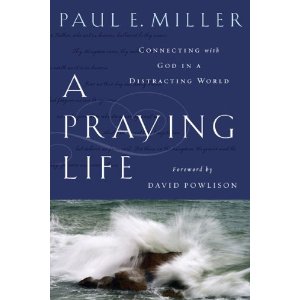
One, is that our lack of some tool or system might reveal a heart of unbelief.  Paul Miller writes: “The bottom line is we don’t write down our prayer requests because we don’t take prayer seriously.  We don’t think it works … I am not naturally a people person, but when I regularly pray for people using some kind of written system, my heart tunes into them.  I am bolder about asking them how things are going because they are already on my heart.”  How many times have I, have you, been talking with someone by phone or Skype and said, “Hey, I’ll be praying for you about that,” and then when we hung up, we never prayed for that need?  Am I, are we just using Christian jargon to make others feel better, or do we really believe that God responds to our prayers?

Second, is that our commitment to a system or tool for prayer might keep us from God rather than drawing us to Him.  Paul Miller describes it this way: “Systems can become rote, desensitizing us to God as a person.  We can become wooden or mindless as we pray.”  Haven’t you felt yourself fall into this trap at times?  You feel like you’re sharing a list with God, rather than engaging Him in heart conversation.

What struck me most is that Paul Miller doesn’t try to solve this struggle for us, by choosing one “option” or another.  He writes: “Remember, life is both holding hands and scrubbing floors.  It is both being and doing.  Prayer journals or prayer cards are on the “scrubbing floors” side of life.  Praying like a child is on the “holding hands” side of life.  We need both.” 

Seeking that balance of both is what makes prayer such a journey worth taking!

Praying In Real Life

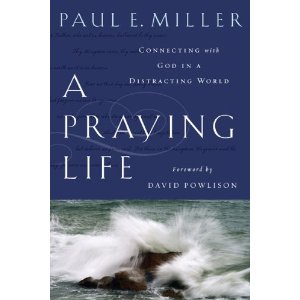
I encourage you to read the last section in the book, A Praying Life: Connecting with God in a Distracting World, called “Praying in Real Life” (chapter 26-32) as we finish our discussion of this helpful book.

David M’Intyre, who I quoted in “Thursday Prayer” last week, wrote this about prayer: “When prayer rises to its true level, self, with its concerns and needs, is for the time forgotten, and the interests of Christ fill, and sometimes overwhelm, the soul.  It is then that prayer becomes most urgent and intense.  It was said of Luther that he prayed “with as much reverence as if he were praying to God, and with as much boldness as if he had been speaking to a friend.”

It is towards that “boldness” in speaking in prayer that we now turn in this final section of Paul Miller’s book.

I would like to invite any of you to submit a blog post to me (international.director@worldteam.org) on one of these final chapters (chapter 26-32) or on a theme that runs through these final chapters.  Each Monday for the next four weeks (starting Monday, March 21st), I will post one of the posts submitted.

Probably even more important though is the prayer we should be praying on behalf of one another, taken from Paul Miller’s comment in his introduction: “that through this book my relatively light suffering will overflow into your life as comfort, freeing you to touch the heart of God.” (12)

Hope And Prayer

Thanks to Mark for today’s post:

“At a recent gathering of workers from the part of the world in which I serve I opened the sessions with a prayer for the group that we would experience community, joy, and hope. Hope, the great center point of the Gospel, is a reality of our pilgrimage with the Master Jesus, but is amazingly one of the least considered elements of prayer we Christians pause to consider.

When you think about it, hope is why we pray. At a minimum it will be difficult to pray if we do not believe, by hope, that God not only hears us (which is only the start of hope), but that he also responds to the cries of his people (the middle of hope), and finally draws together all our yearnings for him in the grand finale of our eternal life to come (in a sense the end of hope, for we will no longer need hope, since all will be revealed in the new heavens and the new earth). But to pray without hope is worse than difficult, it is impossible.

In chapter 24 of his book A Praying Life author Paul E. Miller reflects on hope in the context of family life and he strikes this same chord on the relationship between hope and prayer. “As we wait and pray, God weaves his story and creates a wonder. Instead of drifting between comedy (denial) and tragedy (reality), we have a relationship with the living God…”

Together with you and with our literary companion Paul Miller I want to say “yes!” The dynamic of the relationship between the Lord Almighty and us provides the terrain for hope to grow wild in our bodies, souls, minds, and spirits. And with hope we come again and again, daily, in our prayers to our God and we affirm: our hope is built on nothing less than you, Oh God!”

Feeling Weaker All the Time

Thanks to Karry for this week’s post:

I’ve enjoyed reading A Praying Life by Paul Miller.  I have always wanted to be more committed to prayer and deeper in my own praying.  A few times I’ve felt frustrated, wondering what it will take to spur me ahead in this area.  This book has helped, and chapter 20 touches on one of the things God is doing to teach my heart to pray.

Early in Chapter 20, Miller writes about his prayer for his teenage daughter. “I was keenly aware of my inability to grow faith in her heart.  God just had to do it.”

I’ve really noticed that.  My own inabilities drive me to prayer.  I probably should say they leave me with no other recourse than to pray.  The things that matter most to me are mostly out of my control. 

As I have coached and taught and mentored my three sons from childhood to adulthood, I have constantly been reminded of the reality. Although I work hard to teach them well, in the end, they make their own decisions.  In disciple-making and church planting, it’s similar.  The ultimate outcomes depend on other people’s decisions.

For an action-oriented person like me, this is a very frustrating situation.  My first impulse usually is to figure out what to do, to find a way to solve the problem, to see the opportunity and seize it.  My first impulse is to leave prayer for later.

During our oldest son’s senior year in High School, he developed a relationship with his first girlfriend. The nice young lady had previously dated a Mormon, and during the 18 months our son pursued her, she became increasingly involved with Mormonism.

Charlyn and I, of course, had many talks with him.  Our son desperately wanted to convince her of the falsehood of Mormonism and win her to true faith in Christ.  We were pretty patient.  Our basic strategy was to present biblical truth, sound reasoning, and our own hearts.  But it took forever.  Those 18 months felt like 18 years. 

I realized how weak I really am.  So much hung in the balance.  Could our son get himself trapped in a cult?  Or might he be led into moral compromise?  What was going to happen to our son?  He had to sort it out for himself.  I was completely out of control.

I could only pray.

One thing I learned through that experience is that I really am weak. Seeing my weakness for what it is strengthens my faith in God who alone is strong.  It also moves me to pray.  And when I really see clearly, I can even relax about it.  Even though the most important things in life are out of my control, they are in God’s control!

I wish that were a lesson I had learned once and for all, but my basic makeup has only changed gradually.  A few days ago, Charlyn was exhausted, so I stayed up to help our female dog deliver puppies.  After the dog pushed and groaned for more than two hours, I decided she needed a C-Section.

I woke up Charlyn and, after her more experienced examination, she agreed.  We quickly packed for a midnight run to the vet emergency room.  Then Charlyn said, “Let’s pray.” Charlyn’s first reaction nearly always is to pray.  “Now she’s doing it again,” I thought to myself.  Even though I knew better, I blurted out what I was thinking: “What good will that do.  She obviously has to have a C-Section.  You can pray while we drive.”

Charlyn glanced over at me, her husband and leader.  And of course, we stopped and prayed right then.  Within ten minutes, the first puppy was born and the danger passed.  God is relentlessly working to tame my desperately activist heart.  I’m glad He is patient.  And I’m glad He is so innovative.  He has spoken to me through a Mormon girl, and He has spoken through my son.  He’s even spoken to me through our dog.  And of course, He always speaks to me through my wife.

Karry

PS:  Our son finally broke up with the Mormon girl and put that experience behind him.  Several years later, God blessed him with the woman of his dreams.  They were married in June, 2008 and live in Chicago where he is in medical school and they are members of Willow Chicago Church.

What a Wonderful God We Serve

Thanks to Ray for today’s post:

What a wonderful God we serve….” Just think about God’s creation, the universe. Scientists tell us that the part of the universe that can be detected from earth is about 93 billion light-years in diameter: It might be much, much bigger. The psalmist stated that God stretches out the heavens like a tent (Psalm 104:2). Solomon was inspired by God to state: “The heavens, even the highest heavens cannot contain you (God).” (1 Kings 8:27)  Now, think about the stars. If one divides the number of stars among the six billion plus people in the world, each person would have dozens of trillions of stars.

God, the creator of such a universe, “raised us up with Christ and seated us with him in the heavenly realms in Christ Jesus.” (Eph 2:6) Yet, even though we are seated with Christ in the heavenly realms, circumstances leave us wondering the validity of Jesus’ statement in John 14:14: “You may ask me for anything in my name, and I will do it.” We are aware of the conditions elsewhere in the New Testament which qualify that statement: we must always pray and not give up (Luke 18:1); we must have faith that he will answer us (James 1:6-8); we are to ask in Jesus’ name (John 16:23-24); we must obey his commands and do what pleases him (1 John 3:22); and we must ask according to his will (1 John 5:23). Yet reality easily makes us ponder.

I understand very well Paul Miller’s desert. We all have been there. We all have appreciated the lessons that God has taught us there, the peace that God has given us as a result, the assurance of his faithfulness as we look back at the desert, and the joy that God gives us as we step from the desert into his throne of grace. The biggest lesson God has taught me is to seek to know his will before I pray his will to happen.

These days I seek to pray less glibly for God to heal the sick around me, for God to meet the financial needs of those I know, for God to show his power to my unsaved friends. Rather, I pray that God will guide me in my personal and public prayers, give me the words to say, and then to answer the prayer that he gave me to say. My own self at times gets in the way; my emotions at times blind me. But God continues to lead me unconditionally towards the throne of grace.

God continues to shower his grace sometimes in humorous and surprising ways. Last month, as we were riding on the road past a game park with a visitor and a friend, my wife asked that friend to pray that God would show us some animals. Within a half hour we stopped three times: first to see a bunch of monkeys, second to see a bunch of giraffes, third to see a couple of the largest deer in Cameroon. Our friend was very surprised and joyful. So was I.

Living in Your Father’s Story

Thanks to Albert for today’s post:

“I love the title, Living in your Father’s Story, of Part 4 of this book.  When I try to live out my own story, I tend to use prayer as a way of getting God to fulfill my dreams.  The diagram in chapter 19, page 170, gives good insight on living in my Father’s story.

When I am God-centered, I focus on His power and rest in knowing that He is in control.  When I slip into me-centeredness, I either become demanding, telling God what to do to accomplish my goals or I sink in despair and conclude that prayer doesn’t work because things are out of my control and life doesn’t seem to be working for me.

When I am weary and burdened, Jesus invites me to come to Him for rest.  He tells me to submit to His yoke and learn humility.  He wants me to surrender my desires to be in control.  When I accept Jesus’ invitation and humbly give control to Him the weight of my burdens shift to Him and I experience release and joyous freedom.  I enter His story and discover the wonder and delight of Him living His life in and through me.

My power struggles and discouragements are transformed by a delightful awareness that God is always in control with full power to even use evil to work out His good purposes.  Prayer becomes a delight because it releases me from me—my biggest burden.  I find God praying through me, aligning me with His story, which I know will result in my being part of history—His story.  Wow!  I like it.  I want more of it.”