• Our hope-filled future is bound up in sharing the story of Jesus, in discipling others, in bringing those disciples together into communities of believers, and in developing and releasing those believers to create other communities... till Jesus the King comes again!

Unfinished Stories

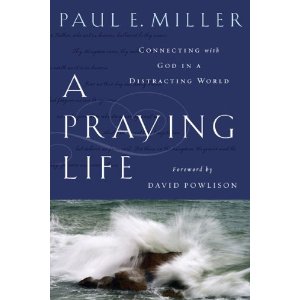
I’m not sure there is any better way to finish our study of A Praying Life other than quoting from the beginning and end of Paul Miller’s final chapter:
In the stories I’ve told in this book, we can see God weaving a tapestry.  In my experience, as we abide in him, he usually shows us what he is doing.  But sometime he doesn’t … We live in many overlapping stories, most of which are larger than us.  Each of us will die with unfinished stories.  We can never forget that God is God. Ultimately it is his story, not ours …

Some stories aren’t tied up until heaven.  Because of Kim, Jill longs for heaven.  This desire permeates her conversation.  Jill doesn’t say, “It’s a beautiful day outside.”  She says, “This would be a good day for Jesus to come back.  Everyone can see him.”  Jill wants to go home.  Living in unfinished stories draws us into God’s final act, the return of Jesus.  While we wait for his return, it is easy to predict the pattern of the last days.  The book of Revelation pictures a suffering church, dying as creation itself is unraveling.  Through suffering God will finally make his church beautiful and reveal his glory.  In the desert you see his glory.  In the last days the bride will be made beautiful, pure, waiting for her lover.  Come quickly, Lord Jesus.”

May the knowledge of the coming return of our King cause us to persevere with grace and courage in a “praying life”!

I would love to hear your reflections on this book in light of these questions.  Please post them as comments to this post.  I will make a summary of that feedback for a future post.

  • What has God shown you about a “praying life” through reflecting on the chapters in this book?
  • How do you desire to grow and change in your “praying life”?

Real-Life Praying

The celebration of the resurrection of Jesus is the most important event in the life of any community of believers.  It is the announcement that Jesus has broken
the power of sin over our lives, and that we can now freely enter into God’s presence to talk and interact with him.  It is a day when we hear our name spoken in a  new way as Mary Magdalene did when she encountered Jesus in the garden (John 20).

Our hope is found in our ‘conversation’ with the Father on a daily basis.  I think that is what Paul Miller is getting at when he writes his chapter on “Real Life Praying.”

Prayer,” Paul Miller says, “is where I do my best work as a husband, dad, worker, and friend.  I’m aware of the weeds of unbelief in me and the struggles in others’ lives.  The Holy Spirit put his finger on issues that only he can solve.  I’m actually managing my life through my daily prayer time.  I’m shaping my heart, my work, my family – in fact, everything that is dear to me – through prayer in fellowship with my heavenly Father.  I’m doing that because I don’t have control over my heart and life or the hearts and lives of those around me.  But God does.”

I believe that, but it is the daily practice of conversation in prayer where I can struggle.  Maybe that is why it is so important to regularly hear the voice of Jesus and be reminded of His great love for me, demonstrated in such a powerful way in His death and resurrection.

Prayer Journaling

When life makes sense, it becomes a journey, a spiritual adventure.  Writing down the adventure as it happens gives us a feel for our place in the story God is weaving in our lives.  Journaling helps us to become aware of the journey.”  Journaling is not one of my strengths or common practices, but I recognize the benefit of processing life from time to time through journaling as Paul Miller describes in the quote above.

What was new to me in this chapter, though, was Paul Miller’s insight that prayer journaling provides a means to ‘become aware of self on the journey.’  It is an avenue to self-awareness. 

Here’s how he puts it: “The modern quest for self-fulfillment is a secularized version of Christianity’s discovery of the self.  Without the Shepherd guiding us to see our true selves in relationship to him, we can lose our way and become obsessed with self. Instead of seeing our bent toward evil, we can become increasingly touchy, supersensitive to self but insensitive to others.  We no longer see ourselves clearly.  The spiritual pilgrimage is the opposite.  The discovery of self in relationship to God leads to a lifestyle of repentance.”  So, a prayer journal could serve as an opportunity not just to process life, but to become more aware of how I am interacting with and ‘being received’ by others.

Two questions can guide this process:

  • “How am I doing?  What is coming at me?  Am I happy, sad, thankful, discouraged, angry, frustrated?”
  • “What is God saying to me?  What does the Word say to me?”

 Writing down our reflections to these questions can help better discern what God is teaching us. 

What’s been your experience with ‘prayer journaling’?

Listening to God

As I re-read Paul Miller’s chapter on, “Listening to God”, I was struck by the common themes that I had also heard during the Central Asia & CH Area Conference on prayer and discernment.  I won’t try to summarize three packed days of reflecting on this topic, but I wanted to come back to one element that stood out both in the book and the conference, and that is the need to cultivate a listening heart.  Let me quote from A Praying Life:


Listening is just one of the things that happens in the course of my soul connecting with God.  You can’t listen to God if you are isolated from a life of surrender that draws you into his story for your life.  And it must be a gospel story. By that I mean your dying, your weakness is what you bring to the table.  God brings to the table his grace, his resurrection … When referring to communication with God, Scriptures assumes that I know what God is saying.  The problem isn’t the activity of listening, but my listening heart.  Am I attentive to God? Is my heart soft and teachable? Am I remembering his ways, his commands?  Psalm 25:15 says, “My eyes are ever toward the Lord.”  The means of communication is secondary to a surrendered heart.  Our responsibility is to cultivate a listening heart in the midst of the noise from our own hearts and from the world, not to mention the Devil.”  (247)


It’s not just ‘listening’ that is fundamental, but cultivating a heart that is tender towards the Spirit’s voice.  Miller says that keeping the Word and the Spirit active together in my life happens as I “saturate my life with the Word, so as to give the Spirit a vocabulary to personalize the Word to me.”


Cultivating such a listening heart is the journey that we are on.


[For more input on this topic, you might want to read, The Voice of Jesus, by Gordon Smith, IVP Press.  Gordon spoke at the recent Central Asia & CH conference)

Prayer Work(s)

I started trying to write out some ‘prayer cards’, like those that we read about last week in Paul Miller’s book, A Praying Life.  It’s not an easy task.  But then I read his short chapter on “Prayer Work” and realized what Paul is talking about is not a task, but a journey; a process in which I am intimately involved with the Father, and with others:

My prayer for Bob had a familiar threefold pattern.  First, I wrote the prayer down.  Then I watched for God to work while I prayed.  Finally God provided an opportunity where I “worked” the prayer request. By worked I mean that God involved me in my own prayers, often in a physical and humbling way.” (236)

In reality, God is working to change me through my work in praying for others.  As Paul Miller writes later, “If Satan’s basic game plan is pride, seeking to draw us into his life of arrogance, then God’s basic game plan is humility, drawing us into the life of His Son.” (238)

How has this been your experience in your journey in prayer?

Prayer “Cards”

I have used a prayer list for years.  So, I was fascinated by Paul Miller’s idea of “prayer cards” which he talks about in chapter 27 of A Praying Life.  Not that I was looking for another “tool”, but I have often felt my list keeping me from greater engagement and conversation with my Father because I “had to get through the list” before I finished praying.

Paul Miller shares that “a prayer card has several advantages over a list.  A list is often a series of scattered prayer requests, while a card focuses on one person or area of your life.  It allows you to look at the person or situation from multiple perspectives.  Over time, it helps you reflect on what God does in response to your prayers.  You begin to see patterns, and slowly a story unfolds that you find yourself drawn into.”

I love the idea of “keeping track of the story” through prayer; of focusing on seeing what God is doing rather than on my ability to get through a scattered list of requests and losing the larger focus. 

It might be worth the effort to try writing out a few cards this week, not as some kind of new “tool”, but as a means to better direct my prayers, your prayers for others.

Prayer is asking God to incarnate, to get dirty in your life.  Yes, the eternal God scrubs floors.  For sure we know he washes feet.  So take Jesus at his word.  Ask him.  Tell him what you want.  Get dirty.  Write out your prayer requests: don’t mindlessly drift through life on the American [Western] narcotic of busyness. If you try to seize the day, the day will eventually break you.  Seize the corner of his garment and don’t let go until he blesses you.  He will reshape the day.”