• Our hope-filled future is bound up in sharing the story of Jesus, in discipling others, in bringing those disciples together into communities of believers, and in developing and releasing those believers to create other communities... till Jesus the King comes again!

Starting Again

It’s that time of year when you are either in the rush of a new academic and ministry year (Northern hemisphere) or moving to the end of your school & ministry year. Either way, it’s a time to step back and remember how God has shown grace to you as His child and how He has used you in His greater missional plan for this world.

Again and again, the Bible calls us to remember: “I will remember the deeds of the Lord; yes, I will remember your wonder of old. I will ponder all your work, and meditate on your mighty deeds.”  (Psalm 77:11-12). The work of remembering has an active rather than a passive sense.  In the Hebrew Bible, the word is: zakar. It means to call to mind, to recall or to recount. It speaks of bringing something to the forefront of one’s mind. One writer put it this way: “to zakar is to employ your hands and feet and lips to engage in whatever action that remembrance requires.”

When we think of the good news that we share, it is so important to remember how this good news is good news for us. We need to “recount” it again to ourselves (and others) today and each day.

This new start or end to our year is also a time to refocus our hearts and minds on what is our calling, our dream as mission community: to multiply disciples and communities of believers among the lost.

It’s easy for us to lose sight of that larger dream and vision in the rush of the new year or at the end of that year. However, we need to remind one another of our calling as a community.

Multiplying” is not something that occurs in a moment. It is an investment in others. It calls for time spent sharing, talking, training, and platforming others. However, the result is that multiplying disciples (and leaders) and communities of believers bears fruit exponentially. Exponentially in the sense that there are more and more and more workers engaging in God’s project to bring the message of Jesus to this world which is in such great need.
Both remembering and multiplying require energy and investment. But the fruit is well worth the energy and investment.

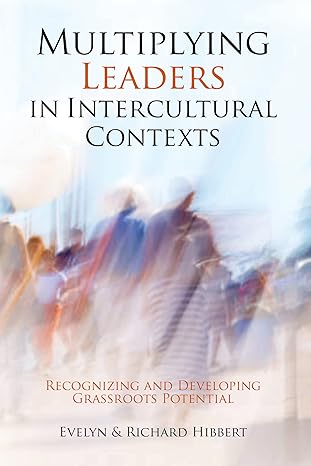
If interested, I recently wrote a book review of the book: Multiplying Leaders in Intercultural Contexts for the journal SEEDBED: https://www.seedbedjournal.com/. The book will give you some tools as to how to remember and invest in others.

Moving mountains

We as a global community of cross-cultural workers are committed to facilitating movements of disciples and churches among those who are lost.  As many writers have observed, church planting or church multiplication movements do not come about as a result of our efforts. They are first and foremost the work of God’s Spirit among a people group.

So, one of the primary means by which CP movements arise is by prayer – fervent, perseverant, and informed prayer on behalf of a people group where the number of believers is extremely minimal. 

It is prayer that is at the top of everyone’s list of CP movement characteristics.  However, two obstacles may keep us from this kind of movement prayer. 

The first obstacle is our desire to “do something”.  Prayer seems like such a passive activity in our minds. We want to be able to engage in some tangible work that would, in our minds, lead to a demonstration of God’s work among a people group.  And yet God calls us again and again to pray.

The second obstacle is a misplaced faith.  Jesus in Mark 11:22-24 says: “Whatever you ask in prayer, believe that you have received it, and it will be yours.”  Alistair Begg comments on this verse this way: “In this bold command, Jesus reminded His followers to trust God, because it is actually faith’s foundation in God that gives that faith significance.  We should not have faith in faith or faith in ourselves, but faith in God alone.”

Once again, we can be tripped up by our own desire to “do something” first, rather than putting our faith in God alone and letting Him direct our actions as He builds a movement among people groups.

Begg goes on to write: “When God is the object of our faith, we can have an audacious faith – a faith that believes the impossible to be possible with Him.  We can know that we are speaking to someone who is able to do far more than we can even imagine (Ephesians 3:20-210. Jesus essentially says to us, I want you to pray in a way that says you actually believe in a God who is too wise to make mistakes, who is too kind to be cruel, and who is too powerful to be subdued by the normal forces of the universe.”

As we look forward to 2023, let us ask God to give us this kind of audacious faith as we pray for CP movements among people groups across this world.

I joined a movement

I often say that I am part of a mission. And that is completely true.

I also say that I belong to a grouping of churches which ‘sent out’ my family and I to serve Christ in another place, in another culture.  And that is true as well.

Recently though I am beginning to say that I am part of a movement.

Saying that is more than just an exercise in semantics. There is depth and commitment behind the truth that I belong to a movement.

A movement in simplest terms is a grouping of individuals or organisations who work together to advance their shared idea, activity, or ministry objective. Being part of a movement means we work collaboratively and collectively, and leverage all our resources together for the growth and development of the movement.

There is fluidity and flexibility to a movement in its outworking in different contexts.  There is loads of room for creativity and innovation.

Yet, something ties the movement members together.  There is alignment in mission and direction.  There is a willingness to lead, and there is a willingness to follow.

What ties the movement members together though is the desired outcome.  For us as WT movement members, it’s seeing multiplying groups of disciples and communities of believers among the lost

But the hardest step in staying in step with the movement is learning yield; to humbly give up what we may want or think is the (our) right way to do things, to serve the larger desire and outcome of the movement.

Multiplicational ministry

I recently read the following quote:

Here, then, is the shape of mission for … the twenty-first century.  Here is the way ahead – a team of focused missionaries who have caught the vision of church multiplication, who have seen the larger picture, who understand that biblical multiplication of reproducing churches results through a determined equipping of local believers for the work of church planting.  It is a vision that calls for a new breed of missionary. One who finds fulfillment, not so much in gathering the harvest, but who by investing his or her own life and energy in the training of others, assures the multiplication of that harvest beyond anything they might have done alone.”

It seems to me that there are a lot of ‘strong’ words in this short quote: ‘the way ahead’; ‘focused missionaries’; ‘seen the larger picture’; ‘a determined equipping’; and ‘a new breed of missionary’.

However, it was the last line that set me back a bit on a first (and even second) read.  The writer argues that investing in others, training them, “assures the multiplication of that harvest beyond anything they might have done alone.”

Multiplication.  It is part of what we say we are all about as World Team workers.  Yet, it is a tricky concept to get our hands around and see how it should work it out in our day to day ministries. 

The author of this quote simply pushes us back to the importance of investing in others (spending the time and energy) to train them to carry out the ministry.  This is the exhortation that Paul gives to us in Ephesians 4:12 – “to equip the saints for the work of ministry”.

Investing in others for the purpose of multiplication bears fruit in the long term, not necessarily in the short term.  The investment is well worth the effort because what is left behind after we leave is a growing number of people carrying out the ministry, and multiplying themselves in others!

One question, though, came to mind and caused me to assess my commitment (or determination) to invest in others and “assure” that kind of ongoing multiplication: What do I prefer more: to do a ministry activity myself OR spend the time it takes to train another to carry out that activity (and as a result be recognized by others)?

Moving to more of this kind of investment and multiplication probably starts by addressing our own pride and desire to be recognized and valued by others.  We must constantly remind ourselves that ‘the God of all grace’ (1 Peter 5:10) is the One who loves us with an unfailing love and called us to be part of His family, His global spiritual community.

By the way, the quote above?  It was written by Joe Conley when he described the outcomes of the Caliraya conference (the launching of our united mission) in 1999 in the Philippines! Just put “WT in” in place of the 3 dots in the early part of the quote.

Nationals do it better

Some of us remember this statement from many years ago.  However, it has lost none of its relevance and importance to the work of multiplying disciples and communities of believers.

Nationals do it better” is meant to focus our eyes on the ‘end’ as well as the process of ministry. prayerart0508_01

The ‘end’ to which cross cultural ministry is directed is a movement of multiplication across a people group. The most fruitful or effective way for this to happen is when national believers take responsibility for the ministry.  One researcher noted that no long term church planting movement has ever been launched or carried out by expat workers.  If that is the case, then more effort needs to be made in investing in others.

Investing in others, particularly nationals, runs into a number of potential hindrances.

First, the hindrance of short term fruit versus long term fruit.  The work of ‘investing in’ others is long term.  You will not see the fruit or results of working to help others grow in Christ in a short period of time. This is why we often prefer to do the ministry ourselves.  Fruit comes more quickly, but may not be the long term fruit needed to see a ministry multiply in the long term.

Second, the hindrance of a limited view of the Spirit’s work in the lives of others.  How many times have we thought our efforts wasted when no discernible fruit was seen in the lives of those we discipled?  Yet, at a much later point that effort finally yielded more fruit than we thought possible. Our efforts were not in vain (1 Corinthians 15), the Spirit applied the truths of Scripture at His appointed time, and we learned that these national believers did a better job of sharing those same truths with others.

Finally, the hindrance of wrongly attributed glory.  We can be unaware of how often the ministry centres on us.  If we listen to our conversations (or read our prayer letters), it is uncanny how often we talk about ‘my ministry’ or ‘the church I am leading’ or ‘the small group I started’.  The glory is being attributed to the wrong person. God seeks for ‘all the saints’ to be participating and ministering in this temple He calls the Church. The glory goes to him as we give away the ministry to those we serve.

Nationals do it better” means we look long term, we trust the Spirit, and we decide that “whether we eat or drink, or whatever we do, we do all to the glory of God.”  (1 Corinthians 10:31)

Learning how to celebrate when we get it right

A number of us are complainers by nature. Part of the reason may stem from the fact that some of us have a perfectionist streak. Part of the reason may also stem from the fact that we don’t really like it when others achieve what we were hoping to achieve; in other words, we don’t really like it when others ‘do better’ than us.

As a result, we can have trouble celebrating with others when God brings fruit to their ministry. We can struggle to rejoice with others‘ when they get it right’ by accomplishing what we say we are all about: multiplying disciples and communities of believers.celebrate

Recently, I have read about how the community of believers launched by the efforts of Bryan & Jacinda (WT Philippines) and their team continues on in outreach and growth. That news should warm our hearts as we recognize God’s power in the lives of new believers to give them the faith and the capacity to carry out the ministry.

I also recently read about Dan, Lisa, Mike and Becky’s (WT Cameroon) efforts to translate the Bible into the Oroko language. They are within sight of completing that task, thanks in part to the partnership between their team and a number of national workers. Not only are they on the throes of putting the Word of God in the language of another people group, but they have ‘multiplied themselves’ through the number of others with whom they are working.

I’m sure there are a number of other examples I could cite.

I don’t know what ‘celebration’ should look like. Maybe it’s just a word of thanks sent or a prayer offered back to God or a big shout of praise. Whatever form it takes, it should start in our hearts as we learn together as a WT community to rejoice with others at what the Lord is doing among us.