
• Our hope-filled future is bound up in sharing the story of Jesus, in discipling others, in bringing those disciples together into communities of believers, and in developing and releasing those believers to create other communities... till Jesus the King comes again!

It only takes a few

loadgame_tippingpoint_logoInnovation, the act of bringing creative ideas to life, is one of the pillars of our global vision.  I would love to see groups of WT workers contextualizing innovative approaches to discipling others in Christ.  If a fire could be lit to stir all of us towards innovative, entrepreneurial approaches, just imagine what fruit might be born.

However, trying to move a whole community in this direction at once is tough.  It really only takes a few, who are ‘full on’ in that direction, to inspire and enthuse the rest of us.

Malcolm Gladwell in his classic work, The Tipping Point, relates one of many scenarios where dramatic change was observed: “What happened is that the small number of people in the small number of situations in which the police or the new social forces had some impact started behaving very differently, and that behavior somehow spread …

Just a few ‘started behaving very differently’ and others were influenced.  A biblical example would be found in Acts 11 where a few started behaving differently by sharing the Gospel with Greek speaking Jews.  They stepped out of their then known cultural context of sharing Christ only with their people to go to a different people group.

We need to give space to ‘a few’ to inspire and motivate us towards more innovative, risk filled ministry.  We need to pray, support and facilitate ‘a few’ so that we can learn from them and be influenced by them.

Maybe you are one of the ‘few’?  Maybe you are one those willing to pray and facilitate ‘the few’?

Innovative teams mean ‘we’ work together

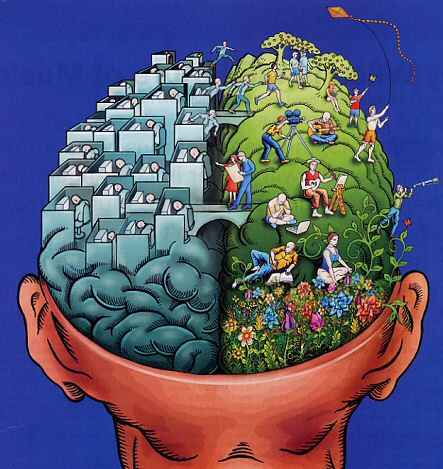
Innovative, creative types are usually right brain people.  At least that is what we have been telling each other for years.  The thinking is that if we are to get innovative, entrepreneurial approaches going in our agency, we need to bring in more right brain people, more “creative” types.left-brain-right-brain

In a recent scientific article, “The Real Neuroscience of Creativity,” this long held idea is challenged.

Scott Kaufman states: “The latest findings from the real neuroscience of creativity suggest that right brain/left brain distinction is not the right one when it comes to understanding how creativity is implemented in the brain … the entire creative process – from the initial burst of inspiration to the final polished product – consists of many interacting cognitive processes and emotions.”  This all sounds pretty dry up to this point.

However, Kaufman goes on to say: “Importantly, many of these brain regions work as a team to get the job done, and many recruit structures from both the left and right side of the brain.”  It was at this point that I made the jump to us as an agency.  Basically, Kaufman is stating one of our values, but in scientific language.  We need one another.  Creativity and innovation happen because all different kinds of people get involved in the process.  It is not the domain of one kind of person or personality type. Innovation happens best in community.

Working on innovation through community is where things can get messy. Others may put ideas on the table that you or I consider outlandish.  Others may challenge our ‘creative and innovative’ ideas, forcing us to re-think their realistic application.  Yet, as I appreciate each person in the process, I gain a different perspective and participate in the creation of truly creative and innovative ideas.

Techie Prayer

In a post last month (24.01.2012), I asked the question as to whether you were “gathering for prayer.”  That post was meant to be an encouragement about trying creative or original approaches to “gather in prayer” for one another.

Well, yesterday I saw an example of such an innovative approach.  As the team here in France gathered for their annual retreat, they began their time in prayer and worship.  The facilitators of this part of the retreat said that we would be praying for each one of our ministries in Europe.  Using their computer screen and an external speaker, they ‘skype-ed’ in each one of the leaders of our European teams.  Each person was given a few minutes to share key prayer items.  One of the facilitators translated each request into French.  When each leader was finished sharing, we prayed together with that leader, and then moved to the next leader.

I don’t know how those other leaders felt, but I can tell you that the time spent together not only enlarged the vision of our Franceteam members, but also unified their hearts in ministry with colleagues in other places in Europe who are experiencing many of the same joys and frustrations.

Neither the distance nor the language posed a problem for the Franceteam.  All I can say is “bravo” to those facilitators for coming up with such an idea, and “thanks” to God for allowing us to share with one another in this important way!


What do you mean when you say “innovation”?

I am sometimes asked a question in light of our global vision statement.  It goes something like this: “What do you mean when you say ‘innovation’?”  Rightly so, it is hard to be intentional about something, if we don’t understand what we mean by the concept (see 04.01.2012 post)

Wikipedia defines innovation this way: “Innovation is the creation of better or more effective products, processes, services, technologies, or ideas that are accepted by markets, governments, and society. Innovation differs from invention in that innovation refers to the use of a new idea or method, whereas invention refers more directly to the creation of the idea or method itself.”  This is somewhat helpful, particularly the distinction between invention (or creativity) and innovation.  However, it still doesn’t help us answer the practical question.

The word innovation also comes from the Latin word meaning “to renew or change.”  So, innovation is the process of initiating change or renewal.  However, what does that look like?

The more I thought about it, the more I realized that the harder I try to “define” innovation, the farther away I move from it.  Rather than defining it, here are a few concrete examples. From these we can discern what innovation means and might look like in our context.

  • A worker in Asia proposes to his board to buy a storefront and open a training school for refugees temporarily resettled in his country.  Being a certified chef, he suggests the school train refugees in food preparation, a marketable skill in most places of the world.  From the very start of the course, this worker talks openly and freely of his faith, offering opportunity for students to share needs and for prayer to be offered.  An innovative approach to outreach.
  • A worker in Europe sees several people come to Christ.  These new believers express a desire to study the Word, and they agree to meet for Bible study once a week.  The worker wants to implicate new believers more quickly in owning and taking responsibility for gatherings.  At the very first meeting, the worker deliberately does not show up.  When these new believers realize that the worker is not coming, they start the study themselves and continue on for weeks before recontacting the worker.  An innovative approach to discipleship or small group leadership.
  • Given the prolific number of cell phones in our world today, one group of workers developed short videos that presented the person of Jesus Christ.  They then sent these videos out to numerous contacts in ‘closed countries’ where they served.  Many came to a personal relationship with Jesus Christ as a result.  An innovative approach to sharing the Gospel.

A creative idea that leads to prayer and new approaches.  What do you mean when you think innovation?

Mushroom Eaters

We long to be more intentional this year in our outreach, our discipleship, our mentoring and our own personal growth and development.  Should we not also long to be more intentional in our innovation?

Jay recently shared this quote from Erwin McManus which speaks to this desire:

The Church Communication Network sent me an invitation to do a session on leadership in one of their national conferences… I would follow one of the most credible experts on church leadership… I was honored… Somewhere in his lecture he started to say something that totally threw me. Point-blank he instructed, “Don’t be an innovator; be an early adaptor… the innovator is the guy who eats the poisonous mushroom and dies. The early adaptor is the guy right next to him, who doesn’t have to eat it…” After thanking him for his amazing contribution to the body of Christ and for mentoring me through his books and ministry I went on to thank him for a new metaphor for my life. I am a mushroom eater… Any day now might be my last supper. But without risking the poisonous mushrooms, we never would have discovered the joys of portabellas. The barbarian call is just this simple; we are called to be mushroom eaters. A world without God cannot wait for us to choose the safe path. If we wait for someone else to take the risk, we risk that no one will ever act and that nothing will ever be accomplished. John the Baptist was a mushroom eater, and it cost him his life…”  [From: Erwin Raphael McManus, The Barbarian Way: Unleash The Tamed Faith Within, Thomas Nelson, Nashville: TN, 2005]


Maybe we should start praying to be “mushroom eaters”; choosing to take the risk and not be satisfied with the safe path.

Applied “Out of Context” Thinking

I’ve done a good deal of reading the past few weeks, and one author I read mentioned the following YouTube clip.  As a preliminary introduction to the clip, he wrote: “The church has an amazing opportunity to become what God is hoping it will become. It’ll take the resculpting of our organizations and corporate culture, the incubation of new art forms, new languages and expressions, new symbols, flexible ways of being organized and led, and even a fuller explanation of what we know as the gospel.” (Underline mine)  I was intrigued, and so I watched.

I was struck by the fact that here was someone trying to apply “out of context thinking” to the very message we seek to contextualize and share.  Now you may not wholeheartedly agree with how the clip presents the Gospel story, but I would suggest we consider one bigger question: What could we learn from such a presentation that would aid or influence our sharing of the Gospel story?