
• Our hope-filled future is bound up in sharing the story of Jesus, in discipling others, in bringing those disciples together into communities of believers, and in developing and releasing those believers to create other communities... till Jesus the King comes again!

Why asking questions is so important

Sometimes in conversations with others, without realizing it, we work from certain assumptions.  For example, we assume the person we are speaking with is more of a talker than a doer.  So, we may have a “good” conversation, but in the end, we assume nothing will really come of the discussion. 

Our assumptions keep us from asking good and powerful questions in those conversations.  Our assumptions keep us from moving forward in our relationships with others to better understand where they are coming from and how we can better serve and work together with them.

Asking powerful questions is a skill each of us needs to learn and in which we need to grow more. 

The book, Crucial Conversations, is required reading for each Leader Cohort group (young emerging leader training).  One thought that the book drives home is the importance of building a “pool of shared meaning”.  That “pool” contains the ideas, theories, feelings, thoughts, and opinions that each person has as they come into a conversation.  The more information we have in the pool, the better prepared we are to understand another, make decisions together, and see results.

Asking powerful questions will help us better understand the other person and clear away assumptions that may be clouding and influencing how we see the other person. Answering questions or making statements are our default mode. But as a friend once said to me: “It’s the person asking the questions who is directing the conversation, not the one answering the questions.”

Let me push the idea a bit further. We as a community of cross cultural workers are called to share the Gospel with those who have not heard the message of Jesus and turned their back to Him.

At the same time, we as a community are called to live out, to demonstrate the work of the Gospel in our own community. The Gospel has to change us at the same time we call others to acknowledge Him as Lord and Savior.

One way to ensure this happens is to grow in practicing asking powerful questions of one another.  Questions that challenge one another to love well and build that “pool of meaning” so we might understand and serve one another better.  As an overflow, those around us will see a model for engaging others well and learning to work through struggles and conflicts we have with one another.

Working one’s strengths

[Joi shares her response to David’s last blog post]

In David’s last blog, he challenged us to think about helping a person grow. But how can we actually help people grow? Since this is a large part of our calling as multiplying “disciple-makers”, it’s worth a think. Yet, because people are naturally very complex, the process can seem daunting.

What if we focus on growing an area of capacity and calling rather than on improving an area of great weakness?

When we start looking for an area of growth, we often look for places of weakness. But God has called us and equipped us in certain ways. He values these gifts. So, increasing our capacity in what we do well is a good investment.

The best opportunity for people to grow and develop — and net the greatest return on investment — is to identify the ways in which they most naturally think, feel and behave, and then build on those talents to create “strengths”. And, knowing one’s own dominant talents and strengths and those of others is an easy way to improve one’s own self-awareness and understanding of others.

I’ve been using a resource, “StrengthsFinder”, that helps me identify the natural “strengths” of individuals. I’ve found that when we better understand how God has hard-wired a person, we are more able to recognize areas for concrete development. When we better understand how a person is gifted to serve others, to live out the functions of Christ’s body, we can better focus on realistic places for growth. Identifying the growth need is an important part of the process. Then, one can describe ways to demonstrate tangible increments of improvement. And, then begin working a growth plan.

Let’s go back to David’s challenge: What could this person become if they gave energy to this one area of their life and ministry?  

Consider using assessments like “StrengthsFinder” (and others) to help us perceive “this one area”. Take time to investigate the area for growth. It honours the Father to invest in His creation. Our Father will give us His glasses to help us see an individual’s need and potential. Thankfully, the Holy Spirit, who knows us much better than ourselves, gives us much wisdom as we invest in this important process.

Had any good conversations today?

A large portion of our work as cross cultural workers aconversationnd leaders consists in engaging people in conversation.  As I thought through my day today, I easily had over five significant conversations.

The question I am asking myself in light of all those conversations is: did I have any good conversations today?

When I say ‘good’, I’m asking myself if any of those ‘significant’ conversations built up another, brought hope back to someone, caused us as a ‘conversation’ group to move a project further along, allowed another ‘into’ my life  to hear my heart, or influenced a young believer in their walk with Christ.  That’s what I, we, should aspire to when ‘talking’ or conversing with others.

If we were honest, a number of our conversations are not ‘good’; not ‘good’ in the sense that there is no purpose or fruit from the time spent talking together. Sure, there are  times when our conversations are moments of jovial fun and laughter.  However, if the majority of our conversations consist of nothing more than lighthearted humor, we should probably ask more regularly: did I have any good conversations today?

Here are a few ideas to assess ourselves when we have a conversation in the next few days. Perhaps these might help us better see the import, the ‘good’ of our conversations:

  • If you were to summarize the conversation you just had in one sentence, what would you say?
  • How many questions did you ask, and how many questions did you answer?
  • If you were the other person in the conversation, how would you have felt when the conversation was over?

“… but only such as is good for building up, as fits the occasion, that it may give grace to those who hear.” 

Another take at unpacking the idea of ‘over-questioning’

I find so much good in the ‘sharing of ideas’; in that part of community where we can help each other ‘grow up in Christ’ as we ‘sharpen one another’ through robust dialogue.  Carolynfun-moving raised a question which led to some further ‘unpacking’ of an idea.

Then another person wrote back with what I felt were very insightful comments. In fact, I responded to this person by saying: “I think you did a way better job of expressing what I was trying to say in my original post.”

Here’s what that person in the World Team Global community wrote: “I appreciated Carolyn’s question, because it reminded me of my experiences as a critical/analytical thinker. Many people took my questions or critical comments, when all I felt I was doing was examining the issue. This happened more when I wrote than in face to face exchanges.  For me, there was no motivation to go after someone, no hidden agenda. The motivation was a questioning mind which wants see all possibilities, hindrances, watch for missing information etc. But this sometimes came across to those with other thinking styles as plain critical, or too perfectionist.

On the other hand, some people would realize what I was doing, and encourage others to listen, to hear me out. But when it comes to asking questions, there are ways to phrase and ask questions in an appropriate way. How we talk can sound like a know it all, arrogant and disrespectful.

One thing I know from myself, is that critical thinkers can come across as having all the questions and no solutions. I have had to learn to know the difference between tearing down and building up. Paul says knowledge puffs up; love builds up. That is the bottom line.”

What stood out to me, what ‘sharpened’ my thinking were three things.  First, the good reminder, said in another way, that asking lots of questions is not wrong.  Second, other people need to get involved in helping a group to receive well the input via questions of one member of the group. It’s a community project.  Finally, growth in self-awareness led this writer to ‘adapt’, to contextualize his questioning mind, in light of biblical principles to the need, growth and development of others.  Did he stop asking questions?  I don’t think so, but he obviously grew in knowing how to exercise
his ‘gift’ for the benefit of the group.

Unpacking the idea of ‘over-questioning’

If you didn’t see it, Carolyn commented on yesterday’s blog post by writing: “David, I enjoyed this thought. Can you “unpack” or expand on this idea: “First, at times ‘over-questioning’ is a smokescreen for our criticism, not our constructive, critical help. We simply want to prove that we are right about the theological or missiological standing behind our comments, rather than help the brother or sister move a new idea forward.unpackinggraphic

So here goes.  ‘Over-questioning’ is when we ask lots of questions where the primary focus is to ‘take apart others’ ideas’.  Our objective is not first to come alongside and assist the other to ‘improve’ the idea by our questions.

If we push back on the someone’s implied criticisms through their questions, we often get a response such as: “I’m just asking questions. I think there are some missiological and theological issues at stake here.

All those questions are just a ‘smokescreen’ as to our real intent in the discussion.  There is nothing wrong with asking lots of questions.  However, the Gospel searches out the motivation behind our questioning; seeking to separate out self-centeredness from other-centeredness.

Other-centeredness causes us to have a different view of others and their ideas.  Our questions become the means by which we can ‘develop others’.  And sometimes, ‘development’ means we just need to let people try and see what the Lord might do through their ideas.

I wonder what the Lord, and the disciples, thought when Peter asked to step out of that boat.

The art of sacrifice in a region (Europe)

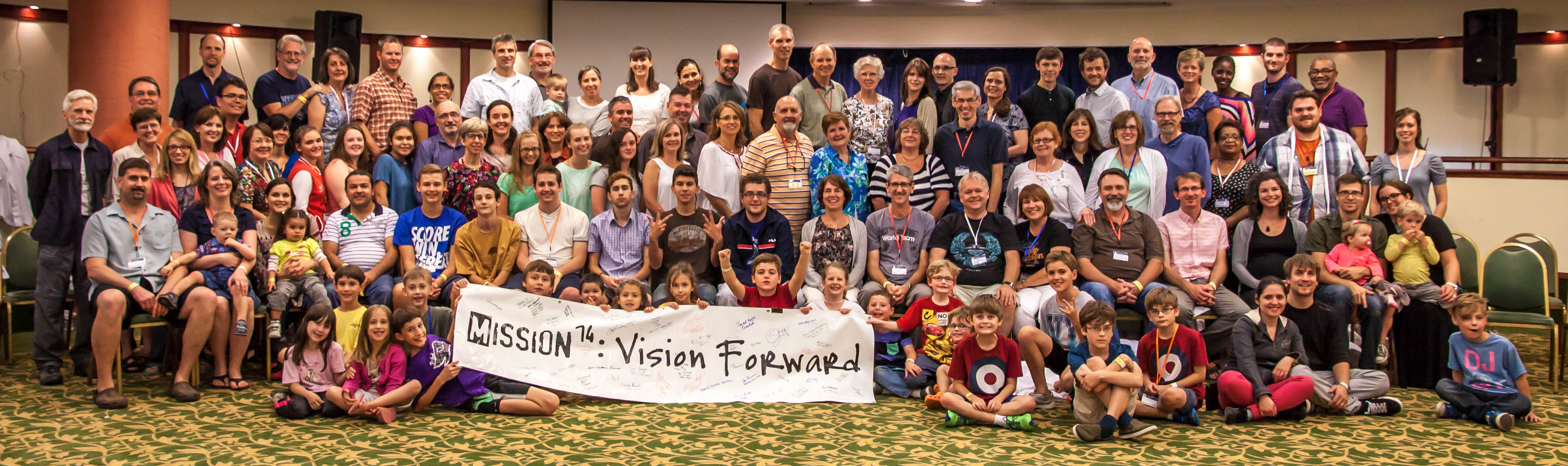
The Mission¹⁴: Vision Forward Europe conference was the final Area conference in 2014.  The conference focused on personal and leader development with presentations by Albert, Steve and Mark, and  was furthered through small group interaction. One highlight was the number of new workers partnering with WT Europe since the last Area conference.  About 15-20 workers have joined WT Europe within the last three years and a number of those workers come from partnerships with other like minded agencies.2014 Europe Conference Picture 2

As I wrote in the previous post, “I shared a number of challenges with each region or Area.  The purpose was to affirm and celebrate what God has done through us over the past few years as well as to challenge Area members to “excel still more” in their work and ministry for Jesus.”

During the WT Europe conference, I shared the following challenges.

First challenge: give away the ministry. Though our drive may be to hold on to the ministry, we must allow, empower, and give others the responsibility to carry out spiritual ministry.  This calls for a strong grasp of the Gospel which reminds us that our ultimate value is not to be found in our work, but in Him.  Multiplication then is a natural outgrowth of a heart that is centred in the Gospel.

Second challenge: choose afresh apostolic rather than pastoral.  A cross cultural worker is by nature someone who is concerned with the spiritual state of others; he/she has a pastoral stance towards others in the sense of wanting those apart from Christ to come into a personal relationship with Him.  However, our calling is to be starters and equippers; our calling is an apostolic one.  We can easily fall into a pastoral stance and inhibit the development of nationals to build and shape the ministry. From the start of any new work, our approach needs to be apostolic.

Third challenge: live in and out of community.  Our values can make great sound bites.  However, for our values to become the compass by which our work and ministry is directed, we must work out those values in the context of community.  The TC4u challenge was a reminder to the WT community of our need as workers to find and build a community where we can speak into others lives as well as allow others to speak into our lives.

Fourth challenge: learn to measure progress.  Numbers are important, but stories tell so much more.  The challenge is to do both well.  Metrics is not a pleasant word for many, but we are called to give an account of what we have done with the resources God has placed at our disposal.  However, accountability is not just about counting disciples or churches, but also about demonstrating the progress and growth that has occurred.   Both are needed and that is the challenge that faces all of us.

I share these challenges given to the WT Europe workers with all of us both as a reminder of the challenges given, but also as a motivation to pray for one another as we seek to learn the further change and growth to which God is calling us.