• Our hope-filled future is bound up in sharing the story of Jesus, in discipling others, in bringing those disciples together into communities of believers, and in developing and releasing those believers to create other communities... till Jesus the King comes again!

Being Mission-ALL is Four

After this I looked, and behold, a great multitude that no one could number, from every nation, from all tribes and peoples and languages, standing before the throne and before the Lamb, clothed in white robes, with palm branches in their hands, and crying out with a loud voice, “Salvation belongs to our God who sits on the throne, and to the Lamb!””
The apostle John, in two short verses, captures the vista of God’s activity in the world and His overarching purpose.  As the church universal gathers around the throne, we see that God’s “mission”, His ultimate objective is the salvation of those who would be entered into His worshipping community.  A fourth element that should characterize the community of believers is that it would be “mission-ALL”. 

To be “mission-ALL” means that the community has an identity and a role that is intimately connected with God’s greater desire or mission.  The community aligns all of itself, centers all of itself around God’s desire to reach out.  One writer states: “Mission belongs to our God.  Mission is not ours; mission is God’s.  Certainly, the mission of God is the prior reality out of which flows any mission that we get involved in.  Or, as has been nicely put, it is not so much the case that God has a mission for his church in the world but that God has a church for his mission in the world.  Mission was not made for the church; the church was made for mission – God’s mission.”

To be “mission-ALL” is not an activity that happens outside the context of the community; something that we do “out there” and that is somehow unrelated to who we are as a community. 

At the very least, to be “mission-ALL” means that the community acts, lives and works, at all times, both gathered and scattered, in ways which are an outflow of their identity and which demonstrate their active engagement in God’s work in this world.  So, what might that look like in the cultural context where you serve?

Communion is Three

We could use a variety of other terms to describe what we are talking about next in regards to the church: fellowship, community or “koinonia”.  When we normally use this word in Western contexts, we mean the activity that happens outside of the time when the community of believers gathers together.  You know, the “fellowship time (or hour)” afterwards, where we share a cup of coffee and conversation.

Yet, the Bible describes “koinonia” as “having a share with someone in something;” in other words, mutually associating and participating with others in Christ.  We “fellowship” with another when we acknowledge our common participation in the life of God in Christ and share that communion by the way we love one another (John 13:34) which is the distinguishing mark of the community of believers.

Communion, centered on the Master’s love, must imply a deeper engagement and participation with one another.  In the context of the community gathered, it manifests itself through the exercising of our spiritual gifts for the growth of one another, through the bearing of one another’s burdens and struggles, through confession and the offer of forgiveness to one another, through praying for another, or through sharing our resources freely with one another.  It is ‘one-anothering’ from the heart.

One writer wrote this about the communal life: “The Graeco-Roman world of the first century was characterized by a sense of isolation and longing for community similar to our own, and there can be no doubt that it was the richness of its communal life which was one of the major attractions of the Christian faith to others of their day.”

Jesus said it this way: “Let me give you a new command: Love one another.  In the same way I (Jesus) loved you, you love one another.  This is how everyone will recognize that you are my disciples – when they see the love you have for each other.”  (The Message)

Reading & Studying the Scriptures Together is Two

The early church is described as being “devoted to the apostles’ teaching and fellowship, the breaking of bread and the prayers.” (Acts 2:42) Though this is not an exhaustive list of the possible elements or functions of a church, it certainly provides an insight into those elements which were considered vital. 

The community of believers were devoted to, committed to or “continually keeping in close company with” the Word of God that had been revealed to them through the apostles teaching (the ‘didache’).  In other words, they were giving significant time and effort to reading, listening to and studying the Word of God together .

What we have said so far, most of us would consider a given.  The difficult question to answer is how this works out when the community gathers.  This is where we confront our own cultural backgrounds or biases towards a particular way or outworking of this element of community life.

The Bible, however, provides a variety of examples for our reflection:

*        Sometimes each member shares teaching or challenges with the other members of the community (Colossians 3:16)

*        Sometimes the community “studies” together to understand the Word (Acts 17:11)

*        Sometimes time is given to the straight up reading of the Word (1 Timothy 4:13)

*        Sometimes a person “teaches” others in the community from the Word (Acts 6:4)

*        Sometimes shared teaching is done so as to equip other members of the community for service (Ephesians 4:11-12)

In each of these examples, we see an interaction between members of the community; all are participants together in reading and studying the Scriptures.  Martin Luther talked about the need for “brotherly conversation and the Bible”.

As we think about what we mean by “church”, we must grapple with the appropriate cultural forms of these functions of the community, in particular having a passion for God and reading and studying the Scriptures together.

Praying In Real Life

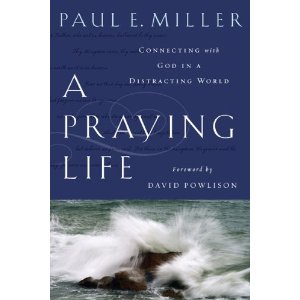
I encourage you to read the last section in the book, A Praying Life: Connecting with God in a Distracting World, called “Praying in Real Life” (chapter 26-32) as we finish our discussion of this helpful book.

David M’Intyre, who I quoted in “Thursday Prayer” last week, wrote this about prayer: “When prayer rises to its true level, self, with its concerns and needs, is for the time forgotten, and the interests of Christ fill, and sometimes overwhelm, the soul.  It is then that prayer becomes most urgent and intense.  It was said of Luther that he prayed “with as much reverence as if he were praying to God, and with as much boldness as if he had been speaking to a friend.”

It is towards that “boldness” in speaking in prayer that we now turn in this final section of Paul Miller’s book.

I would like to invite any of you to submit a blog post to me (international.director@worldteam.org) on one of these final chapters (chapter 26-32) or on a theme that runs through these final chapters.  Each Monday for the next four weeks (starting Monday, March 21st), I will post one of the posts submitted.

Probably even more important though is the prayer we should be praying on behalf of one another, taken from Paul Miller’s comment in his introduction: “that through this book my relatively light suffering will overflow into your life as comfort, freeing you to touch the heart of God.” (12)

Passion for God is One

Knowing that fundamentally the church is the community of all those God has brought into His family, His body, then how do we describe what the church does, in other words, what are its functions, markers or expressions.

I think we would be hard pressed to not say that worship is a central expression or marker of the community of believers.  John Piper writes: “Missions is not the ultimate goal of the church.  Worship is.  Missions exists because worship doesn’t.  Worship is ultimate, not missions, because God is ultimate, not man.  When this age is over, and the countless millions of the redeemed fall on their faces before the throne of God, missions will be no more.  It is a temporary necessity.   But worship abides forever.”  

When the community gathers, passion for God must be a central expression of that gathering.  Worship, then, cannot be confined to just one part or one “activity” of the community; it is to infuse the life of the gathered community.  But, passion for God is meant to also inflame our daily lives as the community scattered, for “whatever you do, in word or deed, do everything in the name of the Lord Jesus Christ, giving thanks to God the Father through him.” (Colossians 3:17)

So, how then does the community work out this central expression, this critical function?  Through allowing grateful hearts, passionate hearts to find substantive outward expression.  Let me try to give an example.  People will often cite ‘singing’ as a key element of worship.  Certainly, singing can be a means of worship.  But if the ‘form’ is mistaken for the substance, then singing becomes an activity in the program, rather than a true expression of grateful hearts, passionate for the God they love.

This is certainly not an easy conversation, but remember that we are looking at “what we mean by “church” so that it provides a common base for all from which to work and which allows the functions of the church to take appropriate cultural forms where the church is established.

Universal … and Local

God, by His initiative, draws us into His community; “the community of all true believers for all time.”  We quickly want to move on from this ‘universal’ concept to the more practical ‘local’ concept.  Communities of believers are both, but the universal concept highlights for us the reality that we are not alone, that we are not marginal.  The people of God are a community bigger than we think.

The Scriptures describe the people of God at numerous points as those called to gather or stand before the Lord (for example: Exodus 19; Isaiah 2:2-4; 56:6-8; Hebrews 12:18-24; and Revelation 5; 19:6-10).  Reading chronologically, this gathering becomes larger and larger.  In some way, when we come together as a community of believers, we gather in the presence of a much larger community.  

One author put it this way: “Our gathering together is not incidental – the church is the assembly of the people of God.  Moreover, as we gather we stand in the presence of the Lord.  We are in the company of the angels and of all believers.  We gather with Abraham, Isaac and Jacob; with David, Elijah and Isaiah; with Peter, James and John.  Above all we come where Jesus our Savior is.”

In a very real way, when we come together as a community of believers, we gather in the presence of our Master Jesus. 

We also recognize that God’s drawing of His people into community, to stand in His presence, always give rise to a particular expression or response.

So, how are you doing discipling your Singaporean student to grasp the concept that ‘church’ is first of all a community of believers called to gather with Him, defined by their relationship to God and initiated entirely by the Father, Son, and Holy Spirit?