
A couple of weeks ago, I read this story sent by a good friend who served with World Team for many years. The honesty with which he shared spoke to my heart and reminded me that God does use all things for our good and for His glory. Here’s the story:
I learned yesterday of the passing of my uncle, Milton, 98 years of age, herald of the Gospel for 2 decades in India and another 2 in Surinam.
The last time I talked to him was probably 20 years ago. We were sitting in the shade on a pile of rocks and I was complaining to him that I had been given a job that was beyond me, nothing was working out like I had hoped, and I couldn’t see what good it all would do in the end.
“Let me tell you a story,” he said. “During much of my life in India I felt just like you do now. But last year, this time, my kids arranged a return trip to visit the village where we had worked and God let me see what he had been up to.
“You know I grew up as a dry-land wheat farmer in Saskatchewan, but from my youth I felt that God had set me aside as one of those who were to take the Gospel to the ends of the earth. I signed up as a missionary, and I was sent to a completely unreached village in India. My mission leadership decided that the best way to use my skills to make contact and to establish trust in the village was to establish a sustainable agricultural project. So there I was, teaching Indian farmers how to grow wheat. That’s NOT what I had signed up for! I wanted to be an evangelist.
“During our second term, our mission decided that we needed to start a clinic and a school for orphans. Since I was the only member of our team who knew which end of a hammer to hold, I was put in charge of construction, overseeing a crew of Indian builders. AGAIN, not what I had signed up for. I wanted to be an evangelist.
“Our third term, it was decided that my wife and I should be dorm parents to the boy students at the school. So there we were, cooking, housekeeping, doing laundry for 20 boys. We poured our hearts into them, but what I really wanted was to be an evangelist. So I requested a transfer and they sent me to Surinam where I was put in charge of rebuilding a tumbled-down Bible camp.
“Now, 20 years later, thanks to my kids, I got to go back for a visit and I understand what was going on. There is drought in the area where we worked, but, thanks to the dry-land farming methods I taught them, our village farmers know how to deal with it – so they have food to eat and surplus to sell. Plentiful food and basic medical care bring crowds of people from other towns to our town every day. Our village is known as a Christian village, and those farmers and builders I worked with are the heart of the Christian community. And the orphan boys? They have grown up to be leaders of that community and they’re out evangelizing in the market place every day. The whole time I was there fretting and complaining, I never saw it coming!”
And then Uncle Milton laid this piece of unfathomable wisdom on me. “Duane,” he said, “Take it from me: You have no idea what God is planning to accomplish through the mess that you’re in now.” He was right, you know.

God is planning to accomplish something for His glory, through whatever “mess” we may find ourselves in right now.
Filed under: Sovereignty, Trust | Leave a comment »
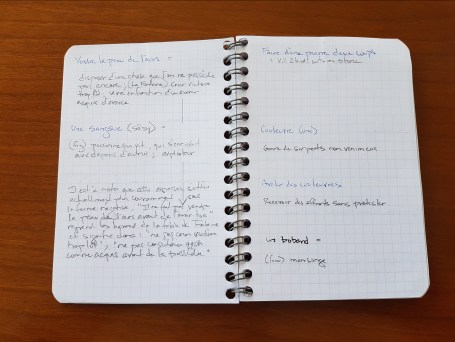 I have found it helpful to have a ‘truc’; some ‘thing’ that provides me a way to keep working on my language ability. It’s a small notebook where I write down any new word or phrase that I hear, its definition and perhaps a simple example of how to use it in a conversation. The purpose of the little notebook is for me to keep learning so that there will be clarity in the Gospel message I share with French people.
 came out of our mouths that was not helpful or something said that would not build up others. She didn’t primarily use that phrase because of bad language, but because of unhelpful or damaging language we were using.
 I have always been fascinated by the verse in Isaiah: “Behold, the Lord’s hand is not shortened, that it cannot save, or his ear dull, that it cannot hear” (59:1). It’s a poetic way of stating that God is not limited, in any way, from doing what pleases Him. What delights Him most is when His creation attributes glory to Him. As the Westminster Shorter Catechism puts it: “And in our prayers to praise him, ascribing kingdom, power and glory to him.” God’s desire is that in everything we do, we bring glory to Him (1 Corinthians 10:31)