• Our hope-filled future is bound up in sharing the story of Jesus, in discipling others, in bringing those disciples together into communities of believers, and in developing and releasing those believers to create other communities... till Jesus the King comes again!

Think, reflect, act

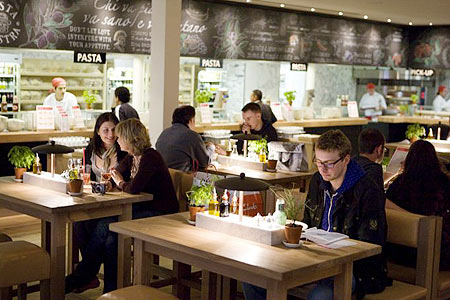
In a recent article in The Economist, a journalist drew a distinction between “casual dining” and “fast casual dining”.  One of the differences between the two is that fast casual dining implies a quicker, more rapid dining experience without all the trappings and expense of a casual dining experience.  Now who isn’t for reducing costs and time spent on meals?  However, what one loses in “fast casual dining” is the slower pace which promotes conversation, engagement and enjoyment.vapiano_450x300
Translate that idea into our context?  Many of us are running at full throttle in our ministry.  We’re definitely into a “fast casual ministry activity”.  What we are missing, though, is time to slow down, think and reflect on what we are doing.  Pulling back in this way might actually give us new ideas, other approaches, or a fresh perspective on all that we are doing.

Here’s the catch: just as a ‘fast casual’ approach takes away reflection time, a ‘casual’ approach can keep us from doing something with what we discover in our reflection time.  We need more time to think and reflect.  We also need time to apply or implement what we learn in those moments apart.

The Vision Forward 2014 conferences are meant to be times where we step away from our current ministries to think, reflect and pray in community on the implications of our global vision.  Once we leave those conferences, the work is only half done.  The challenge once we leave is to prayerfully work to put into practice what God has shown us through our time together in community.

Think, reflect and act.


What are we going to do next year?

build trustThis is the time of the year that many of us will reflect on the impact of Gospel in our lives: how Jesus as the “God among us” stirs and transforms our life and work.  It is also the time when many of us will “remember” what God has done over this past year in us and through us.  The goal of that reflection or assessment is to consider what God longs for us to do in the year to come.

I’m not talking about setting New Year’s resolutions, but about establishing one’s heart direction for the coming year.  In other words, thinking how that heart direction might express itself in one’s life and work.  Paraphrasing Galatians 5:6, we could put the question this way: what will faith expressing itself through love look like this year?

As I thought about World Team and what we might do in the coming year, what God longs to do in and through us, a host of words and ideas came to mind.  For example: transformational communities; church multiplication; greater accountability and follow through; delegation; facilitating others in ministry; and deepening relationships between workers.

However, when I asked the question, what will faith expressing itself through love look like, one word, one heart direction rose quickly to the top of the pile.  That word was: trust.

If there is one heart direction that God desires to characterize us in the coming year, towards which we should strive with all our heart, it should be trust.

I recognize that trust can be easily broken, but I often wonder if we prefer to keep people in a low trust or no trust category because it keeps us from the hurt, pain and struggle of engaging that fellow worker again and looking to Christ for the strength and courage to learn to love well and work together more deeply.

Trust may not be easy, but it begins by each of us offering that trust again to one another.

Help! I’m feeling overwhelmed

It’s the kind of feeling that creeps up on you.  You may be unaware it is coming until it hits you.  It’s that sensation of being overwhelmed; that there is more work and ministry than time permits.overwhelmed

The disciples knew the feeling: “And Jesus said to them, “Come away by yourselves to a lonely place and rest a while.”  (For there were many people coming and going, and they did not even have time to eat.)”  (Mark 4:31)  There was so much work, so many people to whom they had to minister that they did not even have time to stop for a meal.  Everything was a priority except the basic need of life to eat.

Once this feeling hits we begin to drag, ministry goes into a slow motion pace.  We start voicing our “tiredness” more often to others.   Our focus shrinks from everything else to just ourselves.  We start to lose perspective and grow out of touch with the heart of the Gospel.

This is the very moment when we need to step back and take a deep breath. 

Stepping back is the action of pulling oneself out of our self focused world and gaining focus by asking others for help.  Selecting and following our critical priorities will occur as we, first of all, learn to say ‘no’ to priorities that are good, but not critical.  We all know this to be true, but it is so hard to practice it and to actually say ‘no’ to a priority or task.  Part of our unwillingness may stem from our people pleasing bent, not wanting to disappoint anyone.  This is where community can serve us well. People that know us and know the work in which we are engaged can enter our world and help us establish those critical priorities.

Taking a deep breath is physically getting up from where you are and going somewhere else.  It’s the effort to temporarily change locations to help clear one’s mind.  It may be a short walk, a run, a swim or just sitting in the grass.  It’s an activity that helps take one’s mind off of all that has been weighing on us.

Feeling overwhelmed like many of us?  Start by seeking the counsel and prayers of a strong community of friends and colleagues and taking some time outside the office or house.

“Thinking” about a book

think piper bis

There are probably a number of good books on this topic of deep thinking and reflection, but one that came to mind over the weekend was: Think, by John Piper.

It’s worth a read. Maybe you might have some others to suggest to our readers?

Deep thinking is more than just discussing

Something caught my attention in a business blog post I was reading this week. The author wrote: “Focus is hard to come by and we all have to switch between projects and tasks all the time, for a variety of reasons. I mean, it comes with the job-any job really. I don’t think many would argue that when you eliminate distraction and focus, you’ll get better work done faster.”discussion

What I think the author is trying to say is that the outcome or the natural outflow of deep thinking and reflection is focused and directed action. To put it another way, deep thinking is more than just discussing because it leads to specific outcomes or acts.

Discussion is the activity of looking at an issue from a variety of angles. Many of us are very good at this activity. However, discussion in and of itself often does not lead to practical outcomes and steps. We can feel good about having “sized up” an issue and given our thoughts and ideas about the issue. Deep thinking is more than that.

Deep thinking certainly includes discussion, but it pushes us to ask the focused question of how to take all that we have considered and work it out in our lives and ministries. Deep thinking pushes us to “focus” on the issue and discern the practical ramifications for our work.

Discussion is one starting point. However, to move on towards deep thinking, we might ask the question: With the hour that is in front of us, if we focused on this issue, what action steps would flow out from the core principles we have raised and discerned? It takes courage to move the discussion in this direction. It will call for us to first “eliminate distraction” and focus.

Taking the time to think

Most of us have not learned the discipline of stopping, getting away and thinking about all that we are overseeing and have responsibility to lead.” The leader coach who authored those words is calling us to take the time to think and reflect on our lives and ministries.the thinker

Now, it is way easier to “say” we will take time to think and reflect than to actually “practice” it. Our lives and ministries move at internet speed most days and to try and add something else into an already crowded schedule is near nigh impossible. For example, the idea of journaling or taking time to creatively dream and reflect on issues sounds wonderful, but there is just no more room in my day.

Besides, what would I actually do if I took the time to step back and “think”?

Great question! Maybe we need to think about how to take time to think? Let’s look at a couple of ideas:

• Begin by ending my day five minutes earlier. Most of us have trouble just stopping. Ministry certainly presses in around us, but setting an ending to our day would allow us to ask a few simple questions like: What went well? What didn’t go well? What might I do differently tomorrow then to serve and lead others well?
• Take several days to meditate on the verse from Ephesians 5:17: “Therefore do not be foolish, but understand what the will of the Lord is.” To accomplish this task, we will need to “think” hard about what the will of the Lord is. Taking the time to chew on this verse might help us to slow down long enough to get some new thoughts about what that might look like in our lives.
• Tell a co-worker that you are going to take an hour to go out to a park, a café or some other location to sit and prayerfully write down ideas that come to mind as you look back over your life and ministry in the past month. Ask your co-worker to check back with you to see if you actually took the time to get away.

Taking time to think is not “wasted” time. Taking time to think will allow us to move into the future with a greater sense of what God might be calling us to do.