
• Our hope-filled future is bound up in sharing the story of Jesus, in discipling others, in bringing those disciples together into communities of believers, and in developing and releasing those believers to create other communities... till Jesus the King comes again!

Watching a Story Unfold

Paul Miller makes this comment in the next section of A Praying Life: “The act of praying draws God into my life and begins to shape me, the pray-er, in subtle ways.”  I love the way he puts it.  Prayer is ultimately not about us getting what we want, but about God working what He wants into our lives and through our lives into this world.
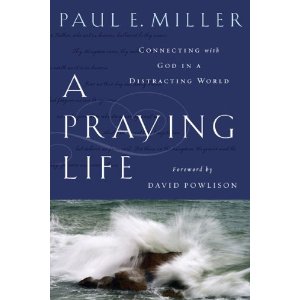

Our (Rebecca and I) recent participation in two of the Vision Forward conferences (Americas and Central Asia) has reminded us of the truth of this thought.  One way that it was expressed in Central Asia was that the inner witness of the Holy Spirit is a convicting witness, calling us to turn and return to Him.  In prayer, God is “drawn into our lives”, turning the spotlight of His Spirit on those areas of our lives which are hurtful (Psalm 139) and “drawing” us back to Himself where there is overwhelming forgiveness and love.

But we need to be listening to His voice, “hearing” what He wants to say to us.

A good question to ask would be: what is God saying to my heart today?

Living in Your Father’s Story

I would encourage you to read chapters 19-25 in A Praying Life as we continue on in our discussion of this book this month.

I am struck more and more by our need for prayer.  Consider these two quotes from Strengthening the Soul of Your Leadership, by Ruth Haley Barton:

When we keep pushing forward without taking adequate time for rest and replenishment, our way of life may seem heroic, but there is a frenetic quality to our work that lacks true effectiveness because we have lost the ability to be present to God, to be present to other people and to discern what is really needed in our situation.”

Without the regular experience of being received and loved by God in solitude and silence, we are vulnerable to a kind of leadership that is driven by profound emptiness that we are seeking to fill through performance and achievement.”

It is in prayer and through prayer that this transformation begins to take place; where we experience God’s love for us and learn to be present to God and to others.

In preparation for the World Team Americas conference, participants were encouraged to read and pray through the Gospel of John following daily posts.  These posts are worthy of your prayerful reflection: http://worldteamamericas.blogspot.com/search?updated-min=2011-01-01T00:00:00-08:00&updated-max=2012-01-01T00:00:00-08:00&max-results=2

Getting In Touch With My Inner Brat

Thanks to Laura for today’s post on A Praying Life:

It did me good to re-read (for the third time, ha) chapter 18.  Mr. Miller ends this section, “Learning to Ask Your Father”, with this lovely line at the bottom of page 161:

“We can’t pray effectively until we get in touch with our inner brat.  When we see our own self-will, it opens the door to doing things through God.”

 And earlier on page 157, he states;

 “The great struggle in my life is not trying to discern God’s will: it is trying to discern and then disown my own.”

 Thanks Mr. Miller, you’ve done it again, you’ve managed to nail me to the wall with your honesty about the role of self-honesty in abiding.

This week, I realize that I am touch irritated with my husband (gasp). I am sure no one can relate, but there I am.  I spoke about this with a friend trying to put a good spiritual face on it by making it clear I knew my husband was not the problem and that I didn’t want to pull away from him emotionally.  She wisely suggested that I speak to him directly about it and get it out in the open so we could pray through it.  “Great idea”, I responded, “I’ll do that before it becomes a big deal”.  But later that day and the next I find that I don’t actually want to talk to him about it for the very reason this author mentions—I haven’t disowned my own will.  I see my own will (there are certain things I want) and I know it is wrong, and I am NOT so quick at disowning my self-will as I thought.

The women I disciple/coach tend to have difficulties discerning their own will as being over and above God’s.  They say, “Of course I want God’s will here,” when they really don’t.  Much of this is an issue of time, maturing and spiritual breaking (for these particular women).  We can’t disown what we don’t own up to in the first place. 

Then there is the actual letting go once we own up to our “brat”.  This is my battle. This is where God becomes God in my head and heart and I say, “Ok Lord, I give this up to you and I won’t demand it from someplace else”.

Reread chapter 18.  What is harder for you, to own up to your self-willed brat or to disown it?

What do we do with Jesus’ Extravagant Promises about Prayer?

Thanks to Jacob for this week’s post on A Praying Life:

Miller gives us quite a reasonable question in the very title of this chapter (chapter 15). What, indeed, do we do with Jesus’ extravagant promises about prayer? Do we explain it away, making it either conditional or restricting it to the realm of “spiritual” things? Do we give it lip service in our meetings, using it to rally people with emotion at public gatherings, while quietly wishing it were true in the daily practice of our lives? Or have we grown cynical, considering these “promises” as too good to be true?

Recently, in a conversation with a fellow World Teamer, I confessed one of my struggles in life. I said, and almost in so many words, “It seems to me that God does not want me to succeed.” The response came wisely. “So, Jeremiah 29.11 applies to all others but not to you?” Good answer!!!

“Whatever you ask in my name, this I will do, that the Father may be glorified in the Son… If you ask me anything in my name, I will do it.” (John 14.13-14) Jesus really does make extravagant promises!

During the past week, members of the WT Europe Region gathered to consider the World Team mobilization crunch. We were challenged! And we came away from the workshop with a new word – “crisitunity.” Susan Best sees this current crisis as an opportunity!

Susan did a great job of delivering the sobering news, along with the challenge for the future, in a context soaked in prayer. Throughout the week we heard, prayed, and repeated again, the phrase, “Lord of the harvest, please send more workers into your harvest fields!”

We can ask this prayer boldly. Why? Jesus said we should! And so, as we ask it in Jesus’ name, we can do with confidence. As Miller says, “Asking in Jesus’ name isn’t another thing I have to get right so my prayers are perfect. It is one more gift of God because my prayers are so imperfect.” Wow, I don’t know what that statement does for you, but it gives me breathing room. It gives me hope that I, struggling as I am with the cynicism that threatens to strangle me at times, can pray, “Lord of the harvest, please send more workers to World Team.”

So, our very “work for God” can turn us to relate to God. After all, Miller reminds us, our asking is relating. We, like little children, come to our good Father and ask; “Please daddy, I would really like that.” We are called to be real before a real God. We are called to be bold before our Father. Yes, we are called to surrender to His will: even when we don’t understand it. But that’s no excuse to stop asking. We can ask! It would seem from the examples given that God does not mind being pestered by our requests! He is not niggardly with his gifts. He delights in giving us good things!

What surprises me in all this is Miller’s conviction that “the praying life is the abiding life.” He says, “One of the best ways to learn how to abide is to ask anything.”

So, really, what are we going to ask for? What is it that we really want? What do YOU want?  What does GOD want?

“Longed For” Prayer Answered

When I read John’s post from yesterday, it immediately made me think of another event.

John wrote:   “This came to mind during Christmas when I preached on Simeon holding the longed-for Messiah in his arms and thanked God for answered prayer. How long had Simeon been praying? How long had the Jews been praying for Immanuel to come, during those 400 years of God’s apparent silence since Isaiah made those great hope-filled Messianic prophecies?

The translation of the Bible into the Kimyal language was the event that came to mind when I read John’s comments.  Watch the video clip below and you’ll understand why I made the connection.

A “longed for” prayer, that the Bible would be translated into the Kimyal language, was answered that day.  But more importantly, the Word of God which brings the life transforming message of Jesus Christ to people was now in the hands of the Kimyal people.  The Kimyal people would now take that Word to others that they might come into relationship with Christ, grow as His disciples and come into communities of believers.  This is our and their ongoing “longed for” prayer: that the earth would be filled with the knowledge of God as the waters cover the sea; that many others from all nations would be brought into God’s great worshipping community.

This is one of God’s ministry highlights for 2010.  I would encourage you to share this link with others within the World Team community and outside, so that together we may rejoice together with our workers who participated in this work at God’s amazing grace and His desire to hear and respond to the prayers of His people.

Unanswered Prayer

Thanks to John W. for today’s post:

Paul Miller’s A Praying Life is particularly insightful and practical because it is a frank biography of his own “praying life” fleshed out powerfully through the way he and his wife Jill persevered in prayer for their autistic daughter Kim. Chapter 21 gives a great perspective on persevering when prayer doesn’t seem to be answered… and yet how after 20 years Paul realized that God had answered a prayer of Jill’s made back in 1981.

This came to mind during Christmas when I preached on Simeon holding the longed-for Messiah in his arms and thanked God for answered prayer. How long had Simeon been praying? How long had the Jews been praying for Immanuel to come, during those 400 years of God’s apparent silence since Isaiah made those great hope-filled Messianic prophecies?

And then I recalled the prayers of the Israelites in Egypt, crying out to God through 400 years of exile-become-captivity.

“And the sons of Israel sighed because of the bondage, and they cried out; and their cry for help because of their bondage rose up to God. So God heard their groaning; and God remembered His covenant with Abraham, Isaac, and Jacob.” (Ex 2:23-25)

From our perspective of the cosmic span of the Bible’s narrative it is easy to forget how hopeless and frustrating it must have felt to those who waited centuries for an answer from God. At the same time, it is a reminder to us to be patient, and to trust that in God’s timetable the unfolding of an answer has ramifications ungoverned by our timescale!

Nevertheless, God does graciously allow us to experience answers to prayer within a timeframe we can comprehend and appreciate.

I remember times when I wanted to stop praying for a person after a while, because there had been no news, or no obvious change, yet it seemed to me that God encouraged me, “Keep on praying!” And it was then, when I intentionally and faithfully persevered in prayer, that I saw an answer!

Or, there have been a few times when, like Job, I came to the end of my words! (Job 31:40) I had prayed so intently for so long for someone without “results”. I had nothing left to say except, “I leave it to you, Lord!”  It was then, when I stopped cajoling God or telling him how to answer my prayer; it was then, when I really let go of any sense of control that God graciously let me see how he was already answering my prayer.

And there have been times when I had believed I was praying according to His will, and yet had not seen any answer. Then my mind was opened to realize that my view of His will was too restrictive; I had presumed that “his will” could only be one thing. How foolish to suppose that an answer would be limited to what I could ask or imagine! Our God “is able, through his mighty power at work within us, to accomplish infinitely more than we might ask or think.” (Eph 3:20)