• Our hope-filled future is bound up in sharing the story of Jesus, in discipling others, in bringing those disciples together into communities of believers, and in developing and releasing those believers to create other communities... till Jesus the King comes again!

I read it in a book

A lot of you are readers, like me.  We enjoying “swapping” or sharing insights that we have gleaned from the latest book (or article) we have read or been reading.  Usually the conversation starts off something like this: “Interesting that you should say that.  I was just reading something along those lines in ….” It is great to hear about what others are reading and profit from one another as we share what we are learning.Young-man-reading-a-book-001

However, reading a book or hearing someone’s summary or insights does not mean that you have actually appropriated those insights for yourself or “taken them downtown to your heart” as one writer puts it.

I have read a number of books on the Gospel over the past number of months: The Prodigal God, The Freedom of Self Forgetfulness, and Gospel: Recovering the Power that Made Christianity Revolutionary.  Each of these books has great insights and I could easily delineate some of those truths. Real change, though, comes as I interact with others and we ask one another the hard questions of what will be the outcomes of such insights in our lives and ministries.  What will transformation really look like for each of us?  How does the Spirit apply such insights and work change in our hearts?

If I’m just a ‘talking head’ of insights, I would be better helped by someone coming alongside and ‘talking me through’ my learning to be able to move it from my head to my heart.

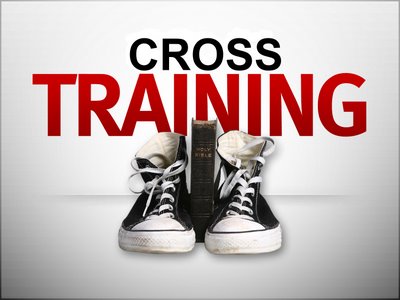
Cross training developmentally

One of the tried and true rules in sports is the importance of cross training.  Cross training means that when preparing for a distance bike ride or some other demanding sporting event, we include some kind of training in other sporting activities.  So, if you are preparing for that distance bike ride, you add in a swimming session or a 5 km run.  The effect is that the primary sporting activity is enhanced or bettered when the skills are transferred and integrated with other sports.cross training

Such is the case for our own development as believers.  A writer I recently came across wrote: “Forming a Christian mind is interdisciplinary.  In order to apply the Bible to a particular area of life – or to understand how another discipline interfaces with our faith – we have to know that area well. How can you expect to understand a biblical approach to, say, the economy, without a certain level of economic literacy?

Now, I’m not advocating that we all go out and get an MBA degree.  However, our growth as believers and as workers in His mission would be enhanced if we engaged in further training in problem solving, team dynamics and priority budgeting, for example.

Cross training can occur in other ways as well.  It might mean reading works outside our theological spectrum.  It might mean changing my habit of spiritual disciplines to investigate other ways of encountering God.  It might mean reaching across an Area to mine the insights of others in World Team.

I’m not saying it’s easy.  I love to run, but I’m not excited about swimming laps.  I just have to push myself sometimes to do what doesn’t come naturally.


Competency is not a bad word

We never stop learning.  It might be a new word, a new expression in the language in which we minister.  It might be another way to send our prayer letters out (such as Constant Contact, Mail Chimp or some other program).  There is a good deal of motivation in this kind of learning because we see its tangible benefit, the help it can provide to our life and ministry.competencies2

We should never stop learning.  However, we also need to pro-actively look for learning that may not have, at first glance, immediate tangible benefit to our life and ministry.  Constant learning is a means to increase our competency, our skills to live as Christ would desire and to minister in more and more fruitful ways.  Paul said, “I urge you to excel still more” (1 Thess 4:1).  Increasing one’s competency is an aspect of glorifying God, a concrete way of worshipping him as we recognize our dependence upon Him and the need for further, ongoing training.

The core skills modules are part of this process for all WT workers.  How grateful I am for the participation of so many in our first module and the feedback we have received.

However, we cannot stop there.  Each of us should prayerfully consider, in discussion with others, our next steps in growth and development (competency), outlining a  quarterly or monthly desired growth goal.

Competency is not a bad word.  It should become an energizing word for us, calling us to never stop learning.

It Never Ends

It’s about that time of the year when I start thinking about our community garden plot.  There are a number of standard plants that we will plant, but every year I look for something new to plant.  That new idea, though, will cause me to go looking for information on what I need to do in order to help this new plant grow.  Just planting something without knowing how to prepare the soil or care for it, will potentially lead to no harvest.never ending bis bis

Our life as workers is all about constantly learning.  At the end of almost 360 pages dealing with the life and work of a cross cultural worker, one author wrote: “Workers ministering in the twenty-first century can expect to serve in an atmosphere of constant change. Missions will be conducted everywhere, in every way, by everyone.  This will demand lifelong learning and lifelong humility.”

Life long learning.  Life long humility.  Where does one begin?  I think the answer lies in taking one area of growth, learning or development, and focusing on that one area over several months.  Check out what materials are available or what online training is being offered.  Ask a colleague to check back with you each week to see how you are progressing.  Most of all, be perseverant in prayer and effort to grow.

Yes filling out feedback forms can be helpful, but setting a short goal, achieving it, and setting your sights on a new goal motivates us further.  On our own, we may have great plans, but we easily let ourselves come up with excuses for why we can’t give time to a lifelong learning project.  Once again, the community needs to come alongside and help us.

Are you ready to join in the journey?

Mentoring 101

mentoring5Mentoring is “the process where a person with a serving, giving, encouraging attitude, the mentor, sees potential in a still-to-be developed person, the mentoree, and is able to promote or otherwise significantly influence the mentoree along in the realization of potential.” In other words, mentoring is about helping or facilitating another in their lifelong development in character and competency.

However, mentoring another doesn’t just happen because we think the idea is “cool”. Getting involved in mentoring relationships begins with three critical steps.

The first critical step is to pray for and learn how to have “developmental eyes”. When a new worker joins our ministry team, how do we “see” them? Do we see them just as additional labor and hands for the work? Or do we see someone with potential to grow in certain areas, to potentially move into certain roles of responsibility? Do we assess the person as to what they can’t do or what they have the potential to do? There are vast differences in the ways we “see” people.

The second critical step is to develop your ability to mentor by asking more questions than you answer. This may be something that requires some new skill training as most of us are trained to answer questions more than we are to ask them. The aim in mentoring is to develop the other. Most often that occurs through their discovering truth and its application.

The final critical step is making known that you are available and willing to mentor others. I’m not talking about “tooting your horn”. I believe that workers truly do want to be mentored, but they often assume others don’t want to mentor them or don’t have the time to mentor. Making known your willingness to mentor offers the invitation to other workers to seek you out.

If one of our core values is training and developing leaders, I believe this means we should be characterized as a community that mentors others well.

What we learned

Here are some quotes from our very first posts on King’s Cross:

“However, if I really understand God, and if I’m truly amazed by Who He is and what He has done, then I would live a life full of devotion, focused on Him.  I’m asked to join Him in this dance, ignore my inhibitions and ignorance, and humbly ask, as I dance with my Savior, “Why me?!”  I don’t deserve the opportunity to join in the dance, but that’s just it.  It’s all about Him inviting me, not what I deserve.” (ch 1)

“Left to ourselves, we continue in our brokenness. This is the reason His call is so significant, He is calling us from a self-centered, self-destructive life by calling us into a whole relationship which requires sole devotion to Himself, so much so that “all other attachments in [our] lives look like hate compared to Him.” Jesus cannot and will not accept moderation, His call is for complete devotion, “He must be the goal.”” (ch 2)

“It is not possible to write about Jesus and his cross without writing about sin as our biggest problem. But he pushes us further. Tapping into C.S. Lewis, as pastors are prone to do, Keller wrestles with this Biblical passage in light of a Lewis story and gives us another phrase – “not deep enough.” And he recommends this: Jesus will cut deep in dealing with our sin. He will pull back the scales. As he did with the paralytic he will identify our bigger problem and then he will go deep enough to provide the core healing that is needed.” (ch 3)

“Experiencing anew real “rest” comes when a greater treasure displaces our constant search for acceptance in others.  “On the cross Jesus was saying of the work underneath your work – the thing that makes you truly weary, this need to prove yourself because who you are and what you do are never good enough – that it is finished.  He has lived the life you should have lived, he has died the death you should have died.  If you rely on Jesus’ finished work, you that God is satisfied with you.  You can be satisfied with life.””   (ch 4)

“Oh, to be like You Jesus. That’s what I feel when I read this. I have a hard time resting. I know I need it.  Jesus was sure it was time to ‘get away’. He knew that there was just so much a person can handle . . . and He is God! When He spoke to the wind and waves, there was ‘dead calm’, much like a guy sleeping on a cushion. He didn’t need the storm to stop for His own rest. Perhaps He did it for His disciples so that they could see His ability to take care of them. Perhaps He was just proclaiming the importance of rest in a dramatic way . . . reconciling the world to Himself in inexplicable ways.”  (ch 5)


Share your insights to the book, King’s Cross with the larger WT community.  Post your responses here to the question: “What thought or idea from King’s Cross has brought about a change in your heart and attitude?”