• Our hope-filled future is bound up in sharing the story of Jesus, in discipling others, in bringing those disciples together into communities of believers, and in developing and releasing those believers to create other communities... till Jesus the King comes again!

The ministry of incarnational living

Recently, I listed these four (4) possible applications for an incarnational lifestyle for us as cross-cultural workers.

  • We invest significant time in understanding the local culture in which we live and work at mastering the heart language of the people we serve.
  • Disciples and communities are trained to critically contextualize the gospel in a way that preserves the integrity of the gospel as it engages one’s local context.
  • We are not satisfied until we see the gospel multiplied by disciples making disciples, and communities multiplying themselves in other communities.
  • We are not the centre nor the ultimate motor of all this work.

Then I read the following in the prayer update of our one of our fellow WT workers and smiled at the thought that they mentioned, in some way or another, the four (4) possible applications above … as well as one or two others.  We do learn from one another!

Here is what they wrote:

The ministry of language learning?  Moving to the city has allowed us to use language a lot – which means we have a lot of embarrassing moments and some great stories!

But amidst our studies we are recognizing that there is ministry even in language learning. Crossing cultures means you enter into a world where you can barely communicate basic needs at times – much less navigate cultural cues. The things that give us confidence, identity, importance, or even just predictable stability are thrown out the window.

Anyone who has ever attempted to live in a context not their own can relate. Yet God is using the very stretching, awkward journey of learning language and culture to prepare our hearts and minds for the ministry ahead. The language skills and cultural understanding that we gain in this season will have a profound impact on how we serve others in the future.

But just as significant is the emptying (Phil 2) that we are experiencing in the process. Only when we are empty can Christ flow through us; only when we are weak is His strength perfected in us (2 Cor 12:7-10).”

What’s your method?

Truc’ is one of those all-purpose words in French.  It means a thing, an object, or just whatever it is you can’t think of the name for.  If you are at the hardware store and you’re looking at a piece of electrical equipment, but can’t remember the exact word in French, you can simply ask how this ‘truc’ works.

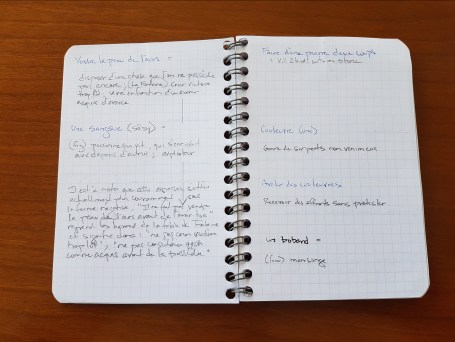
20180628_093648.jpgI have found it helpful to have a ‘truc’; some ‘thing’ that provides me a way to keep working on my language ability.  It’s a small notebook where I write down any new word or phrase that I hear, its definition and perhaps a simple example of how to use it in a conversation. The purpose of the little notebook is for me to keep learning so that there will be clarity in the Gospel message I share with French people.

It’s a method or technique that works for me.  It may not work for you.  However, you may have other ways, a ‘truc’ that has helped you in ongoing language learning. We would love to hear what that might be.

Watch your language

My mother used to tell my brothers and I, “Watch your language”, whenever a word thatWatch-your-language-1868661-ralphiesoap_super came out of our mouths that was not helpful or something said that would not build up others.  She didn’t primarily use that phrase because of bad language, but because of unhelpful or damaging language we were using.

When we live and minister among another people group other than our own, we need to ‘watch over our language’.  What I mean is we cannot accept a ‘global understanding’ of another’s language.  We should not settle for just passable language acquisition.

The apostle Paul writes in the context of our teaching and disciping: “For this I toil, struggling with all his energy that powerfully works within me” (Colossians 1:29).  We are to ‘work hard’ as an athlete does in all our efforts and work, including language acquisition.

When do not make this effort, we create a context where the Gospel message might be truncated; where our ‘language’ potentially ends up hindering the clear communication of the Gospel message in another cultural context.

Many of us have experienced a similar situation when we talk with someone from another culture who is trying to speak in our mother tongue.  If that person’s language skills are just okay, we find ourselves struggling to understand the real content of their ‘message’.  It feels like we are missing something, and we end up using reductionist language in order to continue the conversation.

Two principles should guide us as we seek to ‘communicate well’ with others.

First, remember that language acquisition is a lifelong project.  I still remember learning the word for ‘apple core’ while running with my teammate, David. He saw an apple core on the ground, turned to me and said “Do you know the word for that in French?”  I didn’t, but I learned it that day.  And I had already been in France for over seven years.

Second, regularly ask others for help.  If language acquisition is a lifelong project, then we should not slow down the learning process.  When your teammate, your national co-worker, or another friend encourages you to speak more in the national language, your language ability and your capacity to share the good news will grow and deepen.

Gotta go all the way

go all the wayOkay, I know that’s not proper English (neither British nor American).  However, my point is simply that learning to talk with others in a language that is not our heart language is a work of perseverance in order to get to the objective of sharing our faith with others in a cross cultural context.

Perseverance calls for several actions or heart attitudes that are not natural to our hearts.

For one, the work of perseverance pushes you to always keep the endpoint in mind.  We should not be satisfied with ‘almost there’.  90% is still 10% short, we could say.  The problem here is that we are good at talking ourselves into accepting ‘half-way’ work.   Other concerns begin to weigh in on us. The main concern in cross cultural life, we believe, is to ‘get out into ministry’.

For another, the work of perseverance presses on the humility quotient.  Coming from ministry experience in our own cultural context, we can feel ‘child-like’ in cross cultural life and ministry when we recognize that it takes a whole lot longer to talk, to get a sentence out then it does in our own culture and language.  Perseverance drives us see our need for grace even in language learning and cultural acquisition.

Finally, the work of perseverance can highlight (regularly) our weaknesses. The problem for me (and most of us) is that I don’t always see the benefits of this ‘highlighting’.  However, the psalmist saw this benefit (Psalm 139:23-24) and maybe his prayer should become our prayer.

It is true that at the 30 kilometer mark in a marathon, one ‘hits the wall’.  The temptation to quit is so strong when one ‘hits that wall’ that it’s hard to resist.  When I ran the Paris marathon, one of my teammates here in France stepped on the course at the 30 kilometer mark and ran with me for two kilometers.  The words of encouragement that teammate shared were just what I needed to ‘go all the way’ to the end of the marathon at 42 kilometers.

Perseverance is hard work, but it is a community work.  Struggling in language and culture?  Tempted to ‘call it quits’ before the language acquisition finish line?  Feeling discouraged at not being able to express yourself like you would want?  Call on a friend. Call on a group of friends.  Call on the community to help because we ‘gotta go all the way’ to learning the language and culture of those God has called us to serve.

Do you understand me?

Happy Reformation Day (one day late)!

Today is Reformation Day on many of our calendars.  One of the crucial elements that the Reformation ushered in was the opportunity for ordinary people to read and understand the Word of God in their own language.  People who had to ‘hear’ the Word through another who served as their translator, could now take the Word in their own hands and speak it out loud in sounds and words that would cause their own hearts to be warmed.

What the Reformers did was, in part, to give validity to the necessity and value of Bible translation.  Even more than that, though, the work of the Reformers created a paradigm shift in the then known world of Christianity.  Cultural understanding and contextual application would become vital to the spread of the Christian faith.

language learningWe as workers in God’s mission must give the time and energy necessary to understand another’s world (language, culture, worldview and context) in order to ‘put the Bible in their hands’ for them to discover, learn and apply for themselves in their culture and context.

The possible pitfalls or detours along this road of working to understand another (and his/her culture) are numerous.  Here are a few that come quickly to mind:

  • Global comprehension is adequate”: in other words, as long as I understand the gist of the conversation, I’ll be okay. Unfortunately, that hasn’t always worked for me when it comes to handyman projects. I need to know each step, each detail along the way.  Otherwise, I might find myself with water spewing all over the kitchen floor rather than the faucet correctly attached to the pipes.
  • They are happy I’m trying”: and the truth is, that many times people from another culture are happy you are trying. However, they also long for you to go farther in your abilities the longer you live among them.  The main reason being, so that you will be able to better understand their hearts and struggles.
  • It’s all about ministry”: our vision together is to see multiplying disciples and communities of believers among the unreached. It is about ministry.  However, here’s the rub with cross cultural ministry. It’s not only about what God is doing through us, but it is equally as much about what God is doing in us.  It’s often the ongoing cultural learning piece where God does a lot of work on our hearts.  Short circuiting the work of cultural learning may get you into ministry ‘faster’, but it might deprive you of Holy Spirit heart work that might provide greater foundation to one’s ongoing cross cultural ministry.

What’s great about our community is that there are many who have ‘walked this road before us’ and created ways and processes to help learn well how to ‘understand others’.  I’m sure that many of them would be open to sharing their ideas with other teams.

In the midst of all this work of cultural understanding stands Jesus; constantly calling us back to Himself so that we might have the strength, the grace and the courage to press in order to bring the Gospel to others.

Providence?

Providence?  Kind of a strange word to our ears today, but which is psalm-104-1rich in meaning for our daily lives.  We could talk about His foresight, guidance or sovereign hand over all things happening in our lives and in this world.  Yet, that ‘comfort’ needs to go much deeper into our heart so as to produce a change in how we live and act in light of this biblical reality.

The Heidelberg Catechism is one of several Protestant catechisms.  It was written in 1563 and follows the standard pattern of question and answer, where the question is normally asked of a catechumen (that’s a word to look up!) who then responds with the appropriate answer, summarizing numerous biblical texts.

One of the questions (Question #28) relating to God’s providence is the following:

What does it benefit us to know that God has created all things and still upholds them by his providence?

Answer: We can be patient in adversity,¹ thankful in prosperity,² and with a view to the future we can have a firm confidence in our faithful God and Father that no creature shall separate us from his love;³ for all creatures are so completely in his hand that without his will they cannot so much as move.

¹Job 1:21, 22; Ps 39:10; Jas 1:3.

²Deut 8:10; 1 Thess 5:18.

³Ps 55:22; Rom 5:3-5; 8:38, 39.

⁴Job 1:12; 2:6; Prov 21:1; Acts 17:24-28

Knowing that God cares for us in such a way gives rise to patience, thankfulness and assurance.  If we apply this thought to cross cultural ministry today, it would mean:

  • There is ‘light’ at the end of the tunnel when learning the language of the people among whom we serve
  • Our witness is never in vain, even if rejected by those to whom we are called
  • We should be saying ‘thanks’ a lot more than we currently do

If you were asked the question: What does it benefit us to know that God has created all things and still upholds them by his providence?   Would your response contain anything about patience, thankfulness and assurance?  The joys and difficulties of cross cultural work call us to together think more deeply about God’s providence.