• Our hope-filled future is bound up in sharing the story of Jesus, in discipling others, in bringing those disciples together into communities of believers, and in developing and releasing those believers to create other communities... till Jesus the King comes again!

An online meal together

A fellow church planter, from another culture, once said: “I have yet to participate in an American Thanksgiving online.”  His point was well taken. The Internet is great for communicating across the time zones of the world. But, when it comes to experiencing incarnationally an event, another culture, or another person, it is woefully lacking.  

One of our guiding principles as a WT community is “incarnational” or “incarnational living”. That is where we surrender “our rights to our home culture, language, and ways and embrace those of the host culture.” To do this online is near nigh impossible, because you will miss a certain number of “cultural cues” that could help you understand and embrace this new culture. That’s probably why at the start talking on the phone is one of the more difficult aspects of cross-cultural living. Without facial expressions and other gestures, you only have the voice to go on. And you often miss what the other is actually trying to say.

I’m grateful to a member of our local French church who recently wrote an article on the challenges youth workers could face with the next generation: Generation Alpha.  This will be the first generation raised primarily on the Internet. There will be strengths and weaknesses from this context. One of the challenges though will be the non-incarnational, non-interactive nature of their spiritual development. They will be trying to “share a Thanksgiving meal without being physically in the same room.”

Now I’m not picking on the next generation as we still don’t know how they will “enter” the global missions movement.  I’m just trying to underscore how the coming generation, as well as ourselves, may be pulled, without even realizing it, into a world of strictly online relationships and virtual cultural experiences.

Zoom, Teams, and other platforms are good. However, to really understand the culture and viewpoint of another, you need to “see” and experience their world with them in person, incarnationally.

What do we long for?

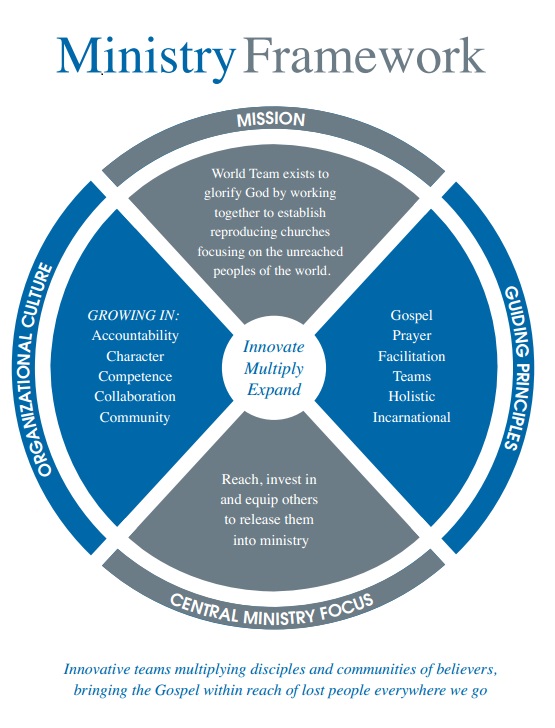
In our work as cross-cultural church planters, we are committed to being “incarnational”.  This is one of our guiding principles as World Team workers, and can be found in the WT Ministry Framework.

We describe what it means to be incarnational in this way: “As cross-cultural workers, we intentionally surrender our rights to our home culture, language, and ways and embrace those of the host culture. By this, we seek to model Christ, who emptied himself of the privileges and powers of divinity, taking on human form, in order to carry out his mission.”

How does this biblical principle, exemplified by Jesus Christ, work itself out in our daily life and ministry?  What is its relevance and impact?

There are at least four (4) applications of an incarnational lifestyle for us as cross-cultural workers.

  • We invest significant time in understanding the local culture in which we live and work at mastering the heart language of the people we serve.
  • Disciples and communities are trained to critically contextualize the gospel in a way that preserves the integrity of the gospel as it engages one’s local context.
  • We are not satisfied until we see the gospel multiplied by disciples making disciples, and communities multiplying themselves in other communities.
  • We are not the centre nor the ultimate motor of all this work.

In my recent reading, I ran across this quote: “… missionaries tend to be self-sufficient. It’s hard for the to be needy.  But not to receive from others make them look superior.”   The writer was speaking of a specific group of missionaries, but I think it applies to all of us in general.  None of the applications above could take root in our lives if we are not dependent on God for His grace and strength to learn one more phrase today in Tagalog, Khmer, Spanish or Portuguese.  None of the applications above could produce any fruit if we are not dependent on those we serve to carry the work of the gospel forward in their culture and context.

So, which one of the four applications is the hardest for you?  What small step might you take today to begin to work that application into your life and ministry this week?

Going ‘national’

Our World Team Ministry Framework highlights the ‘guiding principles’ by which we WT Ministry Framework Jan 2016live and minister as a global community.  One of the ‘guiding principles’ that is a new addition from our previous list of ‘values’ is: incarnational.

The descriptor for this guiding principle is as follows: “As cross-cultural workers, we intentionally surrender our rights to our home culture, language, and ways and embrace those of the host culture. By this, we seek to model Christ, who emptied Himself of the privileges and powers of divinity, taking on human form, in order to carry out His mission.”

Many voices were raised in favor of adding this guiding principle to our list.  The more I have mulled over it, the more I have come to understand why Ray and others kept putting it in front of us as so important.

Living incarnationally pushes us back to the example of Christ (Philippians 2).  Jesus Christ, the eternal Son of God, chose to take on cultural forms, language and habits.  He expressed himself with words that others could understand, in cultural forms that made sense to the people he was addressing.  He made the effort to ‘be like us’ and to accept this world as his ‘home’.  Yes, his ultimate ‘home’ was not here. Yet, he did not make others around him feel that he was keeping himself a stranger to the world in which he found himself.

The word that I find the hardest in this descriptor is: surrender. Not many of us like the sound of that word because it strikes at our feeling of entitlement.  We have seemingly ‘sacrificed’ a lot to go cross culturally, and believe there should be some small return as a result.  However, God asks us to lay it all down.  In the process of that surrender, we will experience blessings and benedictions we would not have shared otherwise.

One blessing that surely stands out is the experience of deep friendship in Christ across cultural boundaries; discovering that God has truly broken down the barriers that separate us from one another.

What’s in a name?

Ruth arrived in Israel with Naomi after quite a series of difficult circumstances. Ruth, seemingly, did not even take the time to unpack her suitcases before she set out to find ways to provide for their material needs.  She ended up gleaning, by sovereign design, in the field whats-in-a-name-bannerof Boaz, a potential kinsman redeemer (2:20)

What strikes me the most in this biblical narrative is that everyone knows about Ruth, without knowing Ruth.  In other words, in spite of her incredible work ethic, Ruth is consistently referred to as the ‘Moabite woman’ (2:6).  No one calls her, ‘Ruth’.

Ever feel that way in cross cultural ministry?  That somehow your defining quality is not ‘Steve’, ‘Heather’ or ‘Joy’?  That the words most likely to come out of a neighbor’s mouth are: “Oh, you’re looking for the ‘Czech guy’.  He lives two doors down.”  You can begin to feel like a name-less person without roots; a person just ‘passing through’ another culture.

Incarnational living starts with a choice. Incarnational living also calls for that same choice to be made daily.  That choice is to find my identity first and foremost in what Jesus says about me.  Despite how others around me may ‘label’ me, Jesus knows me and calls me by my name (Isaiah 43:1; John 10:3).

Knowing that my identity in solidly anchored in what He says about me, I can then move into my world with confidence and courage to ‘reach, invest, equip and release’ others. I can give all my effort daily to serve the people to whom He has called me because His voice rings in my ears throughout the day: “You are mine!  I have bought you with a price.  No one can snatch you out of my hand.”