• Our hope-filled future is bound up in sharing the story of Jesus, in discipling others, in bringing those disciples together into communities of believers, and in developing and releasing those believers to create other communities... till Jesus the King comes again!

The one guiding principle to rule them all

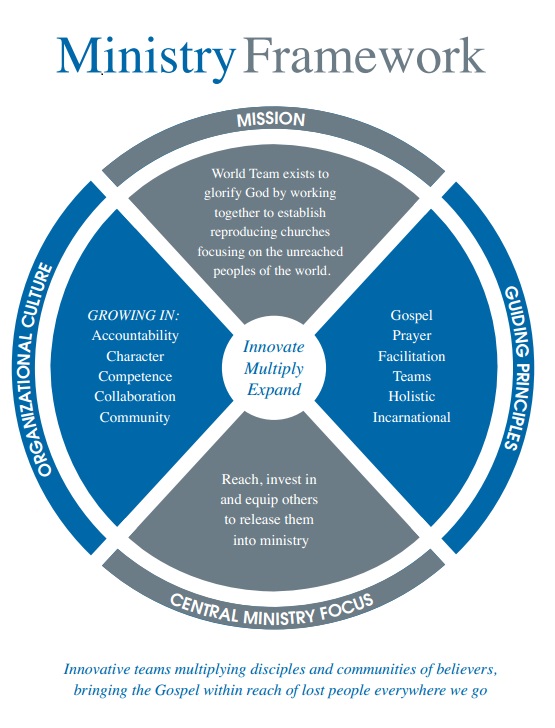
Our World Team Ministry Framework outlines six (6) guiding principles which define how we go about our work; what is it that motivates us to multiply disciples and communities of believers.  The six (6) guiding principles are: the Gospel, prayer, facilitation, teams, holistic and incarnational.

Often I find myself thinking about and speaking of these guiding principles as if they are all of equal value.  In one sense, they need to be as they tell us what drives us in the work God has called us to do.  However, as I continue to daily reflect on the Gospel, I become more convinced that there is one guiding principle from which all the others flow out or are subsets of the one guiding principle.  I am more and more persuaded that there is one guiding principle to rule them all.

All of who we are and what we do arises from one central truth: we are accepted in Christ.  We are not our own, we belong to Him, and find ourselves now cherished members of His family.

This one guiding principle stands apart from all the others.  It is the foundation to which we hold and to which we must return each and every day.

Richard Lovelace put it best when he wrote: “Few know enough to start each day with a thoroughgoing stand upon Luther’s platform: you are accepted, looking outward in faith and claiming the wholly alien righteousness of Christ as the only ground for acceptance, relaxing in the quality of trust which will produce increasing sanctification as faith is active in love and gratitude.  In order for a pure and lasting work of spiritual renewal to take place with the church, multitudes within it must be led to build their lives on this foundation.

In order to give ourselves to prayer, facilitation, working in teams, serving in holistic ways and living incarnationally, we must soak our hearts in the words of the Gospel: “this is my beloved child, in whom I am well pleased.”

I know that the analogy with the Lord of the Rings does not work well (the final ring of Mordor needing to be cast into the river of fire of Mordor), but Jesus Christ experienced the wrath and judgment of God in our place, so that we might be able to cry out: Abba Father; so that we might be able live and serve as an expression of our gratitude and thankfulness for His grace-full gift.

A question for each of us to consider: what aspect of the Gospel are you most needing to hear today, and that would strengthen your heart to live for Jesus?

Culture wins

Culture wins

I’ve been reading a book on my Kindle lately entitled: Culture Wins: The Roadmap to an Irresistable Workplace.  I was somewhat skeptical given the title, but the farther I have gone in the book, the more I understand the thrust of the writer’s argument (who, by the way, was a pastor, before creating his own startup). 

William V simply argues that at the end of the day, it’s the context, the ‘culture’ that causes a company, a group, a mission to retain their workers. It’s the environment that causes people to want to stay long term with you, to recruit others to work with them, and to always speak highly of your organisation even if they move on to another ‘job’. It’s primarily because of the culture and how it makes them feel, how it makes them more productive and fruitful in their work.

Of course, the difficulty comes when our “culture” needs to be worked out in practice.  We know that it is easier to talk about culture than to actually function according to the principles or elements of that desired culture. 

World Team (based on the WT Ministry Framework) desires an organisational culture where we grow in accountability, character, competence, collaboration and community. We are probably doing well in some elements, and maybe less well in others.  What I have gotten out of this book, so far, is that we should not be content with where we are, but strive to grow more in all elements of our desired culture.  So that who we say we are, is how we actually live and minister together.

From where you stand, in which elements would you say we are doing well and in which elements less well?

Going ‘national’

Our World Team Ministry Framework highlights the ‘guiding principles’ by which we WT Ministry Framework Jan 2016live and minister as a global community.  One of the ‘guiding principles’ that is a new addition from our previous list of ‘values’ is: incarnational.

The descriptor for this guiding principle is as follows: “As cross-cultural workers, we intentionally surrender our rights to our home culture, language, and ways and embrace those of the host culture. By this, we seek to model Christ, who emptied Himself of the privileges and powers of divinity, taking on human form, in order to carry out His mission.”

Many voices were raised in favor of adding this guiding principle to our list.  The more I have mulled over it, the more I have come to understand why Ray and others kept putting it in front of us as so important.

Living incarnationally pushes us back to the example of Christ (Philippians 2).  Jesus Christ, the eternal Son of God, chose to take on cultural forms, language and habits.  He expressed himself with words that others could understand, in cultural forms that made sense to the people he was addressing.  He made the effort to ‘be like us’ and to accept this world as his ‘home’.  Yes, his ultimate ‘home’ was not here. Yet, he did not make others around him feel that he was keeping himself a stranger to the world in which he found himself.

The word that I find the hardest in this descriptor is: surrender. Not many of us like the sound of that word because it strikes at our feeling of entitlement.  We have seemingly ‘sacrificed’ a lot to go cross culturally, and believe there should be some small return as a result.  However, God asks us to lay it all down.  In the process of that surrender, we will experience blessings and benedictions we would not have shared otherwise.

One blessing that surely stands out is the experience of deep friendship in Christ across cultural boundaries; discovering that God has truly broken down the barriers that separate us from one another.

Prayer is a guiding principle

praying manThe World Team Ministry Framework describes our commitment and calling to prayer this way:
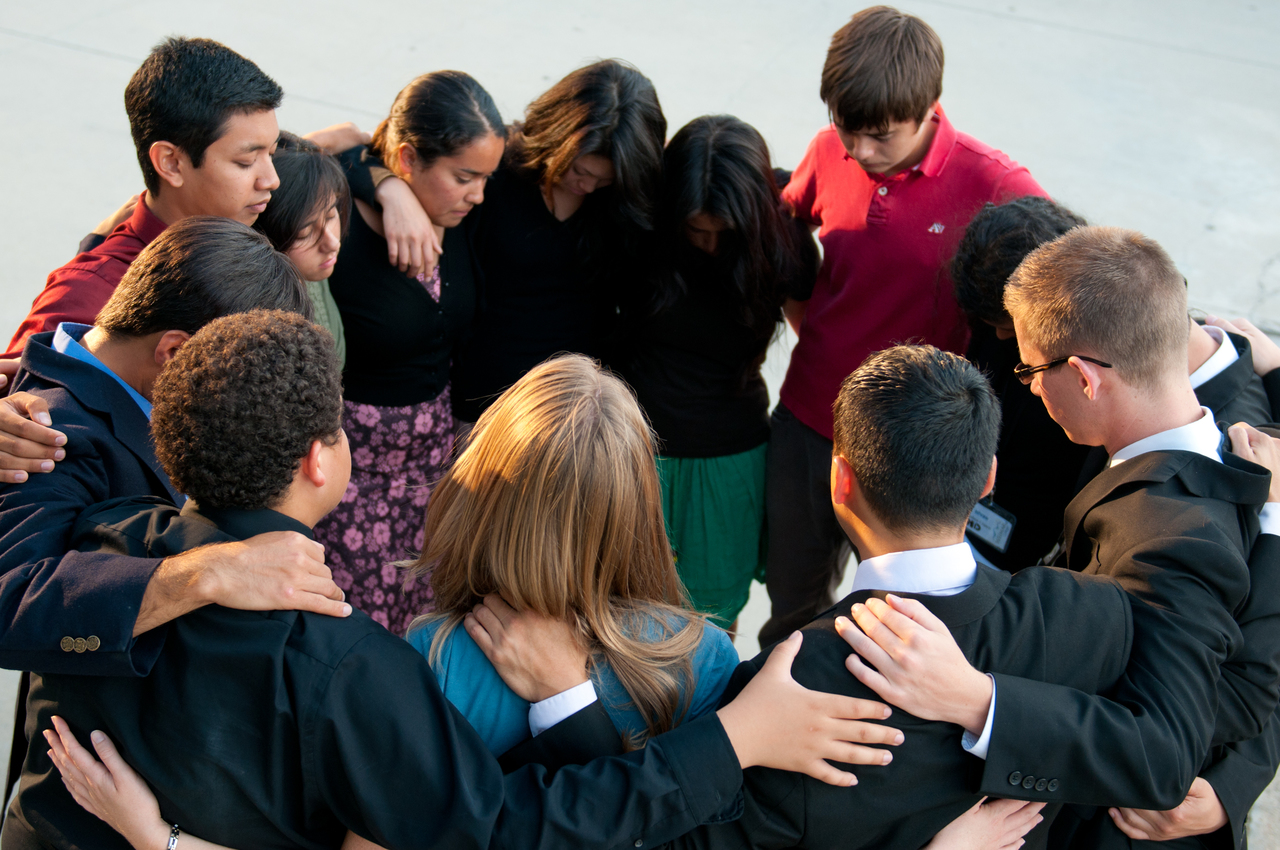
“Prayer is real conversation with God and is vital to a growing relationship with Him and ministry in His name.  Prayer reflects our belonging and submission to Him, our need for direction and provision, and our acknowledgement that we can do nothing without Him.

We believe that personal and corporate prayer manifest obedience and humility, submitting ourselves to God and His agenda, and for His power.  Such dependence nurtures alertness to the spiritual dimensions of our undertakings and equips us with wisdom and knowledge for our calling.  Above all, prayer changes things because it is God’s desire that we ask Him to work.”

We pray because God wants us to talk with Him.  One of the catechisms of the Church puts it this way: “Question: What is prayer?  Answer: Prayer is an offering up of our desires unto God, for things agreeable to His will, in the name of Christ, with confession of our sins, and thankful acknowledgement of His mercies.”

What I like about both the statements above is that there is no sense of an ‘obligation’ to pray, as if it is a work that I must do in order to somehow bend God’s will to mine.  Prayer flows from a heart that recognizes what God has already accomplished in opening the door to relationship with Him.  Prayer is the simple acknowledgement that we need Him in light of all that He has done and continues to do for us.

It’s only natural then that throughout the day, our hearts would turn to Him: when we are working on a project; before we spend time in conversation with others; and when someone is leaving our apartment and we’re standing at the front door.

It’s not a duty.  We’re ‘offering up our desires’ to Him, asking again (and again) that He would work for His glory.

Vital prayer

I remember reading an article, a number of years ago, about the importance of prayer to church planting.  Well, I found that article today in the archives of Mission Frontiers magazine (http://www.missionfrontiers.org/issue/article/the-ten-universal-elements).  This is what the authors wrote in the March/April 2000 issue:

we-pray“1. PrayerPrayer has been fundamental to every Church Planting Movement we have observed. Prayer typically provides the first pillar in a strategy coordinator’s master plan for reaching his or her people group. However, it is the vitality of prayer in the missionary’s personal life that leads to its imitation in the life of the new church and its leaders. By revealing from the beginning the source of his power in prayer, the missionary effectively gives away the greatest resource he brings to the assignment. This sharing of the power source is critical to the transfer of vision and momentum from the missionary to the new local Christian leadership.”

The authors of this article considered prayer as the ‘first pillar in a strategy coordinator’s master plan’.  Now that statement was written over seventeen years ago.  Yet, David Garrison in his work on church planting movements (CPM), came to the same conclusion just a few years ago when  he observed that prayer was the number one element in church planting movements; where there was an urgency, passion, and vitality to believers’ prayers.”

This truth is ‘self-evident’, we might say.  However, I wonder if our practice might say otherwise.  Both Mission Frontiers and David Garrison noted the ‘vitality’ of believers’ prayers for churches to be established and multiplied.

Vitality might best be defined as: the power of enduring; and having a lively and animated character.  Prayer that supports and seeks the startup of multiplying communities of believers is prayer that goes the long haul; that regularly pleads for God to call out His own from a people group; and that is full of enthusiasm and hope in the promise that God will build His church.

Prayer is the ‘pillar’ of our work. Figuring out avenues to grow in prayer ‘vitality’ is part of the church planting process.

And then there were three

three people prayingYesterday, I offered for anyone from the team here to come and pray with me for the World Team Day of Prayer. It was kind of last minute, but I was pleasantly surprised by the number of people who called and said they would have come if they had known sooner.

In the end, we were three. Three may not seem like a lot, but we prayed. We prayed along with many of you around the world, lifting up the needs of World Team and rejoicing in what God has done over the past number of months in our midst.

We prayed. It’s such a simple statement, but it has a lot to say about what is important to us as a mission, as an organization.  I won’t say it wasn’t hard to keep praying when there were only three of us, but the value we hold to ‘pushed us on’ in prayer and at the end, I can say, we were glad we spent that time together.

In October 2016, I’m hoping our ‘small group’ will multiply and there will be six or more people joining for prayer here at the WT Global office. I should probably start thinking about picking up a few more chairs for that day.